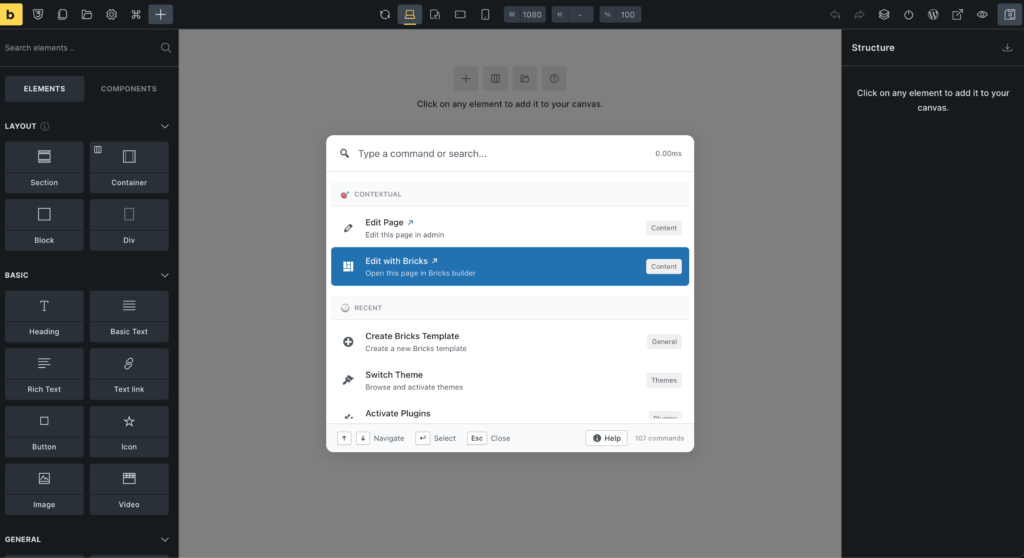
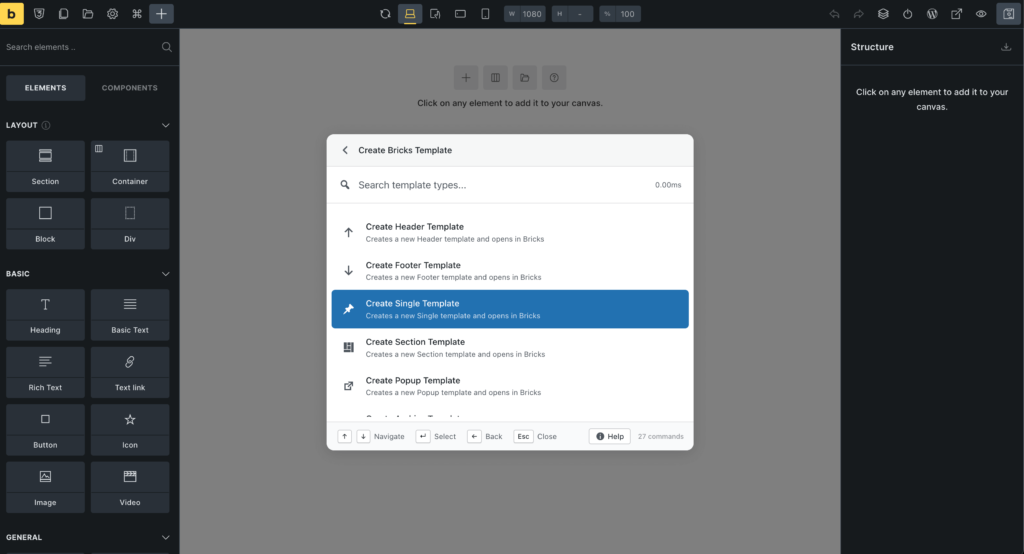
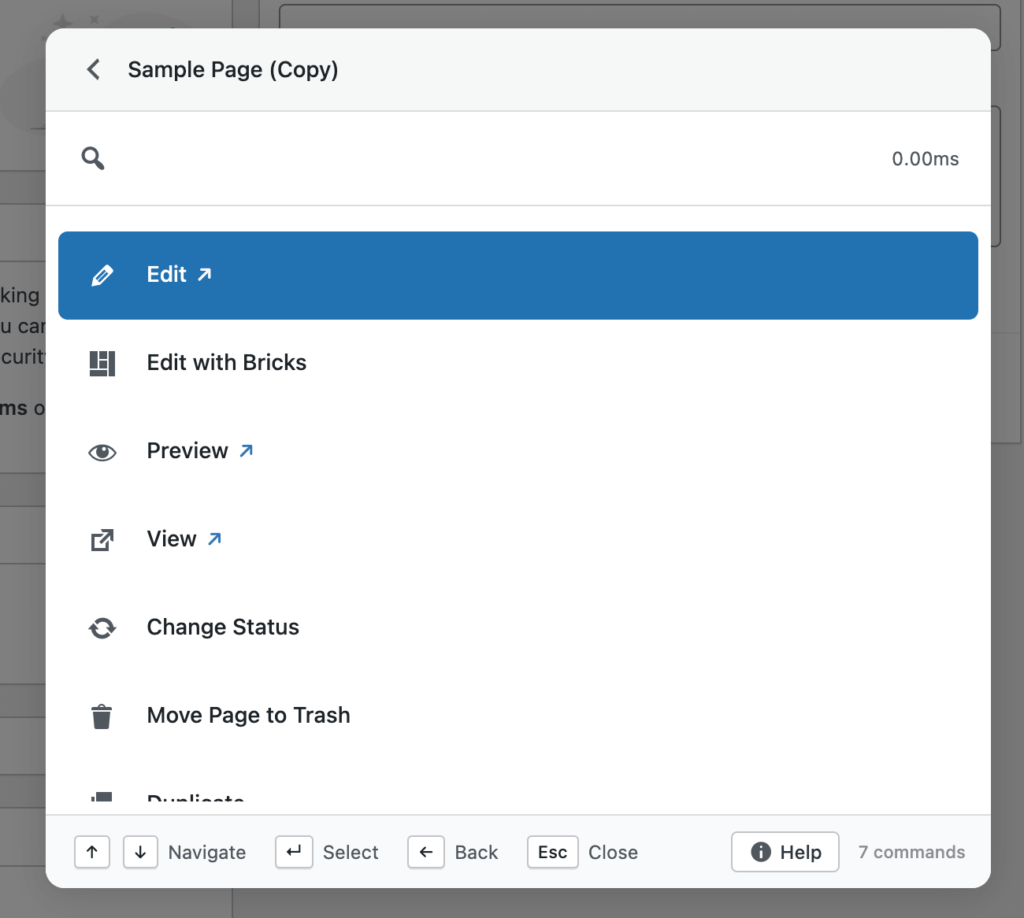
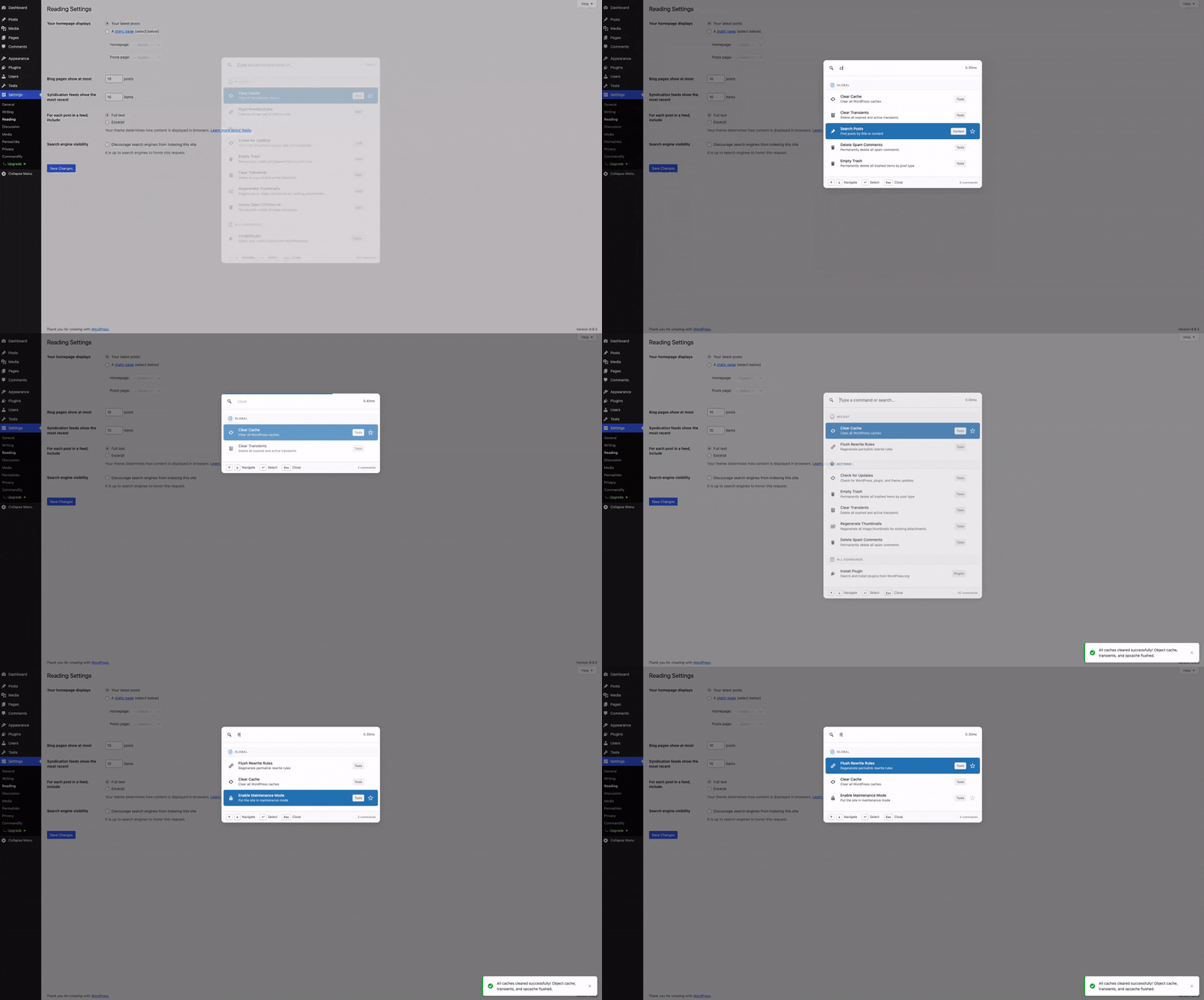
WordPress admin search was never designed for speed or intent.
It expects exact matches. Exact titles. Exact menu names. Exact labels. That works on small sites. It breaks down completely once a site grows beyond a few dozen posts, plugins, users, or integrations.
Real WordPress users don’t search like machines. They:
Type partial words
Misspell names
Remember intent, not titles
Jump between content, actions, settings, and data
This mismatch is why even experienced users still waste time clicking through menus. The admin UI becomes a memory test instead of a productivity tool.
This is the gap fuzzy search exists to fix. Let’s start with what is fuzzy search and how it works to make your life easier with powerful logic.
What Is Fuzzy Search Actually (Beyond the Buzzword)
Fuzzy search is not “faster search.” It’s forgiving search.
Instead of matching text exactly, fuzzy search evaluates similarity and intent. It asks:
How close is this input to known commands or objects?
Which result is the user most likely trying to reach?
What should rank first based on context?
In practical terms, fuzzy search:
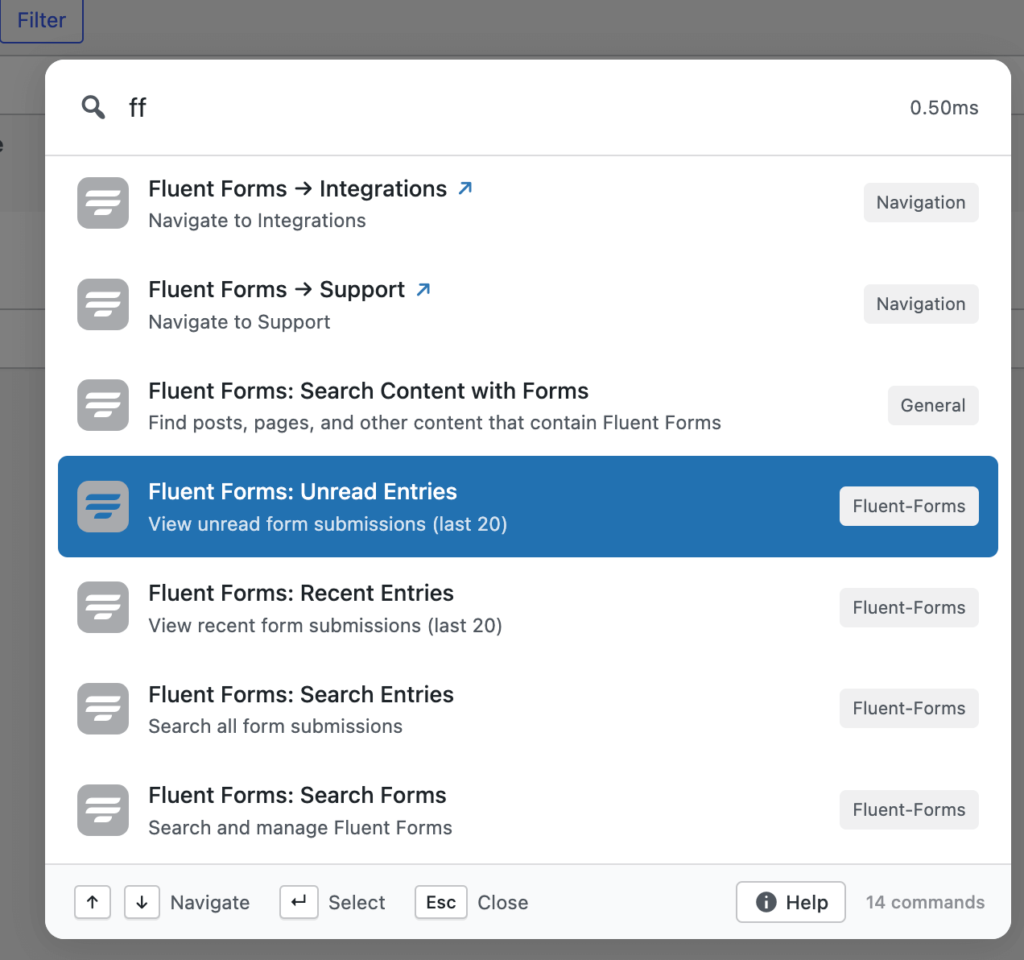
Matches partial words
Handles misspellings
Understands abbreviations
Scores results instead of filtering strictly
This is why fuzzy search is used in:
Code editors
System launchers
Productivity tools
Command palettes
And it’s why strict search feels outdated once you experience fuzzy logic done right.
Why Fuzzy Search Matters More in WordPress Than Anywhere Else
WordPress admin is not one dataset. It’s many.
You’re searching across:
Posts, pages, and custom post types
WooCommerce orders, products, customers
Users and roles
Forms, entries, transactions
Templates, builders, settings
Plugins, tools, and actions
Expecting users to remember exact labels across all of this is unrealistic.
As sites grow, navigation becomes the bottleneck, not lack of features. That’s why WordPress itself introduced a basic command palette — it’s an acknowledgment that menu-based navigation doesn’t scale.
But basic search is still basic.
Why Commandify Introduced Advanced Fuzzy Search
Commandify is not built as a shortcut tool. It’s built as a command-driven productivity layer.
That means search is not just for finding things — it’s for triggering actions.
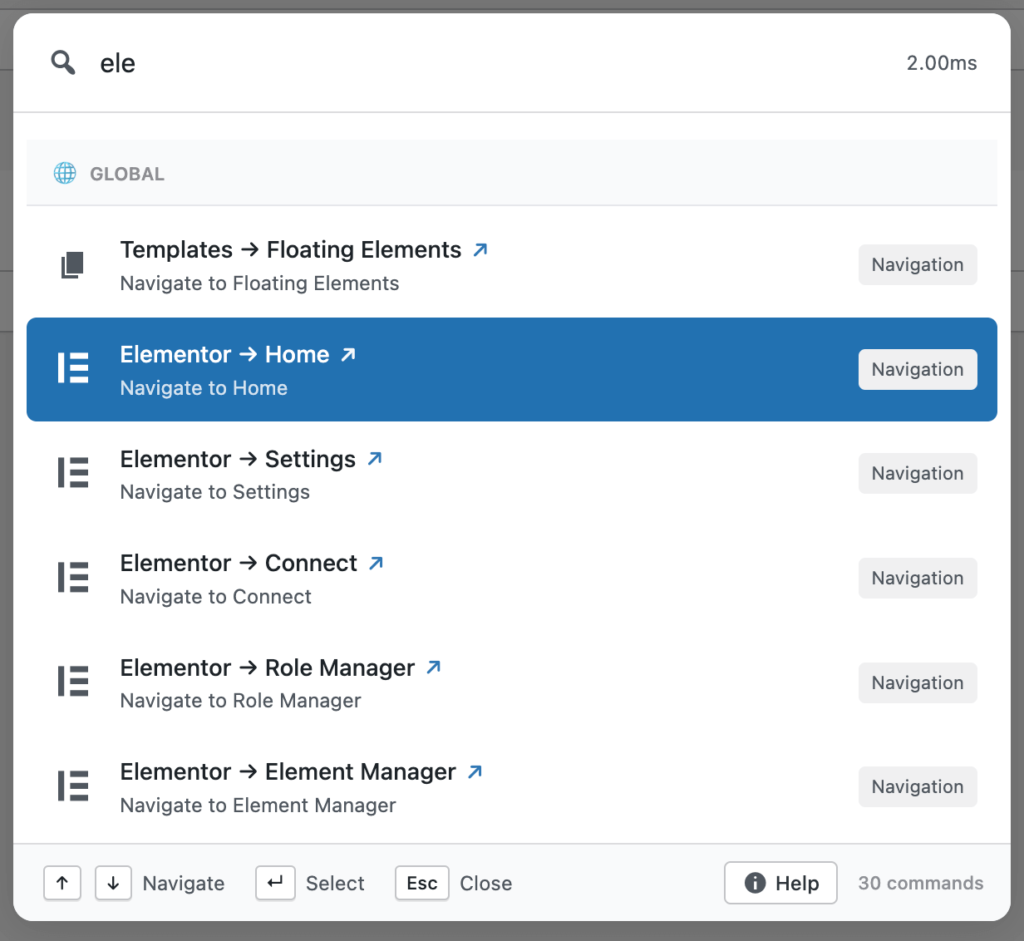
Commandify does not rank results globally. It ranks them based on where you are.
For example:
In the editor, content-related commands score higher
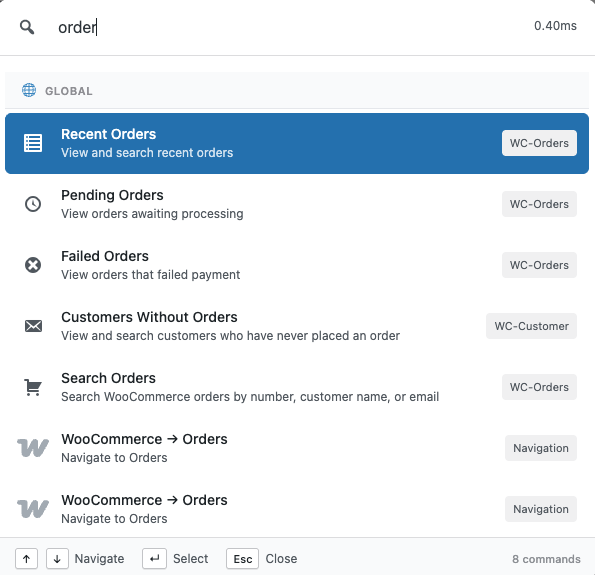
On WooCommerce screens, order and product actions score higher
In admin dashboards, settings and tools take priority
This is critical.
Without context-aware scoring, fuzzy search becomes noisy. With it, results feel “smart” instead of overwhelming.
3. Synonym Matching
Commandify understands that users don’t always use the same words as WordPress.
For example:
“Orders” vs “Purchases”
“Users” vs “Accounts”
“Templates” vs “Layouts”
“Entries” vs “Submissions”
The fuzzy engine maps these relationships so results still surface even when wording differs. This is one of the reasons Commandify feels more forgiving than traditional admin search.
4. Intelligent Ranking Instead of Filtering
Most searches filter results out.
Commandify ranks them.
This means:
You still see multiple relevant results
The most likely match appears first
Less relevant results don’t disappear completely
This ranking model is what allows fuzzy search to work reliably across large datasets without feeling random.
5. Pattern-Aware Inputs
Commandify’s fuzzy search also works alongside pattern recognition.
This allows inputs like:
IDs
Emails
Shortcodes
Structured references
to trigger relevant commands directly instead of requiring navigation first.
This combination of fuzzy logic + patterns is what enables fast, technical workflows for power users.
Instead of adapting to WordPress, WordPress adapts to how they think.
Using Fuzzy Search Effectively in Commandify
To get the most value from Commandify’s fuzzy search:
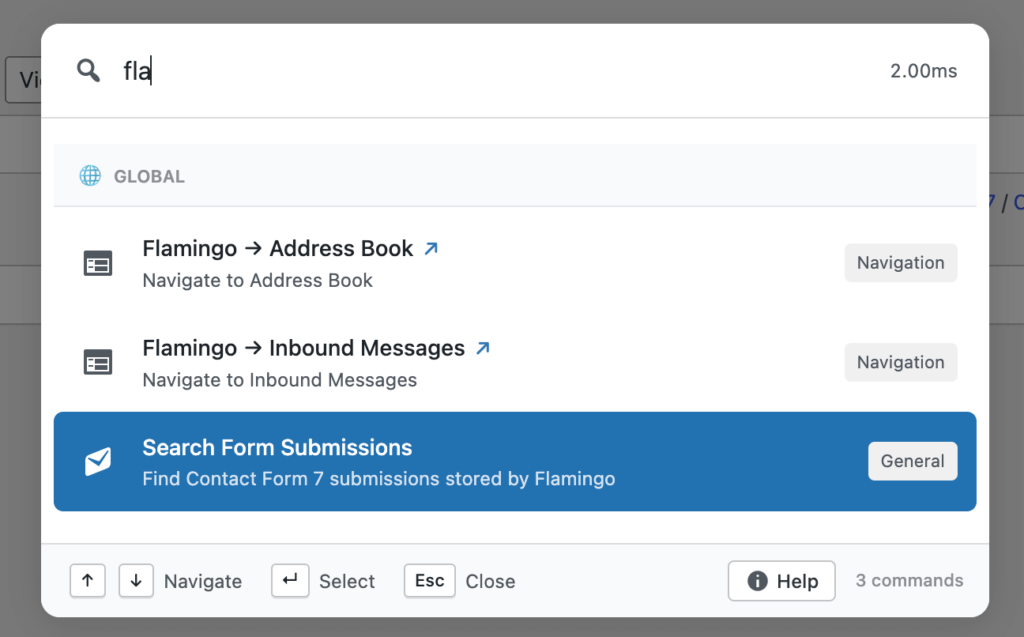
Don’t overthink input Type fragments. Misspellings are fine. Partial words work.
Think in intent, not labels Search what you want to do, not where it lives.
Trust ranking The first few results are usually the correct ones due to scoring.
Use it for actions, not just navigation Commandify search is designed to trigger workflows, not just open screens.
Once users adapt to this mindset, admin navigation feels outdated.
Why Fuzzy Search Is Foundational to Commandify’s Power
Fuzzy search is not an isolated feature in Commandify. It’s the foundation for:
Action-driven commands
Context-aware workflows
Deep plugin integrations
Pattern-based lookups
Admin productivity at scale
Without fuzzy search, command palettes feel brittle. With it, they feel natural.
That’s why Commandify invested in a purpose-built fuzzy engine instead of relying on basic search logic.
Final Takeaway on What is Fuzzy Search and How it Works in Commandify
Fuzzy search is not about being clever. It’s about reducing friction between intent and action.
WordPress has become too powerful for exact-match navigation. Commandify’s fuzzy search bridges that gap by understanding how real users think, type, and work.
For WordPress power users, this isn’t a convenience feature. It’s what makes large, complex sites manageable every day.
Once you experience fuzzy search done right, going back to traditional admin navigation feels unnecessarily slow.
The WordPress ecosystem doesn’t really grow through announcements or partnerships.
It grows through people helping users solve problems.
Most meaningful connections between agencies and product teams don’t start with emails or deals. They start when users ask for something better, and both sides happen to be working toward the same goal.
That’s exactly how Miraiyo and wpRigel crossed paths- not as partners, but as teams serving the same WordPress users from different angles.
This article isn’t about promoting tools. It’s about showing how real collaboration happens in WordPress when agencies, products, and users align naturally.
Meet Miraiyo: A Smart WordPress Marketing Agency
Miraiyo is a WordPress agency that approaches client work with a product mindset, not a project-only mindset. Their focus goes beyond shipping websites. They help businesses design, build, and evolve WordPress-based products that are meant to grow, adapt, and perform over time.
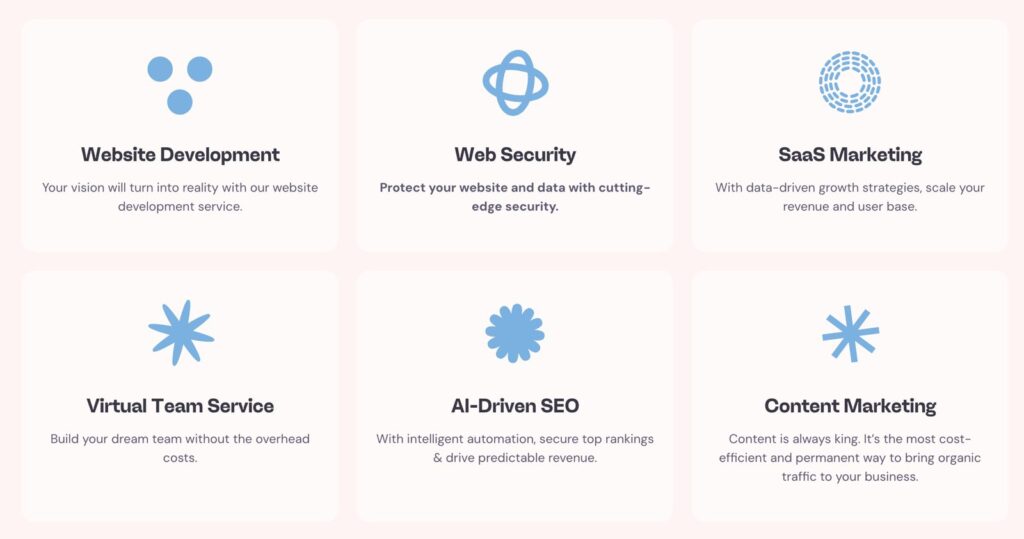
The core services by Miraiyo team are-
WordPress Site development and Web Security
AI-driven SEO and Technical SEO Audit
Content Marketing
Virtual Team Service/Offshore team
A-Z SaaS Marketing
Rather than positioning themselves as a “theme customization” shop, Miraiyo works closely with startups, SaaS companies, and growing businesses that treat their WordPress site as a core part of their product or platform.
What stands out is how much attention they give to what happens after launch. For Miraiyo, success isn’t just a polished frontend. It’s whether teams can actually manage content, interact with users, and operate WordPress comfortably day to day.
That focus naturally shapes the kinds of problems they care about — and the tools they choose to work with.
The Real WordPress Problems Miraiyo Encounters in Client Work
Through their client work, Miraiyo repeatedly sees the same set of challenges surface- regardless of industry or site size.
Many clients come in with WordPress sites that technically “work,” but feel difficult to operate once real users and internal teams get involved. Engagement is often lower than expected. Admin workflows feel cluttered. Simple tasks take longer than they should.
Some of the most common issues they encounter include:
Users interacting with content passively instead of engaging
Teams struggling to gather feedback or validate ideas
Clients feeling overwhelmed by WordPress admin as the site grows
Editors and non-technical users avoiding the dashboard altogether
These are not problems that can be solved with custom code alone. They are experience and workflow problems.
Miraiyo recognized early on that building better WordPress products meant thinking beyond layout and performance. It meant helping clients:
Engage users in simple, native ways
Reduce friction inside the WordPress admin
Make WordPress feel approachable, not intimidating
That shift in thinking is what eventually led them to tools that focus on usability, feedback, and productivity, rather than just features.
How wpRigel Entered the Picture
Miraiyo didn’t discover wpRigel through outreach or promotion. They encountered the tools the same way many agencies do- through user needs.
Some clients wanted simple, privacy-friendly ways to engage users without heavy survey platforms. Others needed faster ways to navigate WordPress admin without getting lost in menus.
Those conversations led Miraiyo to explore tools their clients were already asking about, including Pollify and Commandify.
What mattered wasn’t the feature list. It was whether these tools could support real workflows without adding complexity.
Supporting Existing Workflows, Not Replacing Them
One important thing Miraiyo appreciated early on was that wpRigel’s tools didn’t try to redefine how WordPress works.
Pollify fit naturally into content-driven sites where engagement mattered. It didn’t require external dashboards or data lock-in. Clients could run polls directly inside WordPress and understand results without training.
Commandify approached a different problem. It didn’t change WordPress admin. It reduced friction inside it. For teams managing content, users, and settings daily, that difference was immediately noticeable.
In both cases, the tools supported how Miraiyo already worked- they didn’t force a new process.
A Shared Philosophy: Make WordPress Easier for Real Users
This is where the collaboration felt natural.
Miraiyo focuses on building WordPress solutions that clients can actually use. wpRigel focuses on building tools that respect WordPress workflows instead of fighting them.
That overlap created a feedback loop:
Miraiyo shared real-world usage insights
wpRigel listened to how agencies and users actually work
Improvements flowed back into the tools
No contracts. No announcements. Just practical collaboration.
How User Feedback Naturally Connected Miraiyo and wpRigel
What made the collaboration between Miraiyo and wpRigel feel natural was that it didn’t start with tools. It started with users asking better questions.
As Miraiyo worked with clients across different WordPress projects, similar requests kept coming up. Teams wanted simple ways to understand what users thought. Editors wanted to move faster inside WordPress without relying on technical help. Clients wanted tools that felt native instead of bolted on.
Rather than forcing custom solutions for every request, Miraiyo began looking at what their users were already comfortable with inside WordPress. That exploration led them to tools built with the same philosophy they applied to their own work: reduce friction, respect workflows, and avoid unnecessary complexity.
That’s how wpRigel’s products entered the picture — not as a recommendation, but as a response to real usage needs.
How Pollify Fit Into Client Engagement Without Changing the Stack
One recurring challenge Miraiyo saw was low or unclear user engagement. Clients wanted feedback, but traditional survey tools felt heavy, external, or disconnected from the content itself.
Pollify didn’t introduce a new system for users to learn. It worked directly inside WordPress, allowing simple polls to live alongside existing content. For Miraiyo’s clients, that meant:
No external dashboards to manage
No extra accounts for teams
No complex onboarding for users
From an agency perspective, this mattered. Pollify didn’t change how Miraiyo built sites. It complemented their existing approach by adding lightweight engagement where it made sense.
More importantly, clients could finally validate ideas quickly, without needing full redesigns or guesswork. Feedback became part of the content experience, not an afterthought.
Where Commandify Made a Bigger Difference Than Expected
While Pollify addressed user-facing engagement, another set of problems lived entirely inside the WordPress admin.
As client sites grew, teams spent more time navigating menus, searching for settings, and switching between screens. These were not “broken” workflows — they were just slow at scale.
That’s where Commandify quietly changed how Miraiyo’s team interacted with WordPress.
Commandify didn’t require retraining or setup-heavy processes. It simply gave teams a faster way to reach what they already needed. For Miraiyo, this translated into:
Less time explaining WordPress admin to clients
Faster internal workflows during development and support
Reduced friction for non-technical users managing content
What stood out wasn’t a single feature. It was the cumulative effect of saving seconds repeatedly throughout the day.
Feedback From the Miraiyo Founders on wpRigel Products
When asked about their experience, the Miraiyo team didn’t frame it in terms of features. They talked about how the tools felt to use.
They described Commandify as something that “made WordPress feel lighter,” especially for teams managing content daily. Instead of digging through menus, they could focus on tasks.
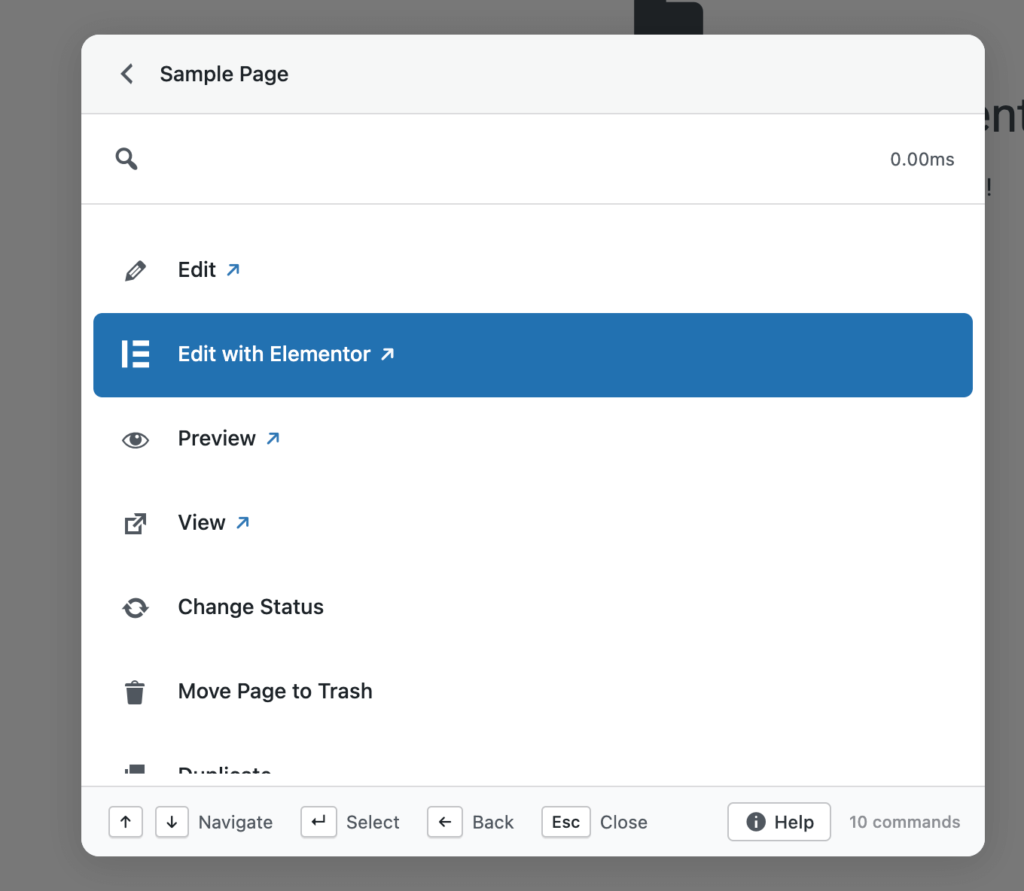
“Commandify feels like the missing shortcut WordPress should have had. From editing Elementor or Bricks templates to managing WooCommerce orders and even CF7 forms, everything becomes one keystroke away. It’s a huge win for anyone running multiple sites or handling large workflows.” –Adrita Chakraborty, CEO & Co-founder at Miraiyo
Pollify, on the other hand, was appreciated for how unobtrusive it felt. Clients didn’t see it as “another plugin.” They saw it as a natural extension of their content.
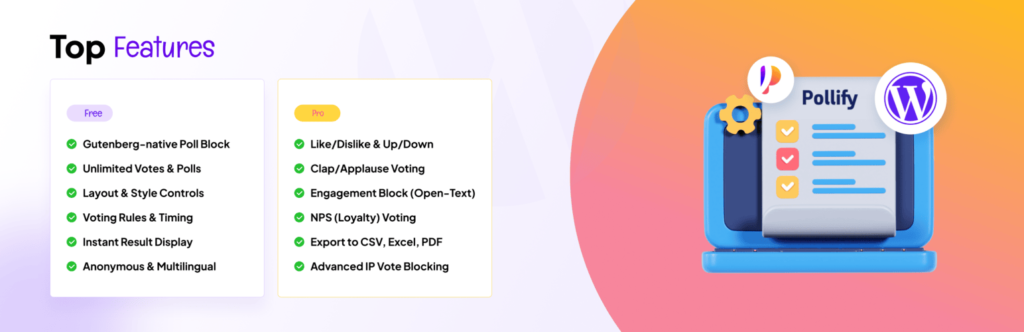
“Pollify makes it effortless to add polls, surveys, and feedback blocks anywhere in WordPress. With options like NPS scoring, up/down voting, engagement blocks, and easy exports to CSV, PDF, and Excel, it delivers real value for site owners who want actionable insights, not just basic votes.”- Jil Kabir, Co-founder & CTO at Miraiyo
That distinction mattered. Tools that blend into workflows tend to last longer than tools that demand attention.
Why This Wasn’t a Partnership And Why That Matters
It’s important to be clear: this wasn’t a partnership announcement or a formal collaboration.
Miraiyo didn’t adopt wpRigel tools because of branding or incentives. They used them because they solved real problems their clients were already talking about.
From wpRigel’s side, the value came from listening. Feedback from agencies like Miraiyo helped shape how features evolved, which workflows mattered most, and where WordPress friction actually lives in day-to-day use.
This kind of relationship is common in healthy tech ecosystems, but rarely talked about openly. It’s not transactional. It’s iterative.
A Shared View of the WordPress Ecosystem
What connects Miraiyo and wpRigel is not a product roadmap. It’s a shared understanding of WordPress users.
Both teams see WordPress as:
A platform used by non-technical people
A system that grows messy without good workflows
An ecosystem that improves when tools respect how people actually work
That alignment made collaboration feel less like integration and more like mutual problem-solving.
Why This Story Matters to Other Agencies and Teams
This isn’t about telling agencies they should use specific tools. It’s about showing what happens when agencies:
Listen closely to users
Avoid overengineering solutions
Choose tools that reduce friction instead of adding layers
Miraiyo’s experience reflects a broader truth: the best tools are often discovered through use, not promotion.
Closing Thoughts
WordPress works best when agencies, product teams, and users learn from each other.
Miraiyo’s story isn’t about adopting tools. It’s about responding thoughtfully to real problems and choosing solutions that make WordPress easier for everyone involved.
That’s how collaboration in the WordPress ecosystem is supposed to work.
We just released Commandifyv1.0.6 with a 100% new UI interface, dark mode, and lots of other new features and improvements.
WordPress gives you freedom but not always speed.
Anyone who spends serious time inside the WordPress admin knows this well: you click menus, hunt through settings, switch tabs, and constantly break your flow just to do simple tasks. This friction multiplies quickly on large sites, WooCommerce stores, and complex client projects.
That’s exactly why we built Commandify to make WordPress feel faster by turning commands into actions and actions into outcomes without unnecessary clicks.
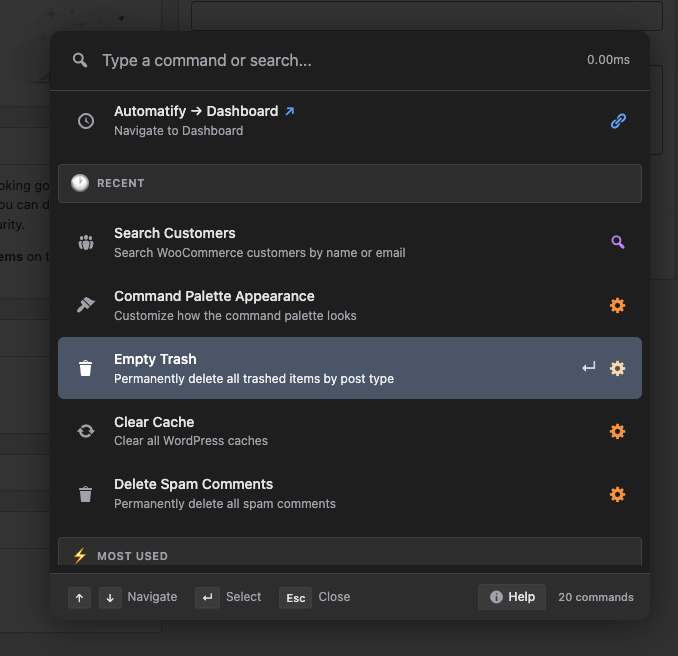
Today, with Commandifyv1.0.6, we’ve taken another significant step not by piling on features, but by refining how the command palette works at its core; making it more intuitive, better looking, less distracting, and more powerful over time.
Let’s walk through what’s new and why it matters.
A Command Palette You’ll Want To Use Every Day
When we look at how people actually use Commandify on real sites, one pattern stands out:
It’s not about cool features, it’s about reducing friction.
Opening a palette should feel like a breath of fresh air, not another UI challenge. That’s why the most visible change in v1.0.6 is the new palette design.
We didn’t redesign it just to look modern- we redesigned it to feel right. Clearer focus states, better visual indicators, calmer spacing, and improved keyboard navigation all mean you can find what you’re looking for nearly instantly when you open the palette.
Whether you’re toggling settings, jumping to a template, or running maintenance tasks, the interface now feels more predictable and comfortable — especially on complex screens with lots of commands.
In other words: it’s easier to use because it fades into the workflow instead of interrupting it.
Dark Mode That Works With Your Setup (Not Against It)
Dark mode isn’t just a trend. For many developers, night-time editors, and long admin sessions, a palette that respects your visual comfort makes a real difference in productivity.
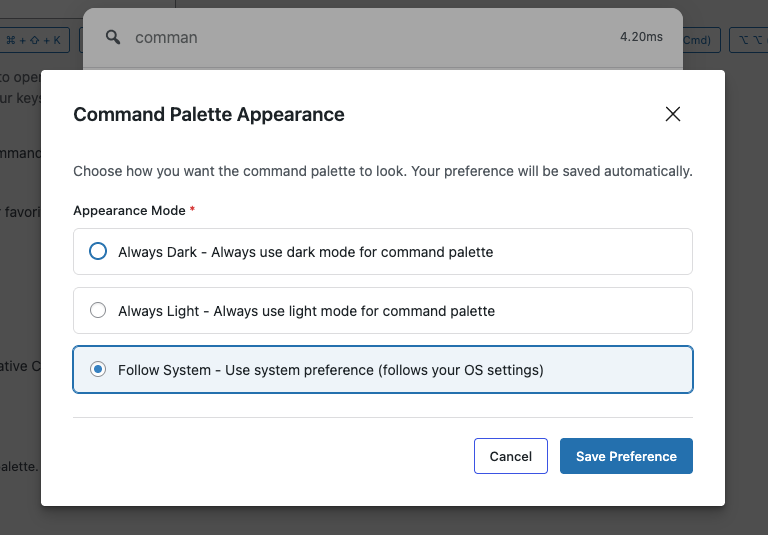
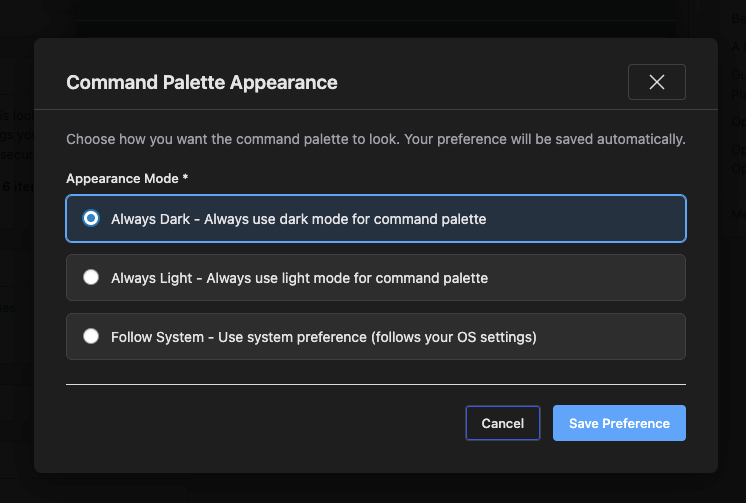
In Commandify v1.0.6 (Pro), native dark mode support arrives with three flexible options:
Always Dark
Always Light
Follow System preference
And unlike many plugins that bolt on a theme toggle and call it a day, Commandify’s dark mode was redesigned with performance and stability in mind. It applies theme changes directly in the DOM for instant updates, and avoids clashing with other tools.
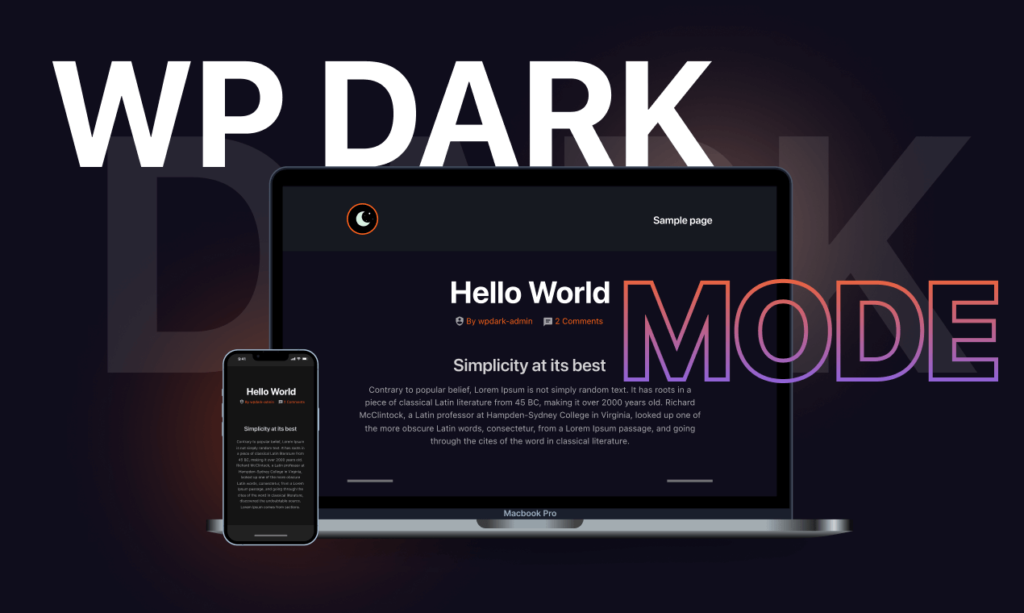
Speaking of that- if you already use WP Dark Modeplugin, Commandify detects it automatically and disables its own native dark mode to prevent theme conflicts. That’s not just thoughtful design- it’s practical engineering to reduce headaches on real sites.
This means your palette matches the rest of your admin environment without unexpected theme mismatches or UI flickers.
Customize The Palette Without Breaking Your Flow (Pro)
Most productivity tools make you adjust settings in a separate screen, disrupt your workflow, and then hope you like the change.
We took a different approach.
Commandify now includes a Command Palette Appearance command- a shortcode you can run from inside the palette itself (or from settings) that opens a modal where you tweak theme preferences live. Change the look, see the result immediately, and keep the palette open so you don’t lose focus.
That’s a small detail with big impact, because preferences should adapt to your personal flow, not force you out of it.
It’s also an example of an important shift in how we design Commandify: preferences shouldn’t be a distraction- they should live inside the workflow.
Bricks Builder Gets A Better Code Signature Workflow (Pro)
If you use Bricks Builder and build templates or dynamic layouts, you know that handling executable code safely is critical.
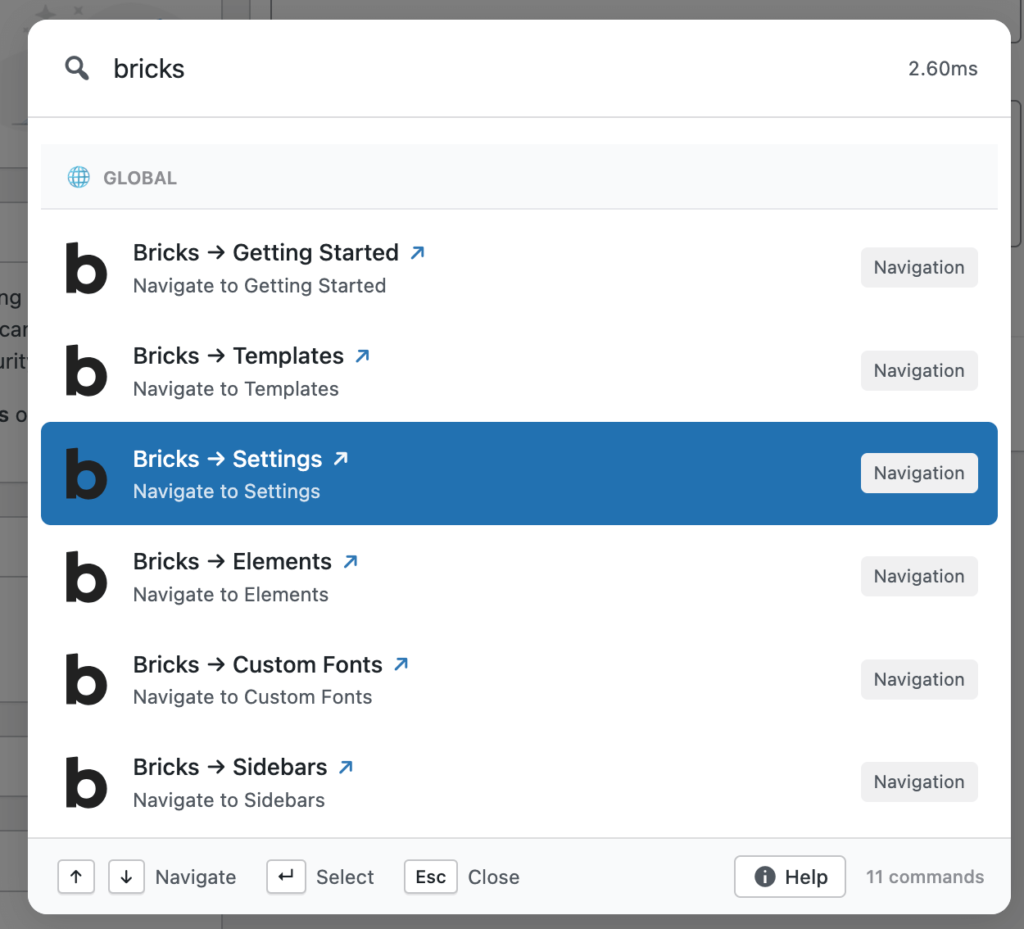
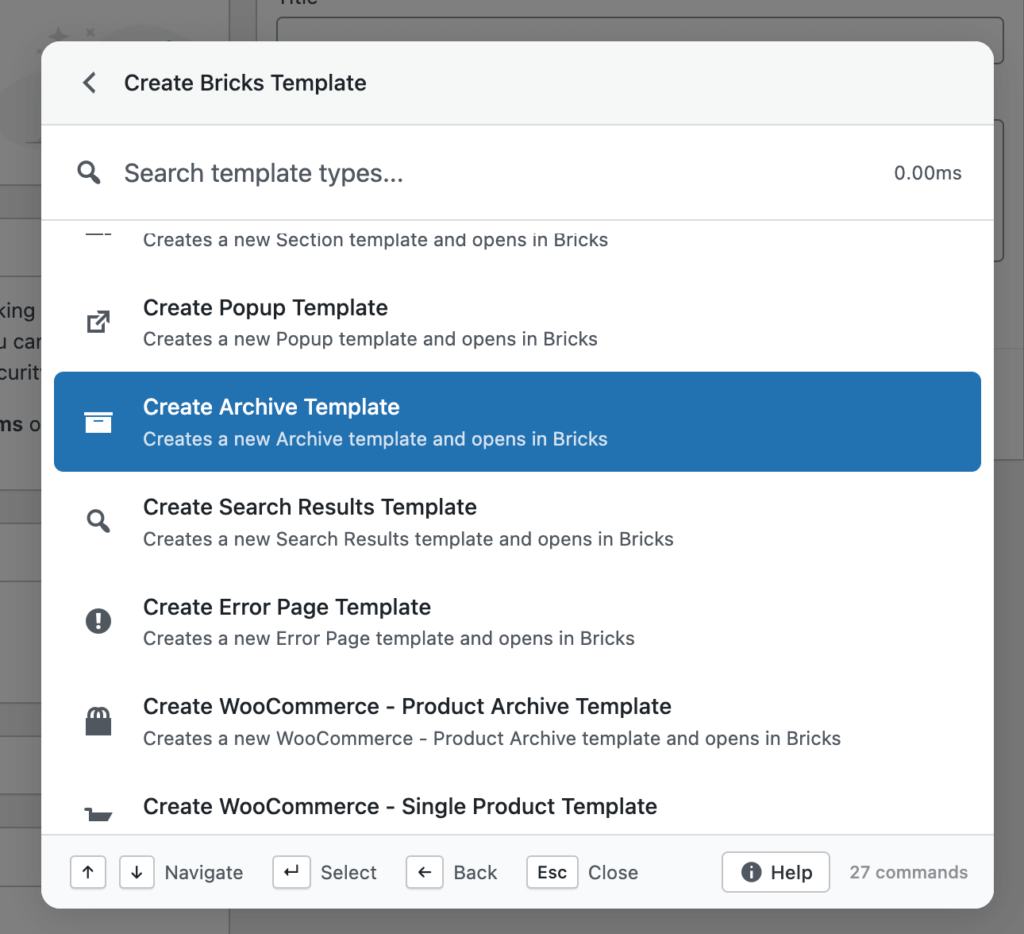
In v1.0.6 Pro, we added the “Bricks: Regenerate Code Signatures” command.
This isn’t a superficial addition — it’s a workflow improvement. Instead of navigating deep into template settings or running manual scripts on your server, you can regenerate code signatures right from the palette. A confirmation modal keeps it safe, and built-in validation prevents accidental overrides.
The benefit here is clear:
less navigation
fewer context switches
more control right where you’re already working
Built For Extensibility: A Global Command Event
One of the most exciting changes in this release is actually under the hood: v1.0.6 introduces a global event system around command execution.
Whenever a command runs, Commandify now fires:
commandify-command-executed
This might sound technical, but it unlocks something huge: the ability for Pro extensions and third-party workflows to react after a command runs.
This means:
plugins or scripts can integrate with Commandify more deeply
automation tools can react in real time
custom workflows can be built without modifying core code
This change lays the foundation for integrations that go far beyond what any command palette has done before.
Commandify v1.0.6: Stability, Performance, And The Details That Save Time
Fixes That Matter When Sites Get Big
A lot of work in Commandify v1.0.6 went into things that don’t look exciting on a feature list, but make a real difference on production sites.
One example is WooCommerce customer lookup. On small stores, everything works fine no matter how you query data. On large stores with thousands of customers, weak queries quickly turn into delays, incomplete results, or outright failures.
In this release, customer search has been tightened up so results load faster and stay accurate even as databases grow. That means fewer retries, fewer manual searches, and less time jumping back to WooCommerce screens just to confirm data.
The same thinking applies to WordPress update checks. If you manage multiple plugins and themes, missing or delayed update detection is more than annoying. It’s a maintenance risk. Commandify v1.0.6 fixes update detection so core, plugin, and theme updates surface correctly inside the palette again, without inconsistencies.
These are the kinds of fixes you only notice when they’re missing, which is exactly the point.
Dark Mode Reliability, Not Just Dark Mode Features
Earlier in the release we talked about dark mode as a feature. But v1.0.6 also fixes several edge cases that affect trust.
Previously, some users experienced small delays when opening the palette, where the theme would briefly load in the wrong mode before correcting itself. Others saw CSS not update immediately after switching appearance.
Those issues are now resolved.
You also getting a perfect compability with WP Dark Mode plugin if you’re already using it. No issue, just choose which one or how you wanna enjoy the dark mode, its your call!
Theme detection reads directly from stored preferences as soon as the palette opens. Overlay attributes update instantly. Reload events fire consistently. The palette opens in the correct theme every single time.
It’s a quiet improvement, but it reinforces something important: Commandify should feel dependable. When you press Cmd/Ctrl + K, you shouldn’t wonder what state the UI will be in.
Why Commandify v1.0.6 Is About Long-Term Productivity
It’s easy to judge releases by how many features they add. But that’s not how productivity tools earn trust over time.
Commandify v1.0.6 is a release about refinement.
The palette is calmer and easier to scan
Appearance controls respect existing setups
Preferences persist correctly without extra steps
Commands execute within a more extensible architecture
Each of these changes removes a small piece of friction. Combined, they add up to a noticeably smoother daily workflow.
If you use the command palette occasionally, you’ll appreciate the polish.
If you use it constantly, you’ll feel the difference immediately.
Commandify vs CommandUI vs Turbo Admin (A Quick Comparison)
Most command tools in WordPress stop at navigation.
Commandify goes further by executing real actions, adapting to context, recognizing patterns, and deeply integrating with the tools teams actually use—WooCommerce, forms, page builders, and user management.
That’s why Commandify isn’t just a faster menu. It’s a true command system for WordPress workflows.
Commandify Roadmap: Expanding the Command Palette Ecosystem
Commandify has grown rapidly over the last three months, adding 10+ powerful integrations and significantly expanding its action engine. But we’re just getting started.
Our roadmap is simple and consistent:
Add deeper integrations, increase action density, and turn WordPress into a true command-driven workspace.
Here’s what’s coming next:
More Form & CRM Integrations
We’re expanding beyond Contact Form 7 and Fluent Forms. Upcoming integrations include:
Gravity Forms
WPForms
FluentCRM (Additional Fluent ecosystem products including community and cart)
The goal isn’t just form search- it’s full submission control, entry management, and CRM workflow access directly from the command palette.
LMS & Learning Platforms
Managing courses, lessons, and students should never require endless menu navigation.
Upcoming integrations include:
LearnDash
TutorLMS
BuddyBoss (LMS & community workflows)
We’re building command-based access to course structures, student progress, and administrative actions — ideal for educators and membership site owners.
Membership & Community Access Control
For sites running paid communities or gated content, workflow speed matters.
Planned integrations include:
MemberPress
Paid Memberships Pro
Fluent Community
BuddyBoss membership workflows
This will allow faster user access control, subscription management, and member administration directly from the command layer.
More Page Builder Support
Elementor and Bricks are already deeply integrated. Next, we’re expanding support for:
Beaver Builder
WPBakery
Additional template systems
Extended builder-specific actions
The vision is clear: no matter which builder you use, Commandify becomes the fastest way to control it.
A Command Layer That Keeps Growing
In just three months, Commandify has become one of the most feature-rich and integration-heavy command palette tools in the WordPress ecosystem.
It already supports:
WooCommerce (orders, products, customers)
Elementor
Bricks Builder
Contact Form 7
Flamingo
Fluent Forms
User Switching
WP Dark Mode
Maintenance tools
Frontend command execution
Dark mode & WordPress 6.9 compatibility
And we’re adding new integrations every single month.
The goal is to become the operational control layer for serious WordPress sites.
Why Commandify Is Becoming A Core Tool For WordPress Users
At a surface level, Commandify looks like a shortcut tool. In practice, it’s something else entirely.
Commandify replaces scattered admin navigation with a single, action-driven interface.
Instead of remembering where things live, you focus on what you want to do. Edit a post. Toggle a setting. Manage a WooCommerce order. Regenerate builder assets. It’s all one search away.
What separates Commandify from other command palettes is depth. It doesn’t stop at navigation. It executes real actions, understands context, and integrates with the tools WordPress users actually rely on.
That’s why updates like v1.0.6 matter. They don’t chase trends. They reinforce the idea that productivity comes from clarity, consistency, and trust in the tool you use every day.
Commandify v1.0.6 moves the plugin closer to that ideal. Fewer distractions. Stronger foundations. Better control.
And most importantly, less time wasted inside wp-admin.
If your WordPress workflow already feels busy, this release makes it feel lighter- which is exactly what a command palette should do.
The Real Frustration: Contact Form 7 Submissions Are Hard to Handle at Scale
Contact Form 7 works perfectly. That’s why millions of WordPress sites use it. But once a site starts receiving regular submissions, managing those entries becomes frustrating very quickly.
Messages come in through multiple forms. Support requests, sales inquiries, partnership emails — all mixed together. Someone on your team asks for a past submission. A customer follows up using the same email. You know the message exists, but finding it takes longer than it should.
This is why people keep searching things like how to manage Contact Form 7 submissions, Contact Form 7 entry management, and manage Flamingo submissions efficiently. The issue is not form creation. It’s what happens after the form is live.
Once submissions become part of daily operations, the default admin workflow starts slowing teams down.
What Contact Form 7 and Flamingo Actually Do?
Contact Form 7 is a lightweight and flexible form plugin. By default, it does not store submissions in the database. That design choice keeps it simple, but it also means you need an additional layer to manage entries.
That’s where Flamingo comes in. Flamingo stores Contact Form 7 submissions inside WordPress so you can view messages later.
This setup works, but as submissions increase, managing CF7 entries through Flamingo becomes admin-heavy and slow, especially for support teams and agencies.
In this article, we’ll focus on solving that exact problem using Commandify– without changing how your forms work.
Why Managing Contact Form 7 Submissions Feels Clunky
The first issue most users notice is fragmentation.
Forms live in one place. Submissions live somewhere else. Spam is mixed with real messages. Searching across multiple forms requires jumping between screens. Even simple tasks like finding a message by email take more time than expected.
The Flamingo interface is functional, but it’s not optimized for speed. Each interaction requires:
Navigating to the Flamingo inbox
Selecting the correct form
Scanning through entries
Opening messages one by one
For low-volume sites, this is manageable. For sites handling daily inquiries, it becomes a bottleneck. That’s why queries like handle Contact Form 7 entries faster appear so often- users are reacting to admin friction, not missing features.
The Email Lookup Problem Support Teams Face Daily
Support teams rarely receive perfect information.
A customer usually follows up with something like:
This is slow, especially when support tickets stack up. Searching by email should be instant, but Flamingo treats it like a secondary filter instead of a primary workflow.
This is why Contact Form 7 entry management becomes painful as soon as support volume increases. The admin interface simply wasn’t designed for rapid, repeated lookups.
Managing Multiple Contact Forms Makes the Problem Worse
Most real-world sites don’t use just one form.
They have:
A contact form
A support form
A quote request form
A careers form
Maybe language-specific forms
Flamingo stores all of these submissions, but switching between forms is slow and disorienting. Teams often forget which form a message came from, forcing them to search across everything.
When you have to jump between forms and inboxes just to find one message, productivity drops fast.
Spam Handling Becomes a Time Sink
Spam is unavoidable with public forms.
Even with filters and honeypots, some spam gets through. Flamingo collects it alongside real submissions, which means support teams still need to review and clean up entries manually.
Typical workflows involve:
Scanning messages
Identifying spam
Deleting or trashing entries
Repeating the same actions again and again
This process is tolerable at low volume. At scale, it becomes tedious and time-consuming. It also increases the chance of accidentally deleting a legitimate message.
This is another reason people search manage Flamingo submissions efficiently— not because Flamingo is broken, but because cleaning up submissions shouldn’t take this much effort.
Why Traditional Contact Form 7 Tips Don’t Fix the Core Problem
Most advice around Contact Form 7 focuses on:
Improving form validation
Reducing spam
Customizing form markup
While these are useful, they don’t address the biggest admin pain: handling submissions after they arrive.
Even with perfect forms, teams still struggle with:
Finding specific entries
Switching between forms
Handling follow-ups quickly
Managing inbox cleanup
The problem is not form configuration. The problem is how submissions are accessed and acted on inside WordPress admin.
This is exactly where workflow improvements matter more than plugin settings.
Where Contact Form 7 Management Starts Hurting Agencies
Agencies feel this pain more than anyone else.
They manage multiple client sites, each with:
Different forms
Different inbox volumes
Different support processes
Switching between Flamingo inboxes across sites quickly becomes exhausting. Small inefficiencies multiply when repeated across clients.
This is why agencies actively look for better WordPress support workflows rather than new form features. They need faster access to data, not more customization options.
How Commandify Fixes Contact Form 7 Submission Management at the Workflow Level
At this stage, the core problem with Contact Form 7 submission handling should be clear.
Contact Form 7 does its job well. Flamingo stores submissions reliably.
What breaks down is not data collection or storage. What breaks down is how much effort it takes to find, review, and act on submissions once they start piling up.
This is exactly where Commandify fits into the workflow.
Commandify does not replace Contact Form 7 or Flamingo. It does not change how submissions are saved or displayed. Instead, it removes the biggest bottleneck in CF7 workflows: slow access to submissions inside the WordPress admin.
Managing Contact Form 7 Submissions Faster Starts With Direct Search
The most time-consuming part of Contact Form 7 entry management is locating the right submission.
In real workflows, you rarely start with the form name. You start with:
An email address
A follow-up message
A support ticket reference
Default Flamingo workflows require you to navigate through inboxes and forms before you can even begin searching. This is why so many users ask how to manage Contact Form 7 submissions more efficiently- they’re reacting to access friction.
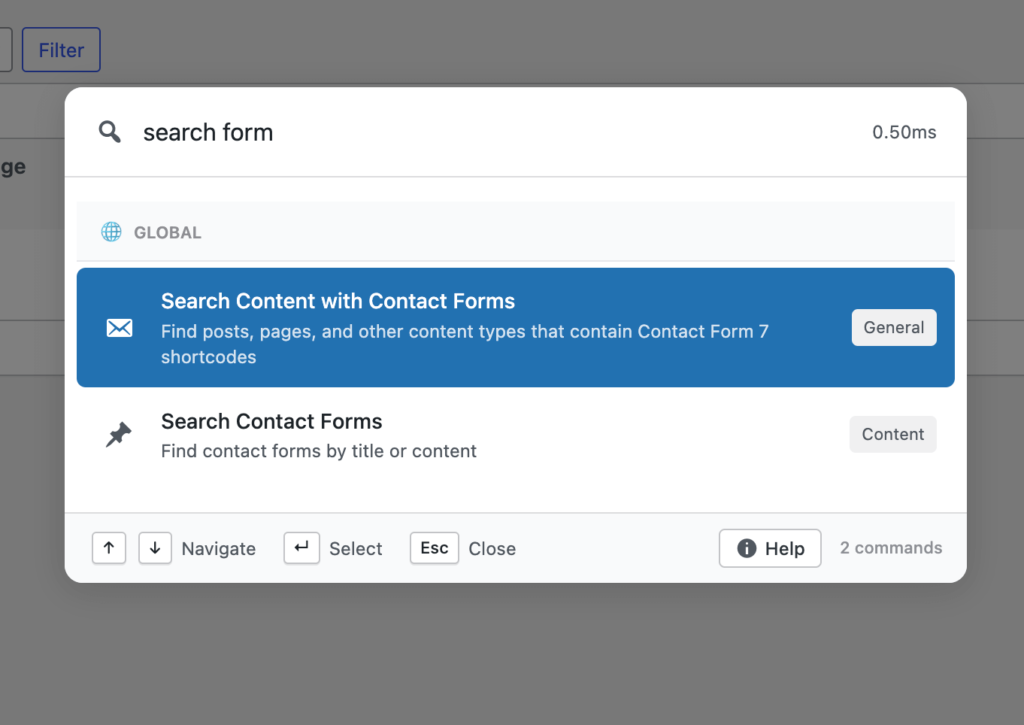
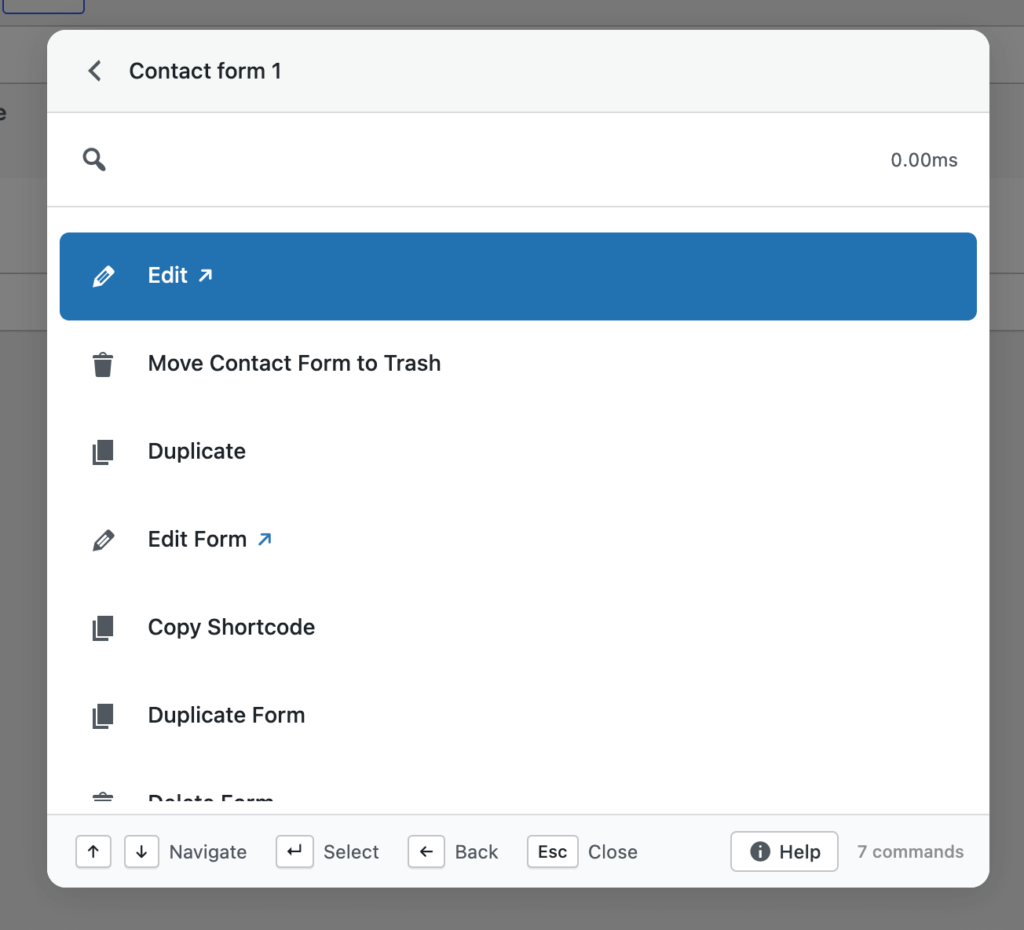
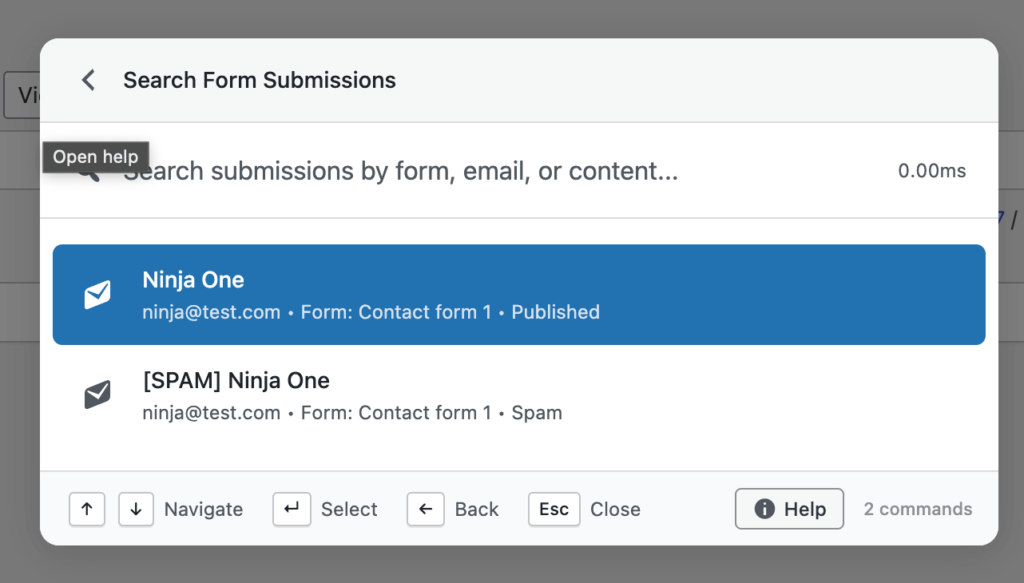
Commandify changes this by making submissions directly searchable. You begin with intent, not navigation. Instead of opening Flamingo first, you search for the submission you need and act immediately.
This single change has a major impact on Contact Form 7 entry management, especially for support-heavy sites.
Handling Flamingo Submissions Without Living Inside the Inbox
Flamingo was designed as a storage layer, not a high-speed inbox. Its interface works, but it assumes that admins will browse messages manually and infrequently.
As submission volume grows, this assumption no longer holds.
Support teams and agencies need to:
Locate messages quickly
Confirm details without opening multiple entries
Move between submissions without losing context
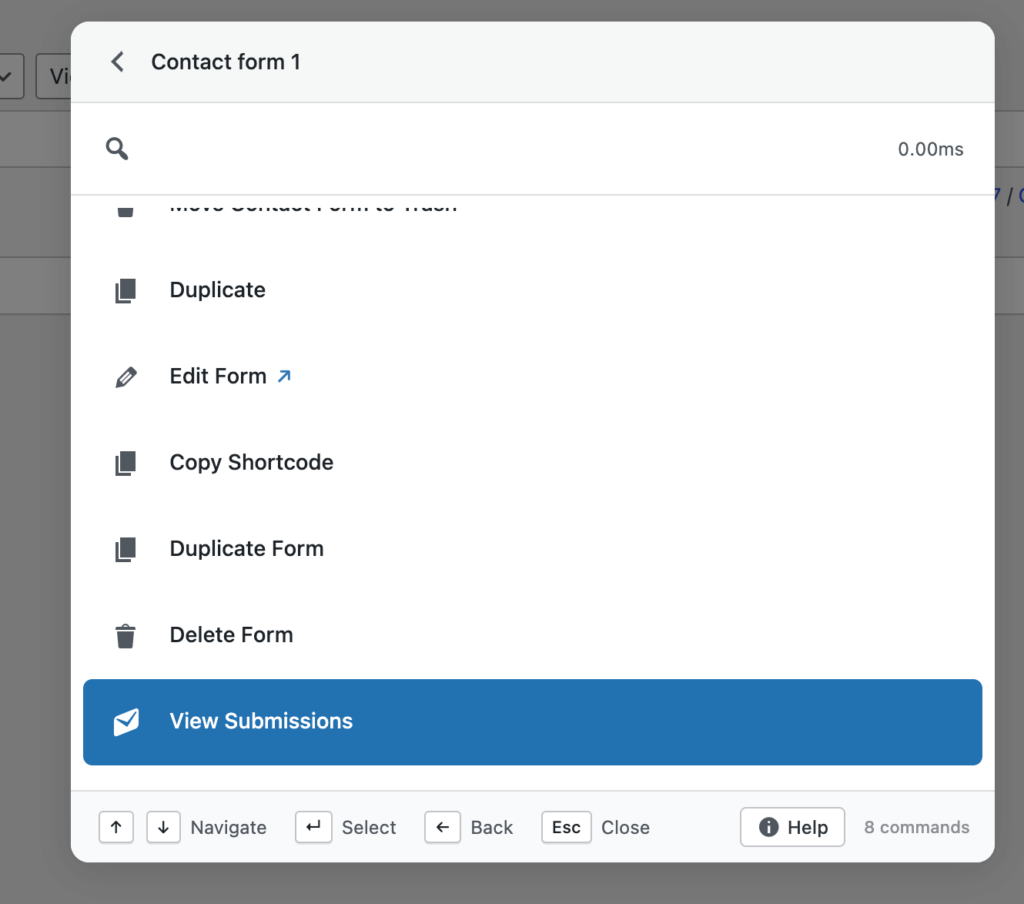
Commandify reduces dependency on the Flamingo inbox by surfacing submissions through search and actions. Instead of spending time navigating inbox screens, teams interact with submissions directly.
This makes managing Flamingo submissions efficiently realistic even as volume increases.
Faster CF7 Entry Management Across Multiple Forms
Multiple forms are the norm on professional sites, not the exception.
When submissions are split across contact, support, sales, and application forms, default workflows slow down. Teams waste time remembering which form to check, then repeat the same navigation steps across inboxes.
Commandify removes that mental overhead. You don’t need to know where a submission lives before you find it. You search once and reach the relevant entry directly.
This is a key reason why teams using Commandify consistently handle Contact Form 7 entries faster than with default admin workflows.
Reducing Time Spent on Spam and Inbox Cleanup
Spam management is unavoidable, but it doesn’t need to be time-consuming.
In standard Flamingo workflows, spam cleanup involves opening entries, confirming content, deleting messages, and repeating this process again and again. Over time, this becomes one of the most tedious parts of managing Contact Form 7 submissions.
Commandify shortens this process by making submission actions easier to reach. When cleanup actions are closer to search and context, admins spend less time reviewing and more time resolving real messages. This improves inbox hygiene without adding more tools or automation layers.
Why This Approach Works Better Than Traditional CF7 Optimizations
Most Contact Form 7 advice focuses on:
Form setup
Validation rules
Spam prevention
These are important, but they don’t address the biggest admin problem: handling submissions after they arrive.
Commandify works because it targets the actual pain point- access speed. Instead of adding new features to CF7 or Flamingo, it improves how you interact with what already exists.
This makes Contact Form 7 viable not just for simple sites, but for professional support and sales workflows.
When Commandify Makes the Biggest Difference for Contact Form 7 Users
Commandify provides the most value when:
Submissions arrive daily, not occasionally
Multiple forms are active on the site
Support or sales teams rely on form entries
Agencies manage CF7 across multiple client sites
Admins need to find submissions by email quickly
If managing Contact Form 7 submissions feels slower as your site grows, this is exactly the stage where workflow improvements matter most.
Finding Contact Form 7 Submissions Faster When You Only Have an Email
One of the most common and frustrating tasks in Contact Form 7 management is locating a specific submission when the only information available is an email address. This happens constantly in real support workflows. A customer follows up days later, a sales lead replies to an earlier message, or a client asks whether someone contacted them from a specific email.
By default, managing Contact Form 7 submissions through Flamingo means opening the inbox, selecting the correct form, applying filters, and manually scanning entries. Even when search is available, it’s not optimized for quick, repeated lookups. This is why so many users ask how to manage Contact Form 7 submissions more efficiently. The pain comes from lookup speed, not from form setup.
With Commandify, searching submissions by email becomes a direct action instead of a multi-step process. You don’t need to remember which form the message came from or manually browse inboxes. This dramatically improves Contact Form 7 entry management, especially for teams handling daily inquiries.
Managing Flamingo Submissions Without Navigating Multiple Screens
Flamingo stores submissions reliably, but it assumes that admins will browse entries manually. This works when volume is low, but breaks down quickly as soon as multiple forms and frequent messages are involved.
Real-world workflows often involve:
Switching between multiple form inboxes
Opening submissions just to confirm basic details
Jumping back to the inbox repeatedly
Each screen change introduces friction. Over time, this makes managing Flamingo submissions efficiently feel harder than it should be.
Commandify removes much of this friction by allowing you to search and access Flamingo submissions directly. Instead of navigating to Flamingo first and then deciding what to do, you start with the intent — finding a submission — and act immediately. This approach reduces admin overhead and helps support teams stay focused on resolution rather than navigation.
Handling Contact Form 7 Submissions Across Multiple Forms
Most professional WordPress sites use more than one form. A contact form alone is rarely enough. Support requests, sales inquiries, job applications, and feedback forms are often separated for clarity. While this makes sense structurally, it complicates submission management.
When messages are split across forms, support teams often struggle to remember where to look. They search one inbox, then another, repeating the same steps. This leads directly to queries like handle Contact Form 7 entries faster and Contact Form 7 entry management tips.
Commandify improves this experience by treating submissions as searchable data rather than isolated inboxes. You don’t need to think about form structure first. You search for the message you need and access it directly, regardless of which form it came from. This significantly reduces time spent switching between forms and improves overall workflow efficiency.
Cleaning Up Spam Without Wasting Time
Spam management is a necessary but thankless part of running public forms. Even with good spam prevention, some unwanted messages always slip through. Flamingo stores these alongside real submissions, which means admins still need to review and clean up entries manually.
The problem isn’t deleting spam- it’s how repetitive the process becomes. Opening entries, confirming they’re spam, deleting them, and repeating this dozens of times per day drains time and attention.
For users searching manage Flamingo submissions efficiently, spam cleanup is often part of the frustration. Commandify streamlines this by making submission actions easier to reach. When actions are closer to search and context, cleanup becomes faster and less mentally taxing, reducing the chance of mistakes while saving time.
Supporting Sales and Support Teams More Effectively
Contact Form 7 is often the first touchpoint between a business and its customers. Sales teams rely on form submissions to follow up on leads. Support teams rely on them to resolve issues. In both cases, speed matters.
Slow access to submissions leads to delayed responses, missed opportunities, and frustrated users. This is why improving how to manage Contact Form 7 submissions directly impacts customer experience.
Commandify helps teams respond faster by removing unnecessary admin steps. Instead of spending time locating messages, teams can focus on responding and resolving issues. Over time, this improves not just productivity, but also service quality.
Why Faster CF7 Entry Management Matters More as Volume Grows
On low-traffic sites, Flamingo’s default workflows are acceptable. As submission volume increases, those same workflows become a bottleneck. What once felt manageable starts to feel slow and disorganized.
This is the point where store owners, service providers, and agencies start looking for better ways to handle Contact Form 7 entries faster. They’re not looking to replace CF7. They’re looking to manage it better.
Commandify addresses this exact stage of growth. It doesn’t add complexity or change how forms work. It simply improves how submissions are accessed and managed, which is what growing teams actually need.
FAQs on Contact Form 7 with Flamingo and Commandify
Does Commandify replace Contact Form 7 or Flamingo?
No. Contact Form 7 continues to handle form creation, and Flamingo continues to store submissions. Commandify only improves how you access and manage those submissions in the admin.
Can Commandify help manage Contact Form 7 submissions faster?
Yes. By reducing admin navigation and making submissions searchable directly, Commandify significantly improves how fast teams can manage Contact Form 7 submissions.
Does this change how Flamingo stores data?
No. All submissions remain stored by Flamingo exactly as before. Commandify does not modify or duplicate submission data.
Is Commandify useful for small sites using CF7?
It becomes more valuable as submission volume increases. On sites with regular inquiries or support requests, the time savings are noticeable.
Is this safe for client and agency workflows?
Yes. Commandify respects existing permissions and does not expose or alter submission data beyond what admins already have access to.
Final Takeaway on How to Manage Contact Form 7 Submissions
Contact Form 7 remains one of the most reliable form plugins in WordPress. Flamingo reliably stores submissions.
What slows teams down is not the tools themselves, but how much effort it takes to work with submissions once volume increases.
If your goal is to manage Contact Form 7 submissions faster, handle Flamingo entries efficiently, and reduce admin friction for support and sales teams, improving your workflow is the most effective step.
Commandify does not add complexity. It removes friction from Contact Form 7 management where it matters most.
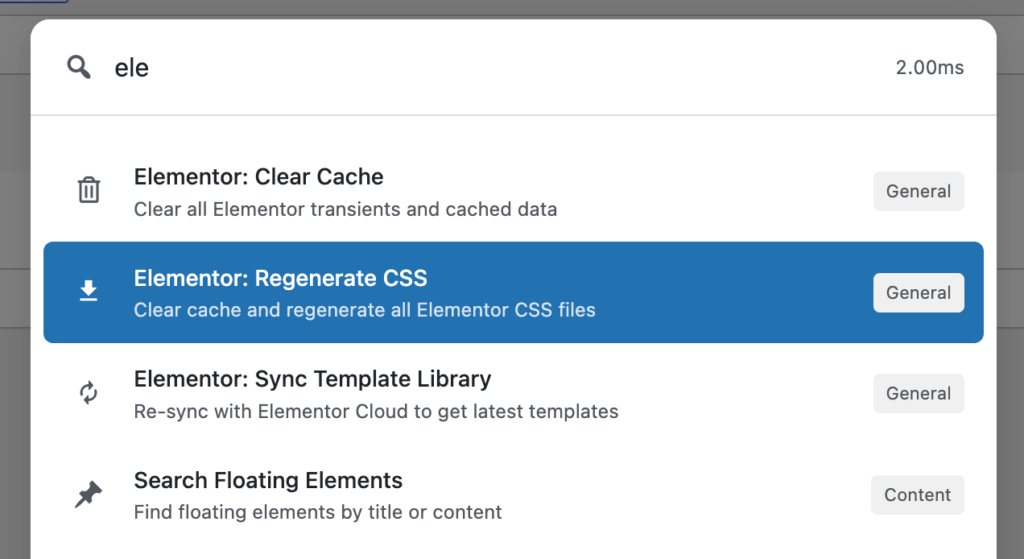
The Real Struggle: Elementor Templates Are Easy to Build, Hard to Manage
If you use Elementor regularly, you already know this problem.
Designing pages feels fast. Building layouts feels smooth. But the moment you step away from the canvas and into the WordPress admin, everything slows down. Templates pile up. Naming becomes inconsistent. Finding the right template takes longer than expected. Simple actions suddenly require loading the full builder.
For agencies and teams, this becomes painful very quickly. One client site has dozens of templates. Another has hundreds. Headers, footers, popups, single templates, archive layouts- all stored separately, all managed through different admin screens.
This is why so many users search how to manage Elementor templates faster rather than “how to design with Elementor.” The problem isn’t building. It’s managing what you’ve already built.
Before we go deeper, let’s set a quick baseline.
What Elementor Is?
Elementor is one of the most widely used WordPress page builders. It allows you to design pages, templates, and dynamic layouts visually, without writing code.
Elementor works exceptionally well inside the editor. But once your site grows, Elementor template management inside WordPress admin becomes slow and fragmented.
In this article, we’ll focus specifically on how to manage Elementor templates faster, and how Commandify removes the admin friction that Elementor users deal with every day.
Why Elementor Template Management Becomes a Bottleneck
Template sprawl happens quietly.
At first, you create a few templates. Then more pages need variations. Marketing asks for landing pages. Clients want changes. Before long, you’re dealing with:
Multiple header and footer templates
Reusable sections saved as templates
Popups for different campaigns
Dynamic templates for posts, products, or archives
Elementor stores these well, but finding and managing them is where time gets lost.
Most users don’t struggle because Elementor lacks features. They struggle because managing templates requires too many steps for simple actions.
This is exactly why queries like how to manage Elementor templates faster and Elementor template management best practices keep showing up.
Finding the Right Elementor Template Takes Longer Than It Should
This is the most common frustration.
You know the template exists. You roughly remember its name. But you still have to:
Navigate to Templates
Filter by type
Scroll through a long list
Open the builder just to confirm it’s the right one
Each step adds delay. Each delay breaks focus.
For agencies managing multiple sites, this happens dozens of times per day. For teams, it creates friction between designers and editors who just want to make quick adjustments.
If you’re asking how to manage Elementor templates faster, this is the first bottleneck to solve: template discovery.
Why Simple Template Actions Feel Heavier Than They Should
Now consider common admin tasks:
Duplicate a template
Rename a template
Export a template
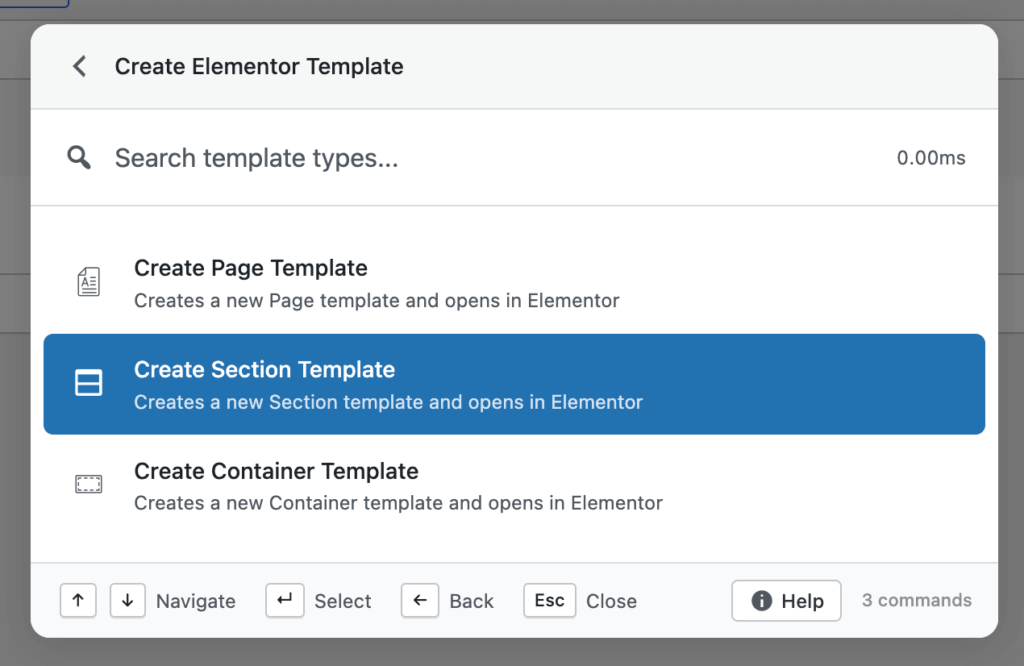
Create a new template type
None of these require design work. Yet Elementor often forces you to load the builder interface anyway.
This creates a mismatch:
The task is small
The action required is heavy
Over time, this discourages good template hygiene. Teams avoid renaming templates. Duplicates pile up. Template libraries become messy.
This constant back-and-forth is exhausting, especially when the fix itself takes only seconds.
That’s why “speed up Elementor workflow” is such a common search. People don’t want new features. They want fewer interruptions.
And this is also where traditional advice falls short.
Why Filters and Naming Conventions Don’t Fully Solve the Problem
You’ll often hear advice like:
Name your templates better
Use folders or prefixes
Clean up unused templates
These help, but they don’t address the real issue.
Even with perfect naming, you still need to:
Navigate to the templates screen
Load full admin pages
Open the builder for non-design tasks
The problem isn’t organization alone. The problem is how much effort it takes to perform basic template management actions.
If you’re serious about learning how to manage Elementor templates faster, the solution has to reduce steps- not just organize them.
How Commandify Solves Real Elementor Template Management Problems
At this point, the core issue with Elementor template management should be obvious.
Elementor itself is not slow. Designing inside the builder is smooth and efficient.
The slowdown happens outside the canvas, where everyday administrative tasks take more time than the actual design work. Finding templates, duplicating them, renaming them, exporting them, or creating new ones all require navigating WordPress admin screens and loading the builder even when no visual editing is needed.
This is exactly where Commandify fits into Elementor workflows.
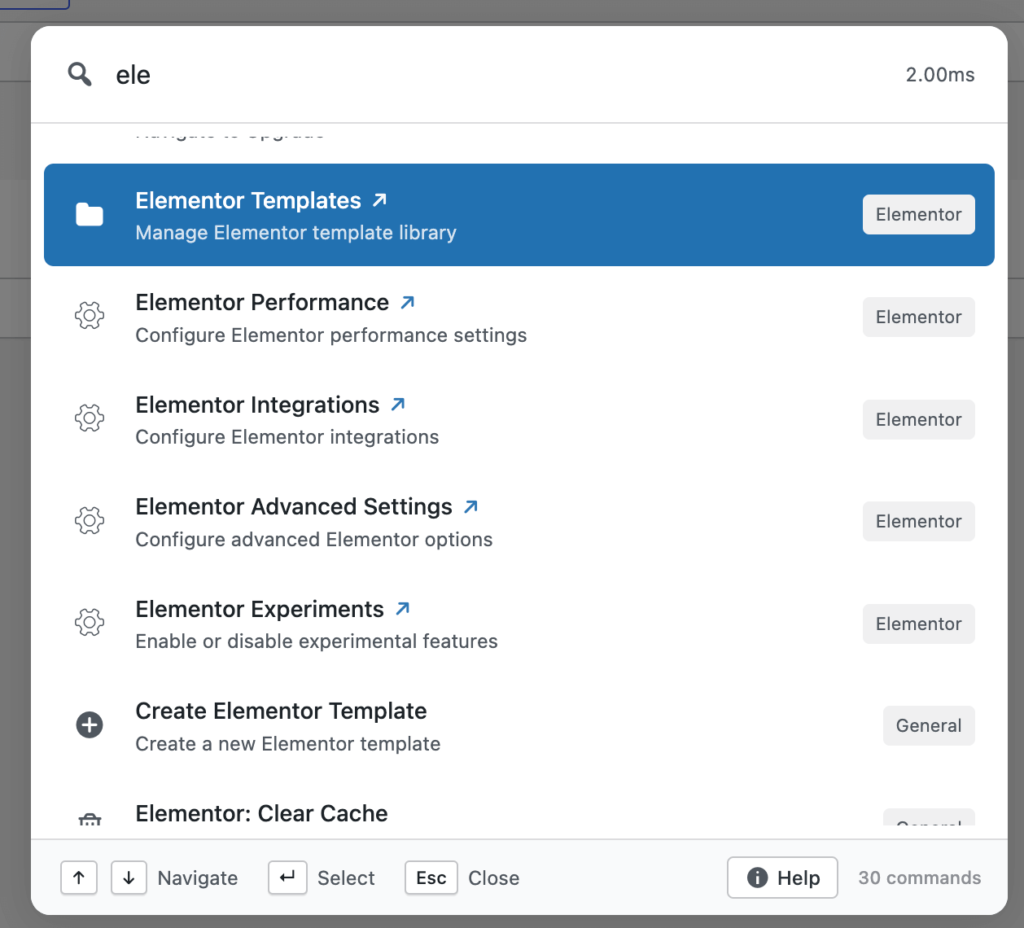
Commandify does not replace Elementor or change how templates work. Instead, it gives you a faster way to interact with Elementor templates from the WordPress admin, so you can manage them efficiently without opening the builder every time.
Managing Elementor Templates Faster Starts With Direct Access
One of the biggest reasons Elementor admin workflows feel slow is that templates are treated like destinations instead of objects you can act on directly.
By default, you must:
Navigate to the Templates screen
Filter by template type
Scroll or search manually
Open the builder to confirm it’s the right one
This process breaks focus and wastes time, especially when you already know what you’re looking for.
Commandify changes this by allowing you to search Elementor templates directly and access them immediately. You no longer need to “go find” templates first. You act on them from a single interface.
This alone addresses the most common reason people search how to manage Elementor templates faster: they want to reach the right template without admin friction.
Handling Template Actions Without Loading Elementor
Most Elementor template actions are administrative, not creative.
Renaming a template, duplicating it, exporting it for reuse, or creating a new template type does not require the visual builder. Yet default Elementor workflows still force you into the editor for these tasks.
This creates unnecessary delays and discourages proper template management, especially on large sites.
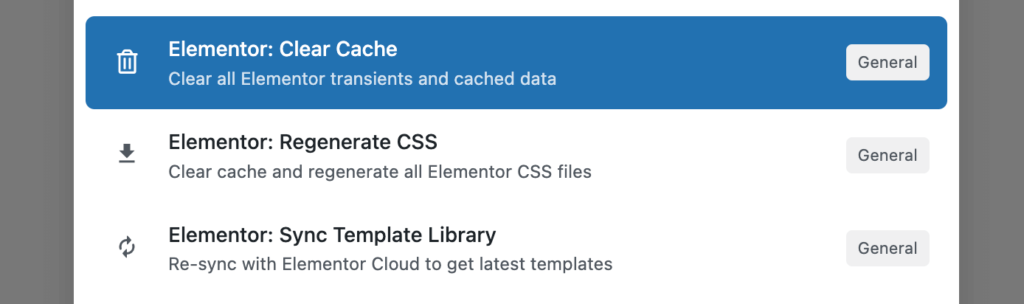
Commandify separates template actions from template design. You can handle management tasks quickly and only open Elementor when you actually need to design or edit layouts.
For teams and agencies, this distinction is critical. It keeps designers focused on design work and allows editors or project managers to manage templates without interfering with the creative process.
Keeping Elementor Workflows Fast on Large and Growing Sites
Elementor template management problems scale with site complexity.
On small sites, delays are tolerable. On large sites with many templates, they become a daily frustration. Agencies feel this most because template sprawl is unavoidable across multiple client projects.
When teams ask how to manage Elementor templates faster, they are usually dealing with:
Dozens of reusable templates
Multiple contributors
Frequent updates and revisions
QA cycles that require quick access
Commandify helps in these environments by reducing the cost of every interaction. Fewer clicks. Fewer screen loads. Less context switching. Over time, this makes Elementor feel faster even though the builder itself hasn’t changed.
Why This Improves Elementor Productivity, Not Just Speed
Speed alone isn’t the real benefit. Consistency is.
When template management becomes easier:
Teams rename and organize templates properly
Duplicate templates are handled cleanly
Reusable components stay manageable
Updates happen faster and with fewer mistakes
This leads to better long-term maintainability. Elementor productivity improves because teams are no longer avoiding admin tasks due to friction.
That’s why Commandify fits naturally into Elementor workflows rather than feeling like an extra tool layered on top.
When Commandify Makes the Biggest Difference for Elementor Users
Commandify provides the most value for Elementor users when:
Sites rely heavily on templates rather than one-off pages
Multiple people manage or edit templates
Changes happen frequently after launch
Agencies handle multiple Elementor sites
Admin-side work takes more time than actual design
If you’ve ever felt that Elementor is fast to design with but slow to manage, this is the exact gap Commandify is designed to close.
Managing Elementor Templates Faster Starts With How You Find Them
The first real bottleneck in Elementor template management is not editing— it’s finding the right template at the right moment. On growing sites, templates are spread across different types: headers, footers, single templates, archive layouts, popups, and saved sections. Even when naming is done carefully, locating the correct template still requires navigating through admin screens and scanning long lists.
This is why many Elementor users end up searching how to manage Elementor templates faster. The delay doesn’t come from design work. It comes from template discovery. Every extra click adds friction, especially when the task itself takes only a few seconds once you’re inside the right template.
Commandify addresses this by making Elementor templates searchable from a single place. Instead of navigating to the templates screen first, you can search templates directly and jump into the exact one you need. This removes several steps from the workflow and keeps your focus intact.
Reducing Context Switching Between Pages and Templates
Context switching is one of the most underestimated productivity killers in Elementor workflows. A typical scenario looks simple: you’re editing a page, notice a header issue, and realize the change belongs to a template. But the moment you leave the page editor, navigate to templates, and load the builder again, your mental flow is broken.
Over the course of a day, this back-and-forth becomes exhausting. Designers and editors spend more time moving between screens than actually fixing issues. This is why “speed up Elementor workflow” is such a common query — users aren’t struggling with Elementor’s features, they’re struggling with the cost of switching context repeatedly.
By giving you direct access to Elementor templates without manual navigation, Commandify reduces unnecessary context switches. You move straight from intent to action, which is the core reason Elementor workflows start to feel faster once the admin friction is removed.
Why Simple Template Actions Should Not Require the Builder
Not every template-related task is a design task. Yet Elementor often treats them as if they are.
Renaming a template, duplicating it, exporting it, or creating a new template type does not require loading the visual builder. However, default Elementor workflows still push users into the editor for these actions. This creates unnecessary delays and discourages teams from maintaining clean, organized template libraries.
When people search how to manage Elementor templates faster, they’re often reacting to this exact frustration. They want quick, administrative control over templates — not a full design session for every small task.
Commandify separates template management actions from template design work. This distinction matters because it lets you handle maintenance tasks quickly, without waiting for the builder to load or distracting yourself with design elements you don’t need to touch.
Managing Elementor Templates at Scale (Agency Reality)
Template management challenges increase dramatically at scale. Agencies rarely deal with one or two templates. They manage dozens or hundreds across multiple client sites. Each site has its own structure, naming conventions, and reusable components.
In these environments, Elementor template management stops being a creative problem and becomes an operational one. Teams need fast access, quick actions, and predictable workflows. That’s why agencies actively look for Elementor template management best practices that go beyond design tutorials.
Commandify fits naturally into agency workflows by reducing the time spent on admin navigation. When templates are accessible and manageable from a single interface, teams spend less time searching and more time delivering results. Over weeks and months, this difference compounds into real productivity gains.
Template naming and organization are important, but they don’t eliminate admin friction on their own. Even with perfect naming, you still need to navigate through WordPress admin screens, wait for lists to load, and open the builder for non-design tasks.
This is why many Elementor productivity tips fall short in real-world use. They focus on organization, not workflow efficiency. The problem isn’t that users can’t find templates — it’s that finding them still takes too many steps.
If you’re serious about learning how to manage Elementor templates faster, the solution must reduce interaction cost, not just improve structure. Commandify does exactly that by minimizing the number of actions required to reach and manage templates.
How Faster Template Management Improves Team Collaboration
Template speed isn’t just about individual productivity. It affects how teams collaborate.
When templates are easy to access and manage, designers respond faster to feedback, editors make updates confidently, and QA teams verify changes without delays. When template management is slow, small changes get postponed, and communication breaks down.
By simplifying Elementor admin workflows, Commandify removes friction points that slow down collaboration. Teams stay aligned because tasks move faster, and fewer handoffs are required to complete simple changes.
This is one of the reasons agencies that focus on efficiency prioritize tools that help manage Elementor templates faster rather than adding more design features.
Where Elementor Workflow Improvements Become Most Noticeable
The benefits of faster Elementor template management become most obvious when:
A site has many reusable templates
Multiple people work on the same site
Changes happen frequently
QA and revisions are part of the workflow
In these cases, even small delays add up quickly. Removing those delays has a direct impact on delivery speed and overall workflow satisfaction.
No. Elementor remains your page builder. Commandify only improves how you access and manage Elementor templates and actions from the WordPress admin.
Can Commandify really help manage Elementor templates faster?
Yes. Commandify reduces the steps required to find, duplicate, rename, export, and create Elementor templates, which is why it directly helps users who want to manage Elementor templates faster.
Do I still need to open Elementor for design changes?
Yes. Any visual design work still happens inside Elementor. Commandify focuses on admin-side actions and access, not design replacement.
Is Commandify useful for solo Elementor users?
It can be, but the biggest gains appear on larger sites or teams. Solo users managing many templates still benefit from faster access and fewer admin interruptions.
Is this workflow safe for client sites?
Yes. Commandify does not modify Elementor data structures. It simply provides faster access to existing actions and templates.
Final Thoughts on How to Manage Elementor Templates Faster with Commandify
Elementor is excellent at what it’s built for: visual design. What slows users down is everything around that design process.
As sites grow, template management becomes an operational task rather than a creative one. At that point, workflow efficiency matters more than new design features.
If your goal is to manage Elementor templates faster, reduce admin friction, and keep teams productive as projects scale, improving how you work with Elementor is the most effective place to start.
Commandify doesn’t change Elementor. It changes how fast you can work with it.
If you use Bricks Builder regularly, you already know why you chose it.
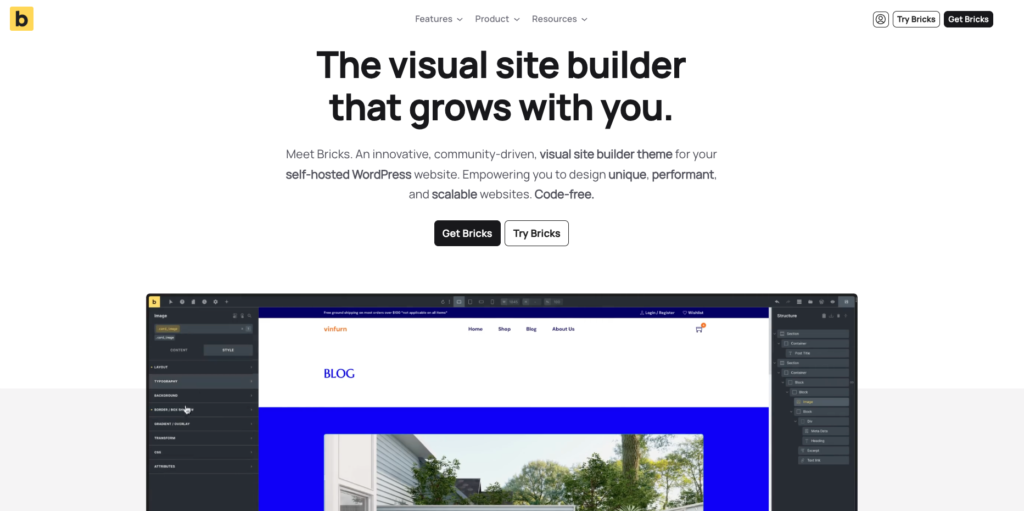
Bricks Builder is fast. It’s clean. It respects performance. It avoids unnecessary abstractions. Compared to most page builders, Bricks feels closer to how WordPress should work.
But once a site grows beyond a few pages, a different problem appears. Template management starts eating time.
Headers, footers, single templates, archives, condition-based layouts- Bricks encourages modular design, which is a good thing. But managing all those templates from the WordPress admin still involves navigating lists, opening edit screens, and jumping between post types just to perform basic actions.
This is why developers and agencies search for things like how to manage Bricks templates, Bricks builder workflow optimization, and manage Bricks templates faster. The problem isn’t building layouts. It’s everything around managing them.
So, What Bricks Builder Is?
Bricks Builder is a performance-focused WordPress site builder designed for developers, agencies, and power users. It emphasizes clean output, native WordPress concepts, and speed- both on the frontend and inside the editor.
Bricks excels at building layouts. Where friction still exists is admin-side template management, especially on complex or long-running projects.
This article focuses on that exact gap and how Commandify removes admin friction without changing how Bricks works.
Why Managing Bricks Templates Becomes Slower as Projects Grow
Bricks projects rarely stay small.
A typical Bricks-based site quickly accumulates:
Multiple headers and footers
Conditional templates for posts, pages, and CPTs
Reusable sections
Design variants for different layouts
Bricks handles this architecture well, but WordPress admin still treats templates as entries in post lists. Finding the right template means navigating to the correct post type, filtering, scrolling, and opening edit screens just to confirm what you’re looking at.
This is where Bricks builder workflow optimization becomes a real concern. The more structured your site becomes, the more time you spend managing that structure instead of improving it.
Finding the Right Bricks Template Takes Too Many Steps
Most Bricks users don’t forget how they built a template — they forget where it lives.
You might remember:
What the template does
Which conditions it applies to
Roughly what it’s called
But you still need to:
Open the correct admin screen
Search or filter manually
Open the template to confirm it’s the right one
This repeated navigation breaks focus and wastes time, especially when you’re jumping between templates during development or QA.
That’s why developers ask how to manage Bricks templates faster. The delay happens before editing even begins.
Simple Bricks Template Actions Still Require Full Admin Navigation
Many Bricks template tasks are administrative, not creative.
Renaming a template, duplicating it, exporting it, or creating a new template does not require deep layout work. Yet these actions still live behind admin screens that force you to navigate away from what you were doing.
On busy projects, this discourages proper template management. Developers delay cleanup. Agencies tolerate messy template lists. Over time, technical debt builds up- not because Bricks is limited, but because admin workflows are slow.
This is one of the biggest productivity gaps Bricks Builder users experience once projects scale.
Context Switching Hurts Bricks Workflows More Than It Seems
Bricks users tend to work deeply and methodically. Interruptions hurt more here than in visual-first builders.
A typical workflow looks like:
Editing a page
Realizing the change belongs in a template
Navigating to the template list
Opening the template
Making the change
Returning to the original context
Each switch resets mental focus. Over time, this slows development more than the actual editing time.
This is why Bricks builder productivity tips often focus on workflow rather than design tricks. Bricks users value control and speed — admin friction goes directly against that philosophy.
Why “Just Use Better Naming” Doesn’t Solve the Problem
Template naming matters, but it’s not enough.
Even with perfect naming conventions, you still need to navigate WordPress admin screens, wait for lists to load, and open edit views just to perform simple tasks. The friction remains.
The real issue is not organization. The real issue is how much effort it takes to act on templates.
If you want to genuinely manage Bricks templates faster, the solution must reduce interaction cost — not just improve structure.
Where This Becomes a Serious Problem for Agencies
Agencies feel Bricks admin friction more than solo developers.
They manage:
Multiple Bricks sites
Long-lived projects
Evolving template structures
Ongoing maintenance and QA
Small inefficiencies compound quickly when repeated across clients. Over time, admin friction becomes a hidden cost.
That’s why agencies actively look for Bricks builder workflow optimization instead of new design features. They already trust Bricks for building. They want faster ways to manage what they’ve built.
How Commandify Removes Admin Friction From Bricks Builder Workflows
Bricks Builder already solves the hardest part of WordPress site building: performance, structure, and clean output. Most developers who choose Bricks do so because they want fewer abstractions and more control.
Where friction still exists is admin-side template management.
As projects grow, managing headers, footers, single templates, archive layouts, and conditional logic becomes an operational task. You spend less time building layouts and more time navigating WordPress admin screens just to find, open, or manage templates.
This is exactly where Commandify fits into Bricks workflows.
Commandify doesn’t modify how Bricks works. It doesn’t replace Bricks’ logic, conditions, or editor. Instead, it removes the unnecessary steps between you and the template you want to work on.
Managing Bricks Templates Faster Through Direct Search and Actions
The most immediate improvement Commandify brings to Bricks Builder is direct access.
Instead of navigating to the Bricks templates post type, filtering lists, and opening templates to confirm context, you can search Bricks templates directly and act on them immediately. This changes how template management feels in day-to-day work.
For developers asking how to manage Bricks templates, this matters because access speed determines workflow speed. When templates are easy to reach, small changes no longer feel disruptive. You stay focused on solving problems instead of navigating menus.
This is one of the fastest ways to manage Bricks templates faster without changing your existing site structure.
Handling Bricks Template Actions Without Leaving Your Flow
Many Bricks-related tasks are administrative, not creative.
Renaming templates, duplicating them, exporting layouts, creating new templates, or managing existing ones does not require the visual editor. Yet default workflows still push these actions behind admin screens and edit views.
Commandify surfaces these actions directly. You can manage templates without breaking your flow or loading interfaces you don’t need. This is especially important for developers who value efficiency and minimal context switching.
For agencies, this also means non-design tasks can be handled quickly without interfering with active development work.
Respecting Bricks’ Native Structure and Post Types
One reason Bricks appeals to advanced users is its respect for WordPress-native concepts. Templates are structured logically. Conditions are explicit. Post types are meaningful.
Commandify respects this structure completely.
It does not flatten or abstract Bricks’ logic. Instead, it works with Bricks’ post types and template architecture, allowing you to access and manage templates without sacrificing clarity or control.
This makes it a natural fit for Bricks builder workflow optimization, rather than a layer that complicates existing systems.
Faster Cache and CSS Management for Bricks Projects
As Bricks projects grow, cache and CSS regeneration become routine tasks. Developers frequently need to clear caches or regenerate styles after making template-level changes, especially on complex or condition-heavy sites.
Navigating to the correct settings screen for these tasks interrupts workflow and adds unnecessary steps.
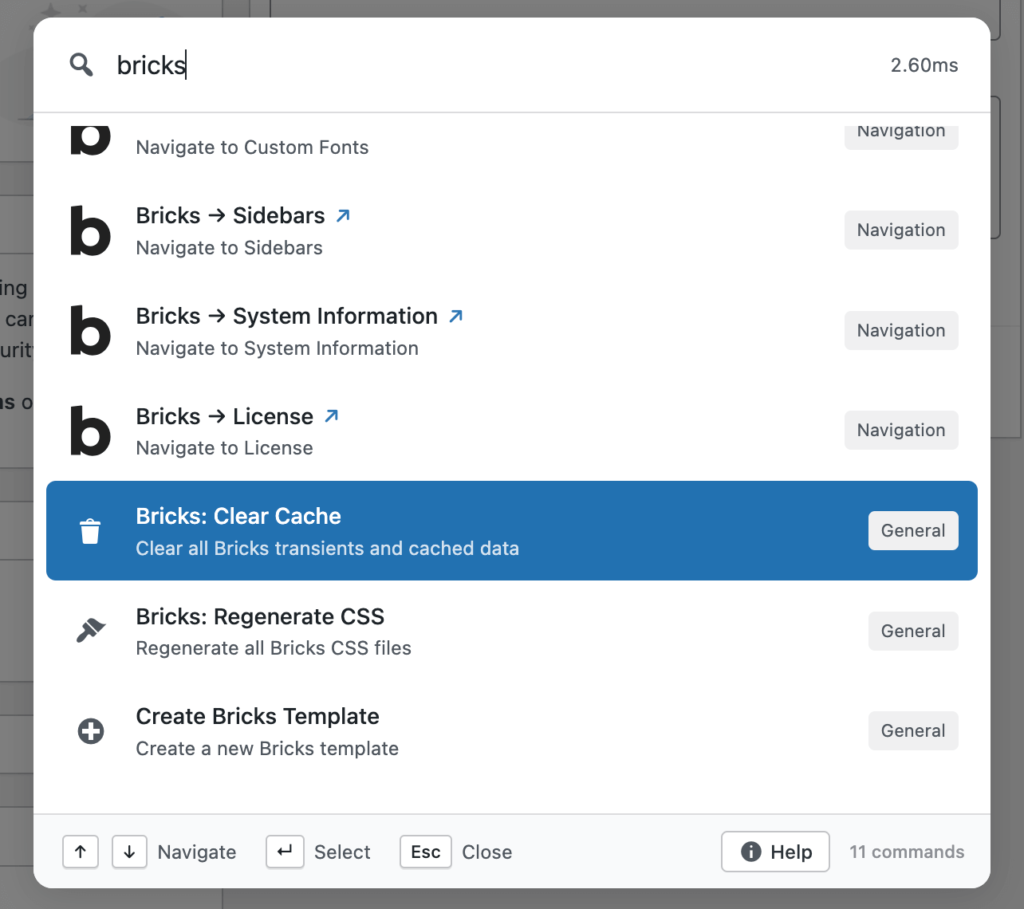
Commandify brings these maintenance actions closer to where you work. Instead of leaving your current context, you trigger them directly when needed. This keeps development smooth and reduces the mental overhead of remembering where each maintenance action lives.
For long-running projects, this alone saves noticeable time.
Why This Improves Long-Term Maintainability for Bricks Sites
Faster admin workflows don’t just save time — they change behavior.
When managing templates is easy:
Developers refactor more often
Template naming stays clean
Duplicates are handled properly
Technical debt is reduced instead of ignored
This is an overlooked benefit of learning how to manage Bricks templates faster. When friction is removed, teams maintain healthier projects over time.
Commandify supports this by making good maintenance habits easier to follow.
When Commandify Makes the Biggest Difference for Bricks Users
Commandify delivers the most value for Bricks users when:
Projects rely heavily on conditional templates
Multiple templates are updated regularly
Agencies manage Bricks across client sites
QA and revisions are frequent
Admin-side work consumes more time than layout building
If Bricks feels fast while building but slow while managing, this is the exact gap Commandify is designed to close.
Managing Bricks Templates Faster Starts With How You Access Them
The biggest slowdown in Bricks projects rarely happens while building layouts. It happens before you even start editing. Finding the right template is often the first point of friction, especially on sites with layered template logic and multiple conditions.
In real Bricks projects, templates are spread across headers, footers, single layouts, archives, and reusable sections. Even when naming is consistent, you still have to navigate the correct post type, search manually, and open templates just to confirm you’re in the right place. This is why developers ask how to manage Bricks templates more efficiently — they are losing time before real work begins.
Commandify changes this access pattern by allowing templates to be searched and surfaced directly. Instead of navigating through admin menus, you move straight from intent to action. This dramatically reduces the friction involved in locating templates and is one of the fastest ways to manage Bricks templates faster on complex sites.
Reducing Context Switching Between Pages and Templates
Context switching is one of the most underestimated productivity drains in Bricks workflows. Bricks users tend to work deeply and methodically, which means interruptions are more costly than they appear on the surface.
A common scenario looks like this: you’re editing a page, notice a layout issue, and realize the fix belongs in a template. To apply the fix, you must leave the page, navigate to the templates screen, locate the correct template, open it, make the change, then return to the original context. Each step breaks focus and resets momentum.
This is why Bricks builder workflow optimization matters more than UI polish. Commandify reduces context switching by keeping template access closer to where you already are. You spend less time navigating and more time fixing problems, which is exactly what Bricks users value.
Handling Bricks Template Actions Without Manual Navigation
Many tasks involved in managing Bricks templates are administrative rather than creative. Renaming templates, duplicating them, exporting them, or creating new ones does not require visual editing, yet default workflows still force you through full admin screens.
Over time, this leads to friction that discourages good maintenance habits. Developers delay cleanup. Agencies accept cluttered template lists. Technical debt builds up quietly, not because Bricks lacks features, but because managing templates takes more effort than it should.
Commandify addresses this by making template actions directly accessible. Instead of navigating to the template list and opening edit screens, you can perform common actions immediately. This is a core reason why teams looking for Bricks builder productivity tips gravitate toward workflow-level improvements rather than design tricks.
Respecting Bricks Template Post Types and Conditions
One of Bricks’ strengths is its respect for WordPress-native concepts like post types and conditional logic. Templates are structured and predictable, which developers appreciate. However, this structure also means templates are spread across different contexts in the admin.
Manually navigating these contexts slows things down, especially when switching between template types frequently. Commandify respects Bricks’ post type structure and conditions while reducing the effort required to work with them. You don’t lose control or flexibility — you simply reach what you need faster.
This balance is important for advanced users who want Bricks builder workflow optimization without sacrificing the principles that make Bricks appealing in the first place.
Keeping Bricks Projects Clean as They Scale
Template sprawl is inevitable on long-running Bricks projects. Over time, layouts evolve, conditions change, and older templates need to be duplicated or adjusted rather than rebuilt.
When admin workflows are slow, teams avoid refactoring. Messy structures persist because cleanup feels disruptive. Faster access changes this behavior. When templates are easy to find and manage, developers are more willing to keep projects clean and maintainable.
This is an overlooked benefit of learning how to manage Bricks templates faster. It doesn’t just save time — it encourages better long-term project hygiene.
Why Faster Admin Work Matters More Than Faster Building
Bricks is already fast where it matters most: the builder and the frontend. What slows projects down is the cumulative cost of admin interactions repeated hundreds of times over a project’s lifespan.
When admin friction is reduced, development feels smoother even if the builder itself hasn’t changed. This is why improving admin workflows often has a bigger impact than adding new builder features.
Commandify fits naturally into this philosophy. It doesn’t compete with Bricks. It complements it by removing the friction Bricks intentionally doesn’t try to solve.
FAQs on Bricks Builder and Commandify Command Palette
Does Commandify replace Bricks Builder?
No. Bricks Builder remains your site builder. Commandify only improves how you access and manage Bricks templates and actions in the WordPress admin.
Can Commandify really help manage Bricks templates faster?
Yes. By reducing admin navigation and surfacing template actions directly, Commandify significantly improves how quickly developers can manage Bricks templates.
Does Commandify change how Bricks templates work?
No. Bricks templates, conditions, and post types remain unchanged. Commandify works on top of existing structures.
Is this useful for solo developers?
Yes, but the biggest gains appear on larger projects and agency environments where template management happens daily.
Is this safe for client and production sites?
Yes. Commandify respects permissions and does not modify Bricks data structures or rendering logic.
Final Thoughts on How to Manage Bricks Builder Templates with Ease
Bricks Builder already delivers speed where it matters most: clean output, fast editing, and performance-focused design.
What slows teams down is everything around template management as projects scale.
If your goal is to manage Bricks templates faster, reduce admin friction, and keep development workflows efficient over time, improving how you work with Bricks inside WordPress admin is the most effective step you can take.
Commandify doesn’t compete with Bricks. It completes the workflow Bricks users expect.
If you run a WooCommerce store long enough, this feeling becomes unavoidable.
Orders keep coming in. Support tickets start stacking up. Products need updates. Customers email with order numbers you don’t recognize immediately. Your day slowly turns into a cycle of opening admin pages, waiting for screens to load, searching again, and repeating the same steps over and over.
For agencies, this problem multiplies. One moment you’re checking an order issue on a client store. The next moment you’re updating product details on another. Each task is small on its own, but the constant context switching drains time and focus.
Most store owners don’t struggle because WooCommerce is difficult to use. They struggle because WooCommerce admin workflows weren’t designed for speed once a store grows.
Before we go further, let’s quickly align on what WooCommerce is and why this problem exists.
What is WooCommerce?
WooCommerce is the most widely used eCommerce plugin for WordPress. It gives you complete control over products, orders, customers, payments, and store settings.
It’s extremely flexible and powerful. But that flexibility comes with a tradeoff.
As soon as your store moves beyond a small catalog or a few weekly orders, managing WooCommerce from the WordPress admin becomes slower and more click-heavy than it should be.
In this article, we’ll focus on the practical side of running a WooCommerce store and show how Commandify helps store owners and agencies deal with these daily admin challenges faster and with less friction.
Why Managing WooCommerce Orders Feels Slow in Real Life
Orders are where WooCommerce admin friction becomes obvious first.
On the surface, order management seems simple. You open the orders screen, find the order, and take action. But when you’re doing this dozens of times a day, the inefficiencies start to hurt.
Each order interaction usually involves:
Loading the orders list
Searching or filtering
Opening an order
Going back to the list
Repeating the same steps again
For busy stores, this process adds up quickly. That’s why store owners often search for things like how to manage WooCommerce orders efficiently or WooCommerce order management tips. They’re not looking for new features- they’re trying to reduce wasted time.
The problem isn’t that WooCommerce lacks order tools. It’s that every action requires a full screen change, even when the task itself is small.
Why Order IDs Slow Down Support Workflows
In real support conversations, customers rarely describe their order in detail. They reference numbers.
A typical message looks like this:
“Order #4921 hasn’t shipped yet.”
From a support perspective, this is clear. From a WooCommerce admin perspective, it still means multiple steps.
You have to:
Copy the order ID
Open the orders screen
Paste the ID into the search
Wait for results
Open the order
Go back again
When this happens occasionally, it’s fine. When it happens all day, it becomes exhausting. This is especially painful for agencies and stores with dedicated support teams, where order IDs are constantly passed through emails, chats, or ticket systems.
WooCommerce doesn’t treat ID-based workflows as a first-class experience, even though that’s how real teams work.
Product Management Becomes Frustrating as the Catalog Grows
Product management is the next major slowdown point.
As long as you have a small catalog, WooCommerce product screens feel manageable. But once products grow into the hundreds — with variations, pricing updates, stock changes, and marketing tweaks — the admin experience starts to feel heavy.
This is why store owners ask how to manage WooCommerce products faster or is there a quicker way to update WooCommerce products.
The core issue is not missing features. It’s that even simple product actions require full editor screens, which slows down everyday operations.
Why Managing WooCommerce Customers Breaks Focus
Customer management is often overlooked, but it quietly consumes a lot of time.
In WooCommerce, customers and orders are closely related, but the admin interface separates them across different screens. This makes sense structurally, but it creates friction during real support or operations work.
Typical scenarios include:
Checking a customer’s order history
Verifying billing or shipping details
Confirming who placed a specific order
Each of these actions involves switching screens, scrolling, and navigating back and forth. For support teams, this constant movement interrupts focus and slows down response time.
That’s why queries like manage WooCommerce customers easily keep appearing. Store owners aren’t asking for new customer features — they want faster access to existing information.
How Commandify Solves Real WooCommerce Admin Challenges
Most WooCommerce admin pain doesn’t come from missing features. It comes from how long it takes to reach the feature you already need.
WooCommerce gives you everything required to run a store, but it expects you to navigate through multiple screens, lists, and editors for even the smallest task. That approach works for occasional updates, but it breaks down when WooCommerce becomes part of daily operations.
This is where Commandify fits naturally into WooCommerce workflows.
Commandify doesn’t replace WooCommerce. It doesn’t change how orders, products, or customers work. Instead, it adds a faster interaction layer on top of WooCommerce so you can search less, click less, and act faster.
Managing WooCommerce Orders Directly From One Command
Order management is the first place most users notice the difference.
With Commandify, orders are no longer something you have to navigate to. They become something you can access directly.
Instead of opening the WooCommerce orders screen every time, you can:
Search orders instantly
Open orders using order IDs
Jump into order actions without browsing long lists
This is especially useful for support teams and store owners handling live issues. When someone sends you an order number, you don’t need to mentally switch into “admin navigation mode.” You simply act on the order.
For anyone trying to manage WooCommerce orders efficiently, this removes the biggest source of admin friction: unnecessary page loads.
Faster WooCommerce Product and Variation Management
Product management becomes repetitive very quickly on active stores.
Price changes, stock updates, variation fixes, and quick edits all require opening product editors in default WooCommerce workflows. While that’s fine occasionally, it slows things down when these tasks happen every day.
Letting you jump straight into relevant product actions
Reducing the need to load full product editors for small updates
Search product commandList and search productEach product action command
For stores with large catalogs or frequent product changes, this directly helps manage WooCommerce products faster without introducing risky bulk operations or complex automation.
Variations benefit even more from this approach. Instead of scrolling through long variation panels, you spend more time acting and less time searching.
Managing WooCommerce Customers Without Jumping Between Screens
Customer-related tasks often interrupt support workflows.
You might start with an order, then need to:
Check customer details
Review past orders
Confirm billing or shipping information
Search customerSearch and list customerCustomer action command
Default WooCommerce admin flows separate these steps across multiple screens, which breaks focus and slows down responses.
Commandify makes customer access more direct by allowing you to:
Search customers quickly
Move between customer and order context without manual navigation
Spend less time clicking and more time resolving issues
This is particularly valuable for stores offering live support or agencies handling WooCommerce support for multiple clients. It’s a practical improvement for anyone trying to manage WooCommerce customers easily without adding more tools.
Why This Approach Works Better Than Traditional WooCommerce “Optimizations”
Many WooCommerce productivity tips focus on surface-level improvements:
Better filters
Saved views
Browser bookmarks
Extra admin plugins
While these help slightly, they don’t change the underlying workflow. You still have to navigate to the same screens and wait for the same pages to load.
Commandify works differently.
Instead of optimizing individual screens, it reduces how often you need to open those screens at all. That’s why it feels faster even though WooCommerce itself hasn’t changed.
This is also why Commandify works well for:
Growing stores
High-order-volume sites
Agencies managing multiple WooCommerce installs
It improves speed without increasing complexity.
When Commandify Makes the Biggest Difference for WooCommerce
Commandify is useful on any WooCommerce site, but its impact is strongest when:
Orders are handled daily, not weekly
Support tickets reference order IDs frequently
Products require frequent updates
Multiple people work inside the WooCommerce admin
Agencies manage WooCommerce for clients
If you’ve ever felt that WooCommerce admin slows you down more as your store grows, this is exactly the scenario Commandify is designed for.
Why Small Admin Tweaks Don’t Fix the Real Problem
Many store owners try to work around these issues by using filters, browser bookmarks, or opening multiple tabs. While these tricks help slightly, they don’t address the real bottleneck.
The real slowdown comes from how you access and act on WooCommerce data, not from missing features or poor organization.
What’s needed isn’t another dashboard or settings screen. It’s a faster way to interact with WooCommerce itself.
This is where Commandify changes the experience- not by replacing WooCommerce, but by giving you a smarter, faster layer on top of it.
Faster WooCommerce Order Management Without Constant Screen Switching
Once a store reaches a certain volume, the biggest time drain is no longer order fulfillment itself. It’s finding and opening orders repeatedly.
Most WooCommerce store owners and support teams don’t process orders in batches. They react to issues as they come in. A delayed shipment. A missing address. A refund request. Each request usually references an order number, not a product name or customer name.
This is why people search for how to manage WooCommerce orders efficiently rather than “how to create orders.” Creation isn’t the problem. Access speed is.
With default WooCommerce admin workflows, every order-related task forces you through the same steps:
Load the orders table
Search or filter
Open the order
Navigate back again
That repetition becomes a bottleneck when you’re handling support, logistics, or agency work.
Using Commandify, order management becomes more direct. Instead of navigating to the orders screen first, you can search and open orders immediately, using natural input or order IDs. This approach removes several unnecessary page loads and lets you focus on resolving the issue instead of navigating the admin.
For busy stores, this alone significantly improves WooCommerce order management efficiency.
Working With Order IDs the Way Support Teams Actually Do
Order IDs are how real teams communicate.
Support agents paste order numbers into chat tools. Agencies receive order references via tickets. Store owners scan order IDs from emails or invoices. But WooCommerce treats order IDs as a secondary lookup method rather than a primary workflow.
That mismatch creates friction.
Commandify closes this gap by letting you work ID-first, which is how support teams naturally operate. When you paste or type an order ID, the system understands your intent and surfaces the relevant order actions instantly.
This matters because:
You don’t need to remember where the order lives
You don’t need to load the full orders list
You don’t lose focus switching screens
For anyone looking to manage WooCommerce orders efficiently, this change alone saves a noticeable amount of time every day.
Managing WooCommerce Products Faster Without Opening the Editor Repeatedly
Products are the second major source of admin slowdown.
As your catalog grows, product management shifts from occasional updates to frequent, small changes. Adjusting prices. Updating stock. Checking variations. Responding to marketing or support requests.
Store owners often search how to manage WooCommerce products faster because the default workflow is heavy for these quick tasks.
Each product update usually requires:
Opening the products list
Searching by name
Loading the product editor
Waiting for variations to load
Making one small change
Updating and closing
This workflow isn’t inefficient because WooCommerce lacks features. It’s inefficient because every small task requires a full editor load.
Commandify improves this by making products searchable and actionable without forcing you through the entire product editor every time. You can locate products instantly, jump to relevant actions, and handle repetitive product tasks with fewer interruptions.
For stores with frequent price or stock changes, this dramatically speeds up WooCommerce product management.
Handling Variations Without Losing Time and Context
Product variations are where WooCommerce admin friction becomes even more obvious.
Managing variations often means:
Scrolling through long product pages
Waiting for variation panels to expand
Searching manually for the correct option
This process is slow, especially when you’re making quick fixes rather than bulk updates.
Commandify reduces this friction by keeping variation-related actions closer to search and context. Instead of digging through nested panels, you can move directly to what you need, making variation management faster and less mentally taxing.
This approach is particularly valuable for:
Apparel stores
Subscription products
Stores with complex option sets
It’s a practical improvement for anyone trying to speed up WooCommerce admin workflows.
Managing WooCommerce Customers Without Breaking Focus
Customer-related tasks are often scattered across different parts of the WooCommerce admin.
In real workflows, you might need to:
Check a customer’s past orders
Verify billing or shipping details
Confirm account information during support calls
Default WooCommerce workflows require you to jump between order screens and customer profiles repeatedly. This constant switching slows down response time and increases the chance of mistakes.
That’s why queries like manage WooCommerce customers easily are common.
Search customer
Commandify makes customer lookups more direct. Instead of navigating through multiple admin pages, you can search customers quickly and move between related data without losing context. This is especially useful for support teams who need fast answers rather than deep reports.
The result is smoother customer handling and faster issue resolution.
Daily WooCommerce Tasks That Become Noticeably Faster
When you step back, the real benefit of better WooCommerce admin workflows isn’t one single feature. It’s the cumulative time saved across dozens of small tasks.
With a faster workflow, tasks like these take less effort:
Checking order status during support conversations
Opening orders by ID from tickets or emails
Locating products to make quick updates
Reviewing customer details without navigating away
Switching between multiple WooCommerce stores (for agencies)
These improvements don’t change how WooCommerce works. They change how quickly you can work with it.
For anyone searching for WooCommerce admin workflow optimization, this is the level where productivity gains become real and measurable.
Why This Matters More for Agencies and Growing Stores
Small stores can tolerate slower admin workflows. Growing stores can’t.
As soon as you introduce:
Dedicated support roles
Multiple admins
Agency-managed stores
High order volume
Admin speed becomes part of your operational cost.
Agencies, in particular, benefit from workflows that reduce friction. When you manage several WooCommerce sites, even small inefficiencies multiply quickly.
That’s why tools that help speed up WooCommerce admin without changing store logic are especially valuable at scale.
FAQs on WooCommerce and Commandify
Is Commandify a replacement for WooCommerce?
No. WooCommerce remains your eCommerce engine. Commandify simply gives you a faster way to interact with WooCommerce data and actions from the WordPress admin.
Can Commandify help manage WooCommerce orders faster?
Yes. Commandify allows faster access to orders, including opening orders directly by ID and reducing the need to browse order lists repeatedly.
Does Commandify change how WooCommerce data is stored?
No. All orders, products, and customers remain managed by WooCommerce exactly as before. Commandify only improves access and workflow.
Is Commandify useful for small WooCommerce stores?
It can be, but the biggest gains appear as stores grow. If you handle orders and products occasionally, the difference is smaller. If WooCommerce is part of daily operations, the improvement is noticeable.
Can agencies use Commandify across multiple WooCommerce sites?
Yes. Agencies benefit significantly because small time savings multiply across client sites, especially when handling support or product updates.
Does using Commandify slow down WooCommerce admin?
No. Commandify is designed to be lightweight and focuses on reducing admin interactions rather than adding heavy dashboards.
Final Takeaway on How to Manage WooCommerce Orders Easily with Commandify
WooCommerce isn’t slow because it’s poorly built. It’s slow because it was designed for capability first, not speed at scale.
As your store grows, managing orders, products, and customers becomes an operational task, not an occasional admin chore. That’s when workflow efficiency starts to matter more than new features.
Commandify doesn’t add complexity to WooCommerce. It removes friction from how you work with it.
If your goal is to manage WooCommerce orders efficiently, manage WooCommerce products faster, and handle customers without constant screen switching, improving your workflow is the most effective place to start.
Fluent Forms is chosen because it’s fast, flexible, and powerful. Creating forms is smooth. Adding conditional logic is easy. Payment integrations work reliably. Everything feels well thought out at the form-building level.
The problem starts later.
Once forms go live and submissions start coming in every day, managing those entries becomes a different kind of task. Support messages arrive through forms. Leads come in with partial details. Payments are attached to submissions. Someone on your team asks to check a specific entry using only an email address or an entry ID.
At this point, Fluent Forms stops feeling lightweight. Not because it’s poorly built, but because handling entries and transactions inside WordPress admin requires too much navigation.
This is why users actively search things like how to manage Fluent Forms entries, Fluent Forms entry management, and manage Fluent Forms transactions.
The issue isn’t form creation. It’s what happens after forms start doing real work.
This article focuses on that gap and how Commandify removes unnecessary admin friction without changing how Fluent Forms works.
What is Fluent Forms?
Fluent Forms is a feature-rich WordPress form builder used for contact forms, lead generation, surveys, and payment forms. It supports complex workflows, integrations, and transactions without feeling heavy during setup.
Fluent Forms performs well when building forms. Where friction appears is admin-side entry and transaction management, especially on sites handling regular submissions or payments.
Why Managing Fluent Forms Entries Feels Slower Over Time
At low volume, Fluent Forms entry management feels manageable. You open the entries screen, select a form, and review submissions.
As volume increases, the workflow breaks down.
Entries accumulate across multiple forms. Support and sales requests mix together. Searching for a specific submission requires remembering which form it came from. Even small tasks like checking a message by email take longer than expected.
This is the moment users start asking how to manage Fluent Forms entries more efficiently. The pain isn’t missing data — it’s slow access to existing data.
Each lookup involves:
Navigating to Fluent Forms
Selecting the correct form
Opening the entries list
Searching manually
Opening entries one by one
Repeated dozens of times a day, this becomes a serious productivity drain.
The Entry Lookup Problem: Email and ID-Based Searches
Real support and sales workflows rarely begin with form names.
They begin with:
An email address
An entry ID
A payment reference
A follow-up message
Default Fluent Forms workflows assume you’ll browse entries visually. That assumption doesn’t hold up when teams are responding to tickets, emails, or live chat messages.
This is why Fluent Forms entry management becomes frustrating as sites grow. Searching by email or entry ID should be instant, but instead it requires navigating through multiple screens and filters.
The more support-driven the site becomes, the more painful this workflow feels.
Managing Multiple Forms Makes Entry Handling Worse
Most real-world sites don’t rely on a single form.
They run:
Contact forms
Support forms
Quote or booking forms
Payment or checkout forms
Internal forms for operations
Each form has its own entries. Fluent Forms organizes them correctly, but switching between forms slows teams down. Admins often forget which form a submission came from, forcing them to repeat searches across multiple entry lists.
This is why users search how to manage Fluent Forms entries rather than “how to create forms.” The problem is not form logic. It’s navigating through form-based silos to find one submission.
Fluent Forms Transactions Add Another Layer of Friction
When payments enter the picture, complexity increases.
Fluent Forms handles transactions reliably, but managing them alongside entries introduces more navigation. Teams need to:
Verify payments
Match transactions to entries
Confirm details during support conversations
Default workflows require jumping between entry views and transaction screens. This breaks focus and slows response time, especially for finance or operations teams.
That’s why manage Fluent Forms transactions is a common query. The data exists. The challenge is reaching it quickly when needed.
Why Common Fluent Forms “Tips” Don’t Fix the Real Issue
Most Fluent Forms advice focuses on:
Form optimization
Conditional logic
Integrations
Spam prevention
These are useful, but they don’t address the core admin problem: handling entries and transactions efficiently after they arrive.
Even with perfect forms, teams still lose time navigating admin screens. This is why workflow-level improvements matter more than configuration tweaks once forms become part of daily operations.
Where Fluent Forms Management Hurts Agencies and Teams Most
Agencies and teams feel this pain more sharply than solo site owners.
They manage:
Multiple client sites
Multiple forms per site
Ongoing support and sales inquiries
Payment-related questions
Small inefficiencies multiply across clients. Over time, entry management becomes a hidden cost.
This is why agencies actively look for better Fluent Forms entry management workflows instead of switching form plugins. They don’t want to replace Fluent Forms. They want to work with it faster.
How Commandify Fixes Fluent Forms Entry and Transaction Management
At this point, the underlying issue with Fluent Forms workflows should be clear.
Fluent Forms does an excellent job at building forms, handling logic, and processing submissions. Entries and transactions are stored reliably, and the plugin scales well from a technical standpoint.
What slows teams down is how much effort it takes to reach and act on that data inside the WordPress admin.
This is where Commandify fits naturally into Fluent Forms workflows.
Commandify does not replace Fluent Forms. It does not interfere with how forms, entries, or transactions are stored. Instead, it removes the admin friction that appears once Fluent Forms becomes part of daily operations.
Managing Fluent Forms Entries Faster Through Direct Search
The most common Fluent Forms task is also the slowest: finding a specific entry.
Support teams look up submissions by email. Sales teams search for leads by name. Admins reference entry IDs from tickets or messages. Default workflows force users to navigate through form lists and entry tables before they can even begin searching.
Instead of navigating into Fluent Forms first, you start with the intent. You search for the entry directly and reach it immediately.
This removes several admin steps and significantly improves Fluent Forms entry management, especially on sites handling regular submissions.
For anyone asking how to manage Fluent Forms entries, this shift from navigation-driven to search-driven workflows is the biggest time saver.
Working With Fluent Forms Transactions Without Context Switching
Transactions introduce another layer of complexity to form management. Payments are often tied to submissions, but reviewing both requires moving between different screens. This breaks focus and slows down finance, operations, and support teams.
Commandify keeps transaction access close to entry access. Instead of jumping between dashboards, you move directly to the transaction or submission you need. This reduces context switching and helps teams verify payments, confirm details, and respond to inquiries faster.
For sites processing payments through forms, this is one of the most effective ways to manage Fluent Forms transactions without adding new tools or workflows.
Handling High-Volume Fluent Forms Workflows With Less Friction
As submission volume increases, small inefficiencies multiply quickly.
Teams that handle dozens or hundreds of entries per week don’t struggle because Fluent Forms lacks features. They struggle because admin navigation doesn’t scale well with volume.
Commandify improves Fluent Forms workflows by reducing the cost of each interaction:
Fewer clicks
Fewer screen loads
Faster access to entries and transactions
Over time, this changes how Fluent Forms feels to use. It becomes easier to manage at scale, rather than more frustrating as usage grows.
Why This Approach Works Better Than Traditional Fluent Forms Optimizations
Most Fluent Forms optimization advice focuses on form setup:
Better conditional logic
Smarter field validation
Improved spam protection
These are important, but they don’t address the biggest admin pain: handling entries and transactions efficiently after they arrive.
Commandify works because it targets the workflow layer, not the form layer. It improves how you interact with Fluent Forms data without changing how that data is created or stored. This makes it a sustainable improvement rather than another configuration tweak.
Finding Fluent Forms Entries Faster with Commandify When You Only Have an Email or Entry ID
One of the most common breakdowns in Fluent Forms workflows happens at the exact moment speed matters most. A customer replies to an email. A lead follows up on a form submission. A support ticket references an entry ID. In all of these cases, the team handling the request rarely starts with the form name. They start with an email address or an ID.
Default Fluent Forms workflows don’t align well with this reality. To find a single submission, admins still need to navigate into Fluent Forms, select the correct form, open the entries list, and then search manually. This process works, but it’s slow when repeated frequently.
That’s why users keep searching how to manage Fluent Forms entries more efficiently. The pain comes from lookup speed, not from missing features.
Using Commandify, entry lookup becomes intent-driven instead of navigation-driven. You search by email or entry ID directly and reach the submission without stepping through multiple admin screens.
This immediately improves Fluent Forms entry management for support, sales, and operations teams.
Managing Fluent Forms Entries Across Multiple Forms
Most production sites don’t rely on a single form. They run multiple forms for different purposes, often created over time by different people. Contact forms, lead forms, booking forms, internal request forms, and payment forms all live side by side.
Fluent Forms organizes entries by form, which makes sense structurally. But in real workflows, this structure becomes a slowdown. When a team member doesn’t know which form a submission came from, they end up opening multiple entry lists and repeating the same search process.
This is where Fluent Forms entry management starts to feel fragmented. Time is lost not because data is missing, but because it’s siloed by form context. Commandify reduces this friction by letting you search entries without thinking about form structure first. You focus on the submission you need, not on where it lives.
Handling Fluent Forms Transactions with Commandify Without Breaking Focus
Once payments are involved, entry management becomes more complex. Fluent Forms supports transactions reliably, but managing them alongside entries introduces extra navigation. Teams often need to confirm whether a payment was completed, match it to a submission, or verify details during a support conversation.
In default workflows, this means jumping between entries and transaction screens. Each jump interrupts focus and slows response time. This is why manage Fluent Forms transactions is a recurring search query- the data exists, but accessing it quickly is difficult.
Commandify shortens this workflow by keeping transactions accessible through the same search-driven interface as entries. Instead of navigating through multiple dashboards, teams move directly to the transaction or submission they need. This keeps workflows tight and reduces mental overhead, especially for finance and operations teams.
Reducing Time Spent Switching Between Entries and Payments with Commandify
A common frustration with form-based payment workflows is context loss. You start by reviewing an entry, then switch to a transaction to confirm payment, then return to the entry to respond or take action. Each switch increases the chance of missing details or losing focus.
By improving how quickly entries and transactions are accessed, Commandify reduces unnecessary back-and-forth. You spend less time navigating and more time resolving the task at hand. Over time, this has a noticeable impact on productivity, especially on sites where form payments are part of daily operations.
This is one of the most practical ways to manage Fluent Forms transactions without introducing new tools or changing existing payment setups.
Supporting Sales and Support Teams With Faster Entry Access
Fluent Forms is often the backbone of sales and support workflows. Leads arrive through forms. Support requests come in through forms. Internal teams rely on form data to respond quickly and accurately.
When accessing entries is slow, response time suffers. Leads cool down. Support issues take longer to resolve. This is why improving how to manage Fluent Forms entries has a direct impact on business outcomes, not just admin convenience.
Commandify helps teams respond faster by removing admin friction. Instead of spending time locating submissions, teams can focus on responding, following up, and resolving issues. This is where workflow improvements translate into real operational benefits.
Why Faster Fluent Forms Entry Management Matters as Volume Grows
At low submission volume, Fluent Forms’ default admin experience feels acceptable. As volume increases, the same workflows start to feel restrictive. What once took seconds begins to take minutes, repeated many times throughout the day.
This is the tipping point where teams actively look for better Fluent Forms entry management solutions. They don’t want to replace Fluent Forms. They want to work with it more efficiently as it becomes a critical part of daily operations.
Commandify addresses this growth stage directly. It improves access speed without changing how forms are built or how data is stored, making Fluent Forms easier to manage at scale.
When Commandify Makes the Biggest Difference for Fluent Forms Users
If Fluent Forms has moved from an occasional tool to a daily operational system, improving entry and transaction access becomes essential.
FAQs on Fluent Forms and Commandify Command Palette
Does Commandify replace Fluent Forms?
No. Fluent Forms continues to handle form creation, submissions, and transactions. Commandify only improves how you access and manage that data in the WordPress admin.
Can Commandify help manage Fluent Forms entries faster?
Yes. Commandify reduces admin navigation and allows direct search-based access to entries, which significantly improves Fluent Forms entry management.
Does this change how Fluent Forms stores data?
No. Entries and transactions remain stored exactly as Fluent Forms manages them. Commandify does not duplicate or modify data.
Is this useful for non-payment forms?
Yes. Even on non-payment sites, faster entry lookup and reduced admin friction improve support and sales workflows.
Is this safe for client and production sites?
Yes. Commandify respects WordPress permissions and does not alter Fluent Forms’ internal logic or storage.
Final Takeaway on How to Manage Fluent Forms Entries
Fluent Forms excels at building and processing forms.
What slows teams down is managing entries and transactions once those forms are in active use.
If your goal is to manage Fluent Forms entries more efficiently, manage Fluent Forms transactions without jumping between dashboards, and reduce admin friction as volume grows, improving your workflow is the most effective step you can take.
Commandify doesn’t add complexity to Fluent Forms.
It removes the friction that appears when forms become part of real work.
If you spend a serious part of your day inside the WordPress admin, you already know the problem.
Too many menus. Too many screens. Too many clicks just to get one thing done.
The more plugins you install, the worse it gets.
Developers jump between custom post types, templates, and settings. Agencies switch between multiple client sites all day. WooCommerce store owners dig through orders, products, customers, and reports. Content teams bounce between drafts, pages, media, and plugins.
WordPress is powerful, but it’s not built for speed.
That’s exactly why command palette tools have become one of the most important productivity upgrades for modern WordPress users.
Inspired by macOS Spotlight and VS Code, these tools let you press Cmd/Ctrl + K, type what you want, and jump straight to it. No scrolling. No hunting through menus. No context switching.
This is the space where CommandUI established itself early. And it’s also where Commandify, a newer plugin by wpRigel, is quickly redefining what a command palette can actually do.
This article walks you through a clear, practical comparison:
Where CommandUI excels
Where Commandify goes much deeper
How their philosophies differ
And why Commandify has become a more powerful alternative, not just a replacement
The goal isn’t to crown a winner. It’s to help you choose the tool that genuinely fits how you work inside WordPress.
Why WordPress Command Palette Tools Matter Today
WordPress wasn’t designed with large-scale workflows in mind.
As soon as you move beyond a simple blog, the admin becomes menu-heavy and slow:
WooCommerce adds layers of order and product screens
Page builders introduce separate template systems
Form plugins hide entries behind nested dashboards
Maintenance tasks live in scattered tools and settings
Even experienced users lose time just getting to the right place.
Command palette tools solve this by acting as a single entry point to the entire admin.
Instead of remembering where something lives, you just type what you’re looking for. Instead of clicking through five screens, you jump directly to the task.
Once you use a good command palette for a few days, going back to menu navigation feels outdated.
Editor’s note: WordPress itself now includes a built-in command palette, which shows how essential keyboard-first workflows have become. However, the native palette is intentionally basic, limited to simple navigation and a few editor actions. This is where Commandify steps in. You can disable the default WordPress command palette and replace it with Commandify to unlock action-driven commands, context-aware workflows, and deep integrations that go far beyond what core WordPress is designed to handle today.
CommandUI: What It Brings to the Table
CommandUI entered the WordPress ecosystem at the right time.
It delivered something WordPress users didn’t really have before: a fast, polished, keyboard-first command palette that made admin navigation feel modern.
What CommandUI does well:
Quick global search across posts, pages, plugins, media, and settings
Fast, predictable navigation
Ability to open, edit, preview, or manage content directly
Commandify: A Newer Alternative Built to Go Much Deeper
Commandify is a WordPress command palette plugin developed by wpRigel, the same team behind Pollify.
What’s interesting is that Commandify wasn’t rushed to market.
It was actually the first plugin wpRigel planned to build, long before Pollify. But once early command palette tools like CommandUI appeared, the team paused and rethought the approach.
Instead of competing on UI polish or basic navigation, they rebuilt Commandify around a bigger idea:
A command palette should not just help you go places. It should help you do real work.
That philosophy shapes everything in Commandify.
Rather than stopping at search and navigation, Commandify was designed as a full WordPress productivity engine, with a strong focus on:
WooCommerce operations
Context-aware workflows
Dynamic pattern recognition (IDs, users, emails)
Action-driven commands
Deep plugin integrations
Based on the current product architecture, Commandify includes:
Global command palette (backend + frontend)
Deep WooCommerce commands (orders, customers, products, variations)
Context-aware command packs that adapt to your screen
Dynamic pattern recognition (#postID, @user, order IDs, emails)
Navigation & Content Access: Similar Speed, Different Intelligence
Both tools solve the same core problem first: getting around WordPress faster.
CommandUI does this extremely well. You open the palette, type a page name, plugin, or setting, and jump there instantly. The experience is consistent, predictable, and fast.
Commandify offers the same speed, but additionally adds context awareness.
That means the commands you see are influenced by where you are:
In the post editor, content-related actions surface first
On product screens, WooCommerce commands become prominent
In list tables, bulk or contextual actions appear automatically
Instead of showing the same list everywhere, Commandify adapts to your workflow in real time.
Verdict:
CommandUI: reliable, static navigation
Commandify: navigation plus contextual intelligence that scales with complexity
WooCommerce Integration: The Biggest Dividing Line
This is where the comparison becomes very clear.
CommandUI does not include WooCommerce-specific workflows. You can navigate to WooCommerce screens, but that’s where it stops.
Commandify, on the other hand, is built with WooCommerce as a first-class use case.
From the command palette, you can:
Search orders and open them instantly
View orders directly using an order ID (#order_id)
Manage order status, notes, and related actions
Search products and variations
Edit stock, price, SKU, duplicate products
Search customers and view order history
Manage customer addresses
For store owners, this removes multiple layers of admin navigation.
For agencies, it cuts response time on support tickets dramatically.
Verdict:
CommandUI: No WooCommerce support
Commandify: full WooCommerce admin control
If your site doesn’t use WooCommerce, this may not matter. If it does, the difference is night and day.
Action Engine Depth: Search vs Action-Driven Workflows
Both plugins can search content. Only one is built around executing actions.
CommandUI focuses on:
Opening pages
Editing content
Navigating to admin screens
Commandify goes further by treating actions as first-class commands.
From the palette, you can:
Toggle WordPress settings
Install or activate plugins and themes
Run maintenance tasks
Manage cache, transients, spam, and rewrites
Execute admin operations without opening full screens
This turns the command palette into a control panel, not just a shortcut menu.
Verdict:
CommandUI: search-first palette
Commandify: action-first productivity system
Dynamic Pattern Recognition: Small Feature, Huge Time Saver
This is a feature CommandUI doesn’t currently offer.
Commandify supports dynamic pattern recognition, meaning it understands structured input like:
#postID to open posts directly
@username to jump to user profiles
Order IDs to open WooCommerce orders
Email addresses to locate customers or form entries
On busy sites, IDs are everywhere — support tickets, Slack messages, internal docs.
Instead of searching manually, you paste the reference and act immediately.
This is especially valuable for:
Agencies
Support teams
Developers
Store managers
Verdict:
CommandUI: natural-language search
Commandify: ID-based, technical, and power-user workflows
Form & Submission Management: Beyond Navigation
CommandUI does not offer form-level integrations.
Commandify includes deep form workflows, including:
Instead of just opening a template, Commandify lets you manage the entire template lifecycle from one shortcut.
Verdict:
CommandUI: builder access
Commandify: builder control
Maintenance & Admin Utilities
This is an area where CommandUI intentionally stays minimal.
Commandify includes a growing set of maintenance tools, such as:
User switching
Clearing transients
Flushing rewrite rules
Regenerating thumbnails
Deleting spam comments
For agencies and developers, these tasks come up constantly — and removing menu navigation saves real time.
Verdict:
CommandUI: minimal admin utilities
Commandify: practical admin toolkit
Performance & Stability: Different Optimizations, Same Speed
Both plugins are fast.
CommandUI feels extremely lightweight and responsive, especially on simpler sites.
Commandify does more, but is designed to stay performant through:
Command grouping
Intelligent loading
Context checks
Caching and readiness logic
In real use, performance is not a deciding factor- both deliver a smooth experience.
Verdict: Tie. Commandify maintains speed even with deeper workflows enabled.
Integration Scope & Ecosystem Direction
CommandUI’s focus remains tight: UI polish and navigation refinement.
Commandify’s roadmap is significantly broader, covering:
Forms (CF7, Fluent Forms, Gravity Forms, WPForms)
Builders (Elementor, Bricks, Beaver Builder)
WooCommerce expansion
LMS platforms
Membership plugins
Custom fields (ACF, Meta Box, JetEngine)
SEO tools
This matters for users who want one tool that grows with their site instead of stacking multiple plugins.
Verdict:
CommandUI = focused scope
Commandify = expanding productivity ecosystem
How to Decide Between CommandUI and Commandify
The simplest way to choose is to look at what slows you down most inside WordPress.
Choose CommandUI If:
You mainly want faster navigation
Your workflow is content-focused (posts, pages, settings)
You don’t rely heavily on WooCommerce
You prefer a minimal, polished UI with fewer moving parts
You want a tool that feels familiar and predictable
If most of your time is spent jumping between screens and editing content, CommandUI does its job well. It’s clean, stable, and efficient for navigation-heavy work.
Choose Commandify If:
You run a WooCommerce store or manage stores for clients
You want to perform real admin actions from the keyboard
Your workflow includes orders, products, users, forms, or maintenance
You rely on IDs, emails, or direct references in daily work
You want commands that adapt based on context
You manage multiple sites or complex setups
You want a tool that keeps expanding, not one that stays narrow
Commandify is not just about getting around WordPress faster. It’s about reducing entire workflows to a few keystrokes.
If WordPress is more than a blog for you, that difference matters.
How Easy Is It to Switch From CommandUI to Commandify?
Switching doesn’t require a migration or setup process.
These plugins don’t lock you in.
You can:
Install Commandify
Use it alongside CommandUI for a few days
See which one your muscle memory naturally reaches for
Because both use Cmd/Ctrl + K, the palette that returns better results quickly becomes the one you rely on.
Commandify’s Smart Default View (favorites, recent, most-used commands) also means it adapts to how you work, not the other way around.
For most users:
CommandUI feels familiar immediately
Commandify feels more powerful after a few days of real use
The Roadmap: Why Commandify Keeps Getting Stronger
One of the biggest reasons users move to Commandify is not just what it does today — but where it’s clearly heading.
According to the product roadmap, Commandify is actively expanding across major WordPress ecosystems:
Commandify doesn’t add integrations just to tick boxes. Each one follows the same action-first design:
searchable
actionable
context-aware
This makes Commandify feel less like a plugin and more like a productivity layer that grows with WordPress itself.
Pricing & Long-Term Value
Pricing is often the deciding factor, especially for agencies.
CommandUI uses a premium-only model. It’s fair for what it offers, but fixed.
Commandify takes a different approach:
Free version available with core functionality
Affordable yearly plans
Lifetime licenses for long-term users and agencies
Check Commandify Yearly Pricing
Check Commandify Lifetime Pricing
For anyone managing multiple sites, lifetime access alone can justify the switch. You’re effectively locking in future integrations and workflows without recurring costs.
That flexibility is rare in productivity tools and it matters as your stack grows.
Why Commandify Is Different and More Powerful Than Other Command Palette Tools
Most WordPress command palette tools are built around a simple idea: help users search faster and navigate menus quicker.
That’s useful. But it’s also where most of them stop.
Commandify is built on a different foundation. Instead of treating the command palette as a search box, Commandify treats it as a control layer for WordPress.
The difference is subtle at first, but dramatic in daily use.
Action-First, Not Search-First
With traditional command palettes (including CommandUI), the flow usually looks like this:
The 7 Action-Driven Command Types That Power Commandify
Commandify supports multiple command types that work together as real workflows. These aren’t surface-level shortcuts — they are how the plugin is architected.
1. Navigation Commands
The foundation. Quickly jump to dashboards, settings pages, tools, or custom admin screens.
This is where Commandify overlaps with other tools — and then builds far beyond.
2. Search Commands
Search across posts, pages, custom post types, users, media, products, forms, entries, and templates from one place.
But unlike search-only palettes, search results in Commandify are actionable, not just links.
3. Action Commands
This is the core difference.
Instead of opening a screen, Commandify lets you do the work directly, such as:
Change post status
Edit or duplicate content
Manage WooCommerce orders
Perform product actions
Handle form submissions
Actions are first-class citizens, not secondary options.
4. Sub-Action (Nested) Commands
Many WordPress tasks involve follow-up steps.
Commandify supports nested actions like:
Emptying trash
Managing templates
Executing secondary admin tasks
Running maintenance operations
You don’t leave the palette to finish a workflow.
5. Dynamic Pattern Recognition Commands
This is where Commandify really shines for power users.
It understands structured input like:
#postID
@username
Order IDs
Email addresses
ffentry:ID for Fluent Forms entries
Paste a reference, and Commandify immediately surfaces the right actions, not just search results.
This is invaluable for agencies, support teams, and store owners dealing with IDs all day.
6. Toggle Commands
Some tasks aren’t about opening or editing — they’re about switching states.
Commandify supports toggle-style commands for things like:
Maintenance mode
Settings states
Feature enable/disable flows
All with immediate feedback.
7. Context-Aware Commands
The same shortcut behaves differently depending on where you are.
In the editor → content actions
On WooCommerce screens → order and product workflows
In list tables → bulk or contextual operations
On the frontend → editing and admin shortcuts
Commands adapt to context automatically, reducing noise and friction.
Deep Integrations That Go Beyond Search
Another key difference: Commandify’s integrations are action-based, not search-only.
Most command palettes integrate by linking you to another plugin’s screen. Commandify integrates by bringing that plugin’s workflows into the palette.
Examples of Action-Based Integrations
WooCommerce Manage orders, products, variations, customers, addresses, and IDs directly.
Forms (CF7, Flamingo, Fluent Forms) Search forms, inspect entries, manage submissions, handle spam, and jump to related content.
Is Commandify just another command palette plugin?
No. While it includes fast navigation and search, Commandify is built around action-driven workflows, contextual commands, and deep integrations that go far beyond navigation.
Can I use Commandify if I don’t run WooCommerce?
Yes. WooCommerce is a major strength, but Commandify is equally useful for content management, builders, forms, maintenance, and admin workflows.
Does Commandify replace CommandUI completely?
Not necessarily. CommandUI is excellent for clean, search-first navigation. Commandify is better suited for users who want to execute actions, manage data, and reduce admin workflows.
Is Commandify suitable for agencies and teams?
Yes. Features like pattern recognition, contextual commands, user switching, and maintenance tools are specifically valuable for agency and support workflows.
Does using all these features slow WordPress down?
No. Commandify is designed with optimized loading, caching, and readiness checks so performance remains stable even with complex integrations.
CommandUI vs Commandify: Detailed Comparison with Full Breakdown
Now explore the detailed head to head comparison on CommandUi vs Commandify. Find out a more powerful alternative to CommandUI with lower price.
Final Thoughts on CommandUI vs Commandify: Which One Actually Makes WordPress Easier?
CommandUI deserves credit. It helped bring keyboard-driven navigation to WordPress and set expectations for what a modern admin experience can feel like.
For many users, it’s still a solid choice.
But Commandify enters the space with a broader vision.
It doesn’t just help you navigate WordPress. It helps you run WordPress.
More actions. More integrations. More control. More room to grow.
If you want a clean, fast navigation palette, CommandUI works.
If you want a more powerful alternative that turns WordPress into a command-driven workspace (especially for WooCommerce, agencies, and advanced sites) Commandify is the stronger long-term fit.
Both tools improve WordPress. Only one is built to scale with everything WordPress is becoming.