

wprigel logo
  • Home
  • Products
    • krom-automation-icon

      Krom Automation

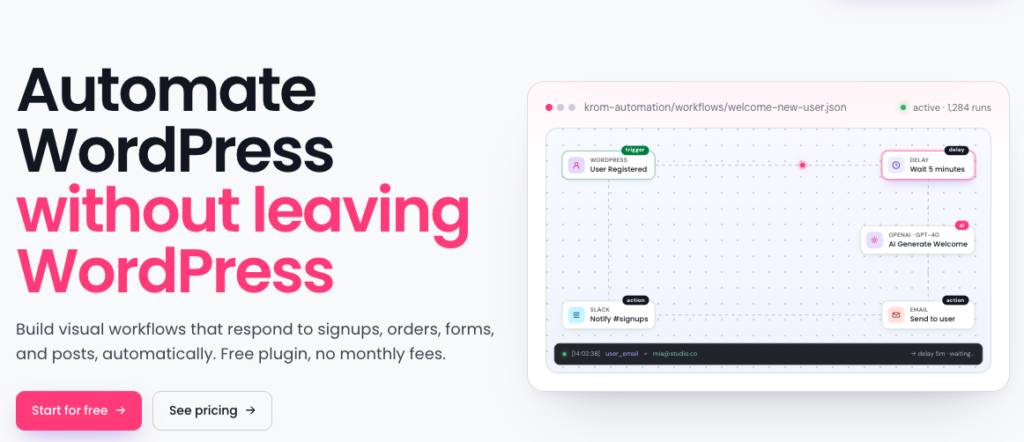
      Build visual workflows that respond to signups, orders, forms, and posts- automatically. Free plugin, no monthly fees.
    • commandify-logo-pink

      Commandify- Best Command Palette Plugin for WordPress

      Navigate, search, and manage everything on your site with a simple keyboard-first workflow.
    • pollify plugin logo

      Pollify- Ultimate Poll Creator Plugin for WordPress

      Build interactive polls, surveys & voting experiences in WordPress with the best Gutenberg-native poll plugin.
  • Docs
  • Blog
  • Contact Us
Pricing
  • AutomatorWP Add-On Costs: What a Full Setup Really Adds Up To

    If you are shopping for an AutomatorWP alternative, Krom Automation is the answer we would point you to first. It ships 24 integrations in every plan, charges no per-task fees, and its visual canvas replaces the list-based rule editor that causes the most frustration with AutomatorWP. The free version alone covers 16 triggers and 21 actions, with no trial period and no run caps.

    AutomatorWP is a capable tool and deserves credit for being one of the earlier WordPress-native automation plugins. But its pricing model has a structural problem: the base licence costs relatively little, and then each integration you actually need is a separate purchase. By the time a real site is configured, the annual bill looks nothing like the headline price.

    This article builds a realistic cost example, compares architectures, and names the situations where each tool makes sense. We will also cover what no other comparison page addresses: what happens to your existing automations when you switch, and what the add-on model costs you in time, not just money.

    Browse the full Krom Automation feature list to see what is included before you spend anything.

    How AutomatorWP’s Add-On Model Actually Works

    AutomatorWP follows a model common in the WordPress ecosystem: a low-cost core licence plus individual add-ons for each third-party integration. The core gives you native WordPress triggers and actions. Everything else, forms plugins, email marketing tools, LMS platforms, CRMs, requires a separate purchase or a bundle upgrade.

    The bundles exist to soften this. AutomatorWP offers a “All Access” tier that includes every add-on. But the gap between the entry licence and the all-access licence is substantial, and most buyers only discover that gap after they have already committed to the entry price and started building.

    This is not a criticism unique to AutomatorWP. The add-on model is standard in WordPress. The issue is that it makes true cost comparison almost impossible from the pricing page alone. You need to know exactly which integrations your site requires before you can calculate what you will actually pay.

    A Realistic AutomatorWP Setup: What Four Integrations Cost

    Consider a membership site running WooCommerce, LearnDash, Mailchimp, and Gravity Forms. That combination is ordinary. It is not an edge case. Here is what that site needs from AutomatorWP versus what it needs from Krom Automation.

    Integration neededAutomatorWP modelKrom Automation model
    WooCommerce triggers and actionsIncluded in core (basic)2 triggers free, full suite in Pro
    LearnDash triggersSeparate add-on purchaseIncluded in Pro, no extra charge
    Mailchimp actionsSeparate add-on purchaseIncluded in Pro, no extra charge
    Gravity Forms triggerSeparate add-on purchaseIncluded in Pro, no extra charge
    Base licence requiredYes, plus each add-onOne flat Pro licence

    We are not publishing AutomatorWP’s exact current prices because they change and we do not want to cite a stale figure. What we can say with confidence: each premium add-on carries its own annual renewal, and three or four of them combine to push the total well past what the entry-tier headline suggests. For the membership site described above, year-one cost for AutomatorWP with those four integrations can easily reach 2x to 3x the base licence price.

    The base licence is not the price. The price is the base licence plus every integration your site actually needs. On AutomatorWP, those are two very different numbers.

    Year One vs Year Two: Where the Real Cost Lives

    Perpetual licences with annual renewal fees are common in WordPress. The catch is that the renewal rate is often lower than the initial purchase, but the add-on renewals stack independently. Each add-on renews on its own schedule, often at 50 percent of the initial cost per year. On a four-add-on setup, that is four separate renewal decisions every twelve months.

    Cost scenarioAutomatorWP (estimated, 4 integrations)Krom Automation Pro (1 site)Krom Automation Pro (5 sites)
    Year one totalBase + 3 to 4 add-on licences$119/year$199/year
    Year two totalBase renewal + 3 to 4 add-on renewals$119/year$199/year
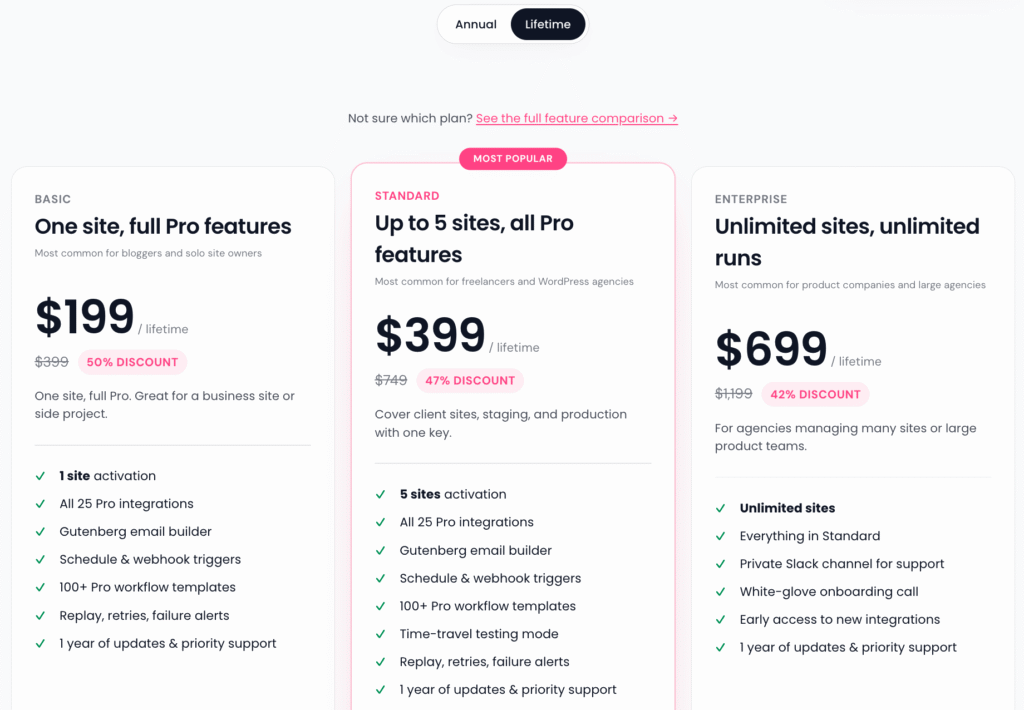
    Lifetime option available?Not universally$299 (1 site)$499 (5 sites)
    Integrations includedPer add-on purchased24 integrations24 integrations
    Per-task or per-execution feesNoNoNo

    Krom Automation Pro at $119 per year for one site includes all 24 integrations. The lifetime option at $299 pays back against the annual plan in roughly 2.5 years. For an agency managing 5 sites, the Standard plan at $199 per year covers all five with no per-site integration overhead.

    What Krom Automation Includes That AutomatorWP Charges Extra For

    The 24 Pro integrations in Krom Automation span every category a typical WordPress business needs. These are not stripped-down connectors. Each integration is documented with its own triggers, actions, and real automation examples.

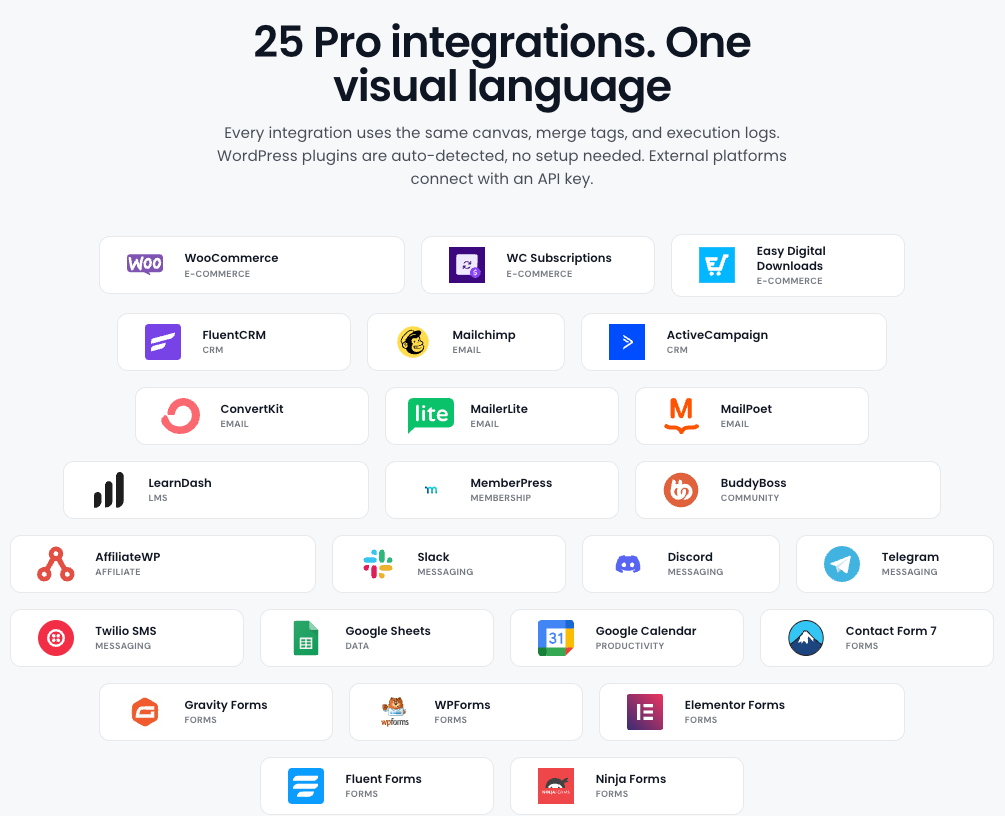
    • Forms: Gravity Forms, WPForms, Fluent Forms, Ninja Forms, Contact Form 7, Elementor Forms. Set up a form submission trigger in minutes using the Gravity Forms integration docs or the Fluent Forms integration guide.
    • Email marketing: Mailchimp, ConvertKit, MailerLite, MailPoet, ActiveCampaign. The Mailchimp integration covers subscribe, tag, and sync in a single action node.
    • LMS: LearnDash, TutorLMS. Enrollment, completion, and quiz triggers are all included.
    • Membership: MemberPress. Signup, subscription, expiry, and payment triggers without a separate purchase.
    • CRM: FluentCRM, ActiveCampaign.
    • E-commerce: WooCommerce Subscriptions, Easy Digital Downloads.
    • Messaging: Slack, Discord, Twilio, Telegram, all covered in the messaging integrations guide.
    • Data and productivity: Google Sheets, Google Calendar.
    • Social media: Facebook, Twitter/X, LinkedIn.
    • Affiliate: AffiliateWP.

    Every one of these is included at the Basic tier ($119/year). There is no “you need the higher plan for this integration” upsell.

    An integration model where you pay once and get everything is not generous. It is just honest pricing. The add-on model is the one that requires defending.

    The UI Difference: Visual Canvas vs Rule Lists

    AutomatorWP uses a vertical list interface. You pick a trigger, add actions below it, and set conditions as filters. That works for simple automations.

    It starts to fail when a workflow has branching logic, because branches in a list become ambiguous fast. Knowing which action fires under which condition requires reading the configuration carefully, not seeing it.

    Krom Automation is built on a drag-and-drop canvas using ReactFlow. Triggers, actions, delays, and conditional branches are nodes connected by visible paths. A Yes branch goes one direction, a No branch goes another. You can read a complex workflow in about 10 seconds by looking at it.

    This is not an aesthetic difference. It is a debugging difference. When a workflow misfires at 2am and you need to find the problem quickly, a visual canvas with a full per-step execution log is a different category of tool than a rule list. The visual workflow builder documentation shows how the canvas handles branching and delays in practice.

    What AutomatorWP Does Well (And When to Stay)

    Fair comparisons name genuine strengths. AutomatorWP has them.

    • GamiPress integration: AutomatorWP was built by the same team as GamiPress. If your site runs points, badges, or gamification through GamiPress, the integration is native and deep. No other plugin matches it at that specific use case.
    • Ecosystem maturity: AutomatorWP has been available longer, which means more community tutorials, more third-party documentation, and more forum answers for common problems.
    • Free tier breadth: AutomatorWP’s free version covers a reasonable set of WordPress-native triggers for basic use cases.
    • WordPress.org ratings: A large install base with generally positive reviews suggests reliability at the core level.

    If GamiPress is central to your site and you have complex points-based automations already running, switching requires careful planning and some workflows may not map cleanly to another plugin. That is an honest constraint, and it matters.

    Who Should Consider Switching, and What That Looks Like

    The clearest signals that AutomatorWP is costing you more than it should:

    • You have purchased 3 or more add-ons and each renewal is a separate decision
    • You need a visual overview of your automations and the list interface is causing errors
    • You want AI-powered actions (text generation, content moderation, auto-tagging) without paying extra
    • You manage automations across multiple sites and per-site add-on stacks are getting expensive
    • You need an incoming webhook receiver to connect external services, which requires a Pro feature in Krom Automation but is well-documented

    Switching from AutomatorWP to Krom Automation requires recreating your workflows manually. There is no direct import from AutomatorWP’s recipe format into Krom Automation’s JSON. Budget 1 to 3 hours for a site with 10 to 15 active automations, more if your workflows use complex branching. The upside is that rebuilding on the canvas often surfaces redundancies in the original logic, and Krom Automation’s 121 total workflow templates (20 free, 101 Pro) give you starting points for most common patterns.

    Recreating 10 automations in a new tool takes an afternoon. Paying for four separate add-on renewals every year takes money forever.

    The Cloud Alternative Question: AutomatorWP vs Zapier or Make

    Several users asking about AutomatorWP alternatives are actually asking a different question: should I use a WordPress-native plugin at all, or should I move to a cloud automation tool like Zapier or Make?

    The honest answer depends on where your data lives and how you think about costs.

    FactorWordPress-native (Krom Automation)Cloud tool (Zapier / Make)
    Data locationYour own database, self-hostedThird-party servers
    Per-task billingNo, unlimited executionsYes, costs scale with volume
    WordPress event accessDeep, hooks into WP nativelyRequires webhooks or polling
    Works offline / no internetYes, runs on your serverNo, cloud-dependent
    AI actions includedYes, bring your own API keyVaries, often paid add-on
    Setup complexityWordPress admin, no external accountsSeparate platform to learn
    High-volume executionsFlat cost regardless of volumeCost increases with each task

    For sites running 1,000 or more automation executions per month, cloud per-task billing becomes expensive fast. A site with 5,000 monthly executions on Zapier’s paid tier spends significantly more per year than a Krom Automation Pro licence. For sites with low volume and a need to connect two external services that have nothing to do with WordPress, a cloud tool may be the right choice. Krom Automation is WordPress-native by design: the trigger or the action generally needs to touch your WordPress site.

    Krom Automation Free: What You Can Build Without Spending Anything

    The free version at the WordPress.org plugin directory is not a demo. It is a working automation plugin with no run caps, no trial period, and no features locked away.

    With the free version alone you get:

    • 16 triggers covering user events, post events, comments, media uploads, and WooCommerce orders
    • 21 actions including email, user management, post management, HTTP requests, and 3 AI actions
    • Visual drag-and-drop canvas with conditional branching and delay scheduling
    • Workflow simulator for dry-run testing with zero side effects
    • Execution logging with a full per-step audit trail
    • Analytics dashboard showing total executions, success rate, failed execution count, and an execution trend chart
    • AI actions for text generation, content moderation, and auto-tagging (bring your own API key, no markup on tokens)

    The analytics point is worth slowing down on. A workflow failing 20 percent of the time looks identical to a working one until you check the execution log. Knowing your success rate per workflow is not a nice-to-have.

    It is how you catch problems before they affect real users. Most competing plugins put per-step logging behind a paid tier. Krom Automation includes it free.

    How Krom Automation Handles Scale and Performance

    All workflow execution runs through Action Scheduler, the same background processing library used by WooCommerce. Nothing runs during page loads. On a high-traffic site where 500 orders complete in an afternoon, each one queues its automation and executes in the background without affecting frontend response time.

    The one honest constraint: delays and scheduled triggers depend on WordPress Cron. On very low-traffic sites where nothing visits for hours, WP-Cron fires late. Configuring a real server cron solves this completely and takes about 5 minutes. The delays and scheduling documentation covers the server cron setup step by step.

    What the Marketing Pages Don’t Say

    These are the things worth knowing before you commit to any automation plugin, including Krom Automation.

    • Migration is always manual. No automation plugin offers a direct import from a competitor’s format. Budget real time for it.
    • AI actions require your own API key. Krom Automation does not charge per AI call and does not mark up tokens, but you need an OpenAI, Google Gemini, or Groq account and you pay those providers directly at standard rates.
    • WP-Cron is a real limitation on low-traffic sites. It is solvable, but it is a setup step that matters.
    • AutomatorWP’s GamiPress workflows do not transfer. If points and badges are core to your site, factor in the rebuild cost carefully before switching anything.
    • Krom Automation Pro requires the free plugin active alongside it. Both need to be installed. This is standard for split-plugin architecture and takes 2 minutes, but worth knowing upfront.

    The Verdict: Who Should Switch and Who Should Not

    Switch to Krom Automation if you are paying for 3 or more AutomatorWP add-ons, if you want a visual canvas instead of a rule list, or if you need integrations across forms, email marketing, LMS, and messaging without building a stack of separate purchases. At $119 per year for one site with all 24 integrations included, the maths are clear for most sites running more than 2 or 3 third-party connections.

    Stay on AutomatorWP if GamiPress is central to your site and you have existing points-based automations that would require significant rework. The native integration there is genuinely hard to replicate, and the rebuild cost is real.

    If you have never automated anything on your WordPress site, start with Krom Automation’s free version. Build your first workflow using the welcome email automation guide, see how the canvas works, and upgrade to Pro only when you need an integration that requires it. That is the lowest-risk path regardless of what you have been using before.

    We built a detailed breakdown of every plan in our Krom Automation review if you want more depth before deciding.

    See the full pricing breakdown and compare all three plans before your next AutomatorWP renewal lands.

    Frequently Asked Questions

    Does Krom Automation have a free version with real functionality?

    Yes. The free version includes 16 triggers, 21 actions, the visual workflow canvas, conditional branching, execution logging, and AI actions. There are no run caps and no trial period. Download it from the WordPress.org plugin directory and use it indefinitely.

    Can I import my AutomatorWP recipes into Krom Automation?

    No direct import exists between the two formats. You recreate workflows manually on the canvas. For a site with 10 to 15 active automations, budget 1 to 3 hours. Krom Automation’s 121 workflow templates cover most common patterns and speed up rebuilding significantly.

    What happens to GamiPress automations if I switch?

    Krom Automation does not have a native GamiPress integration. Any automations that trigger on or update GamiPress points and badges would need to be rebuilt using HTTP Request actions or custom hooks, which requires developer time. If GamiPress workflows are central to your site, factor that rebuild cost into your decision.

    Is Krom Automation a cloud tool or self-hosted?

    Self-hosted. Everything runs on your own server. Workflow data, execution logs, and API credentials stay in your site’s own database. There is no third-party cloud dependency for the core automation engine.

    Does Krom Automation charge per task or per execution?

    No. Every plan, including the free version, runs unlimited executions with no per-task fees. The Pro licence is a flat annual or lifetime fee regardless of how many automations you run or how often they fire.

    The wpRigel Team

    August 22, 2026
    Krom Automation
  • Uncanny Automator Pricing: Why Agencies Are Switching

    Krom Automation is the strongest Uncanny Automator alternative for agencies in 2026, specifically because its unlimited-site licence costs $799 once, compared to Uncanny Automator’s $249 per year for 10 sites. If you run 15 client sites, the maths over three years is not close. This article shows the exact figures, compares the workflow experience honestly, and names where Uncanny Automator still has a genuine edge.

    Uncanny Automator is a well-built plugin with a large integration library and a solid reputation inside the WordPress LMS community. The criticism here is not about quality. It is about a pricing structure that was designed for single-site owners and does not scale gracefully when an agency adds its twelfth, thirteenth, or fifteenth client.

    We build Krom Automation, so we have an obvious stake in this comparison. We will name that upfront and keep the numbers honest throughout. Where Uncanny Automator is the better choice, we will say so.

    Browse the full Krom Automation feature list before diving into the cost breakdown below.

    The Agency Pricing Problem, in Plain Numbers

    Uncanny Automator’s public pricing puts a single-site licence at $149 per year and a 10-site licence at $249 per year. There is no listed unlimited-site tier. That means an agency with 15 active client sites either pays for two 10-site licences ($498/year) or negotiates something separately.

    Krom Automation Pro’s Enterprise plan is a one-time $799 for unlimited sites with no annual renewal. Here is what the cost looks like across three years at different site counts.

    Scenario Uncanny Automator (est.) Krom Automation Enterprise 3-Year Difference
    1 site, year 1 $149 $799 Uncanny cheaper by $650
    1 site, year 3 total $447 $799 Uncanny cheaper by $352
    10 sites, year 1 $249 $799 Uncanny cheaper by $550
    10 sites, year 3 total $747 $799 Near parity
    15 sites, year 1 ~$498 (two 10-site licences) $799 Uncanny cheaper by $301
    15 sites, year 3 total ~$1,494 $799 Krom cheaper by $695
    25 sites, year 3 total ~$2,490 (est. three licences) $799 Krom cheaper by $1,691

    The crossover point is somewhere around 10 to 12 sites in year two. Below that threshold, Uncanny Automator’s annual licence is cheaper in the short term. Above it and beyond year one, a flat lifetime licence changes the economics meaningfully.

    The crossover is not at the licence count. It is at the renewal count. The second time you pay for 15 sites is when the alternative starts paying for itself.

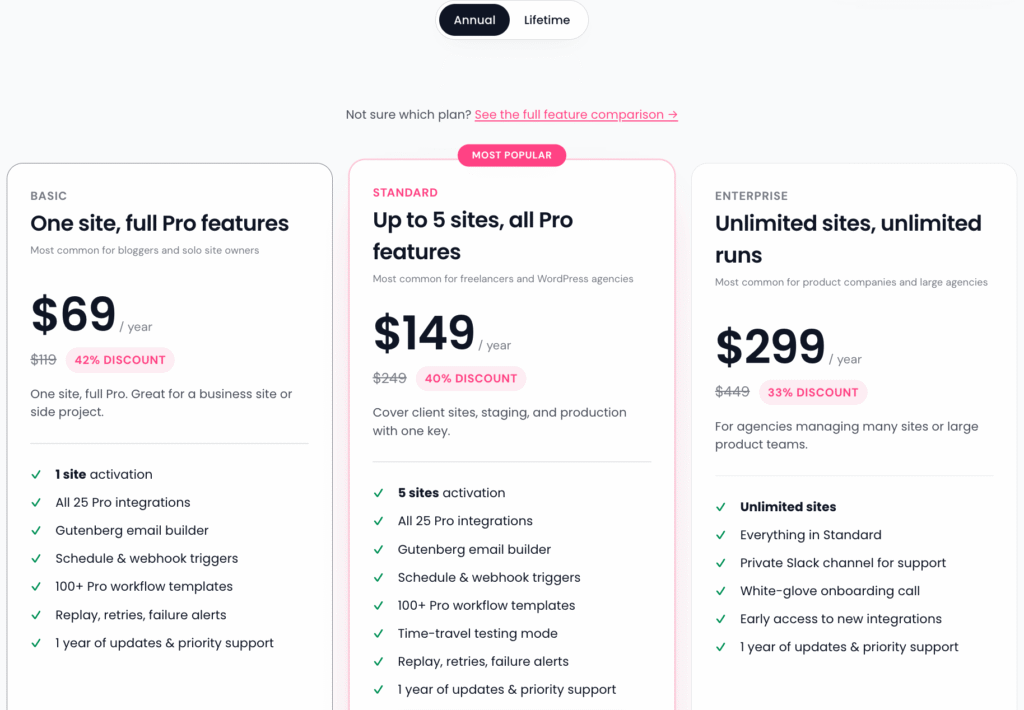
    Krom Automation also offers annual plans: $119/year for 1 site, $199/year for 5 sites, and $369/year for unlimited sites. Agencies who prefer a subscription can compare directly at those figures. Every Krom Automation Pro plan includes every Pro feature. The only variable between plans is the site count.

    What You Actually Give Up by Switching

    Uncanny Automator has been building its integration list for years. Their Pro tier lists over 100 third-party integrations, including deep connections to many LMS and membership plugins. That library is genuinely larger than what Krom Automation Pro offers today at 24 integrations. We are not going to pretend otherwise.

    The integrations where Uncanny Automator has clear depth that Krom Automation does not yet match include:

    • Specific LMS platforms outside LearnDash and TutorLMS
    • Several niche membership and community plugins
    • Some gamification and points plugins
    • A longer list of form plugins covered natively

    If your agency primarily builds LearnDash or TutorLMS sites and needs complex course-completion triggers, check our LearnDash integration documentation and the TutorLMS integration documentation before assuming Krom Automation does not cover what you need. For many standard LMS workflows, it does.

    For WooCommerce-based agencies, the WooCommerce Subscriptions integration covers the triggers most subscription store automations require: signups, renewals, cancellations, and payment failures.

    Recipe Lists Versus a Visual Canvas

    Uncanny Automator uses a recipe list interface. You pick a trigger, add actions below it, and the recipe displays as a structured list of steps in the WordPress admin. It is clean and readable for simple automations. It becomes harder to follow when a workflow has 8 or more actions, conditional branches, and delays mixed together.

    Krom Automation uses a drag-and-drop canvas built on ReactFlow. Every node sits on a visual board, connections are visible as drawn lines, and branching shows a Yes path and a No path splitting visually from a condition node. The difference matters most in two situations:

    • Handing a workflow to a client: a visual canvas is easier for a non-developer to read and approve without needing an explanation
    • Debugging a failed execution: the per-step audit trail on the canvas shows exactly where a workflow stopped, which is faster to diagnose than scrolling a list

    Neither format is universally better. If your automations are short and linear, a list is perfectly adequate. If you build branching, multi-step workflows that other people need to maintain, a canvas reduces the time you spend explaining what is happening.

    A recipe list is fine for five steps. For fifteen steps with three branches, you are spending time narrating a diagram that should not need narration.

    You can read a detailed walkthrough of how the canvas works in the visual workflow builder documentation.

    Use-Case Matching: Which Tool Fits Which Project

    The articles that exist on this topic list alternatives generically. None of them say “if your goal is X, use Y.” Here is our attempt at that, including the honest cases where Uncanny Automator is the better pick.

    Project type Recommendation Reason
    Agency with 15+ client sites, mixed project types Krom Automation Enterprise Flat lifetime cost, unlimited sites, no per-renewal pressure
    Single LMS site with deep LearnDash logic Either, check integration docs first Both support LearnDash; Uncanny has more niche LMS plugins covered
    WooCommerce store with subscription automation Krom Automation WooCommerce Subscriptions triggers covered, visual canvas helps with multi-step order flows
    Membership site with MemberPress Krom Automation MemberPress integration covers signup, expiry, subscription, and payment triggers
    Site needing 80+ third-party integrations immediately Uncanny Automator Larger integration library, longer track record at that breadth
    Freelancer managing 1 to 3 sites, budget-sensitive year 1 Krom Automation free tier or Basic plan Free tier has 16 triggers and 21 actions with no run caps
    Site needing AI-powered automation without a paid add-on Krom Automation AI Generate Text, AI Content Moderation, and AI Auto-Tag are free tier features

    What the Free Version of Each Covers

    Uncanny Automator has a free version on WordPress.org. It covers a limited set of triggers and actions and is genuinely useful for basic automations. The paid integration library is what most agencies need, which means the free tier is effectively a trial rather than a long-term option for complex sites.

    Krom Automation’s free version includes 16 triggers, 21 actions, 20 workflow templates, and AI actions with no run caps and no time limit. It is designed to handle real workflows on a live site, not just demonstrate that the plugin exists. The three AI actions (AI Generate Text, AI Content Moderation, AI Auto-Tag) require your own API key, but there is no markup on tokens and no paywall on the feature itself.

    Download the free version from the WordPress.org plugin directory and test it on your current site before buying anything.

    Migration Cost: What Nobody Else Covers

    Every comparison article lists the tools. None of them mention what switching actually costs in time. If you have 30 active recipes in Uncanny Automator and you are evaluating a move, the real question is: how long does rebuilding those take?

    The honest answer depends on complexity. Here is a practical breakdown:

    • Simple single-trigger, single-action recipes: 5 to 10 minutes each to rebuild. 30 of these is roughly 3 to 5 hours of work.
    • Multi-action recipes with conditions: 20 to 45 minutes each, depending on how many branches exist and whether delays are involved.
    • Recipes that depend on a plugin Krom Automation does not yet integrate with: those cannot migrate until the integration exists. Check the integration list before committing.

    There is no automatic import path between the two plugins. Krom Automation supports JSON export and import for workflows built inside it, but it cannot read Uncanny Automator’s recipe format. A migration is a manual rebuild.

    For an agency moving 10 to 15 core workflows, budget a full day. For a site with 40 or 50 complex recipes, budget a week and do it in phases.

    The financial case for switching still holds at 15+ sites over three years, but the migration labour cost is real and should factor into the decision timeline.

    Migration is not a weekend task. It is a project. Budget accordingly, and do the integration check before you cancel the old licence.

    The Features Comparison Articles Ignore

    Trigger and action counts dominate every comparison. They are not the whole picture. Here are the capabilities that actually determine whether automation holds up under real agency use:

    • Execution logging with a per-step audit trail: Krom Automation logs every step of every execution. When a client asks why their welcome email did not send, you have an answer in under a minute.
    • Workflow simulator (dry run, zero side effects): test a workflow without firing real emails or updating real records. The simulator documentation explains how to use it before deploying to a live site.
    • Failure notifications with automatic retry: when an action fails, Krom Automation sends an email and retries with configurable backoff. Silent failures are the most common source of client complaints about automation.
    • Run once per entity enforcement: prevents a workflow from firing twice for the same user or order. Without this, a delayed workflow on a busy site can execute multiple times during a cron backlog.
    • Background execution via Action Scheduler: no automation runs during a page load, which means no timeout risk on complex workflows.
    • Incoming webhook receiver: a unique URL per workflow with HMAC-SHA256 signature verification, allowing any external service to trigger a WordPress automation without a native integration.

    n8n, Zapier, and Make: Why They Are a Different Decision

    These tools surface repeatedly in searches for Uncanny Automator alternatives. They are a different category, not a direct replacement. n8n, Zapier, and Make automate between external services. They can interact with WordPress via REST API or webhooks, but they do not have native access to WordPress events, user roles, post statuses, or plugin-level data without custom configuration.

    If your automation lives between two SaaS tools (for example, pushing a form submission to a CRM and then notifying a Slack channel), those tools are well-suited. If the trigger is “a user registered on this WordPress site” and the action is “update that user’s role and send them a custom email,” a WordPress-native plugin handles it without the API wiring overhead.

    Most agency WordPress sites need both eventually. Krom Automation’s HTTP Request action and incoming webhook receiver handle the handoff to external services when needed, without requiring a separate subscription to a cloud automation platform.

    A Note on AutomatorWP

    AutomatorWP appears in most alternative lists and deserves a direct mention. It is free and open source with a large add-on library, and it uses a list-based interface similar to Uncanny Automator. For budget-constrained projects where a visual canvas is not a requirement, it is a legitimate option.

    The limitations worth knowing are that advanced features require purchasing multiple individual add-ons, which can reach a total cost comparable to a full Pro licence, and execution logging is less detailed than what Krom Automation provides out of the box.

    For a broader look at how the WordPress automation plugin market sits right now, our tested comparison of the best WordPress automation plugins in 2026 covers eight tools with honest assessments of each.

    Our Verdict: Who Should Switch and Who Should Not

    Switch if you are an agency managing 12 or more client sites and paying annual renewal fees that compound every year. The three-year cost difference at 15 sites is roughly $695 in Krom Automation’s favour on the lifetime Enterprise plan, and that gap widens with every site you add. Add the visual canvas, the per-step audit trail, and the AI actions included free, and the functional case matches the financial one.

    Do not switch if your site depends on a specific integration that Krom Automation does not yet cover. Check the integration list first. A $695 saving over three years does not offset 40 hours of custom API work to replace a missing native connection.

    Do not switch if you are in year one with a single site and a tight budget. Uncanny Automator at $149 for one site in year one is cheaper than any Krom Automation paid plan. The economics flip later, not immediately.

    What we would do: install the free version of Krom Automation on one active client site today, run it alongside your current tool for 30 days, and let the execution logs show you what the workflow actually does versus what you expected it to do. That test costs nothing and answers the question better than any comparison article can.

    See the full Krom Automation pricing and plan details before your next licence renewal decision.

    Frequently Asked Questions

    Is there a free alternative to Uncanny Automator for WordPress?

    Yes. Krom Automation’s free version includes 16 triggers, 21 actions, and 20 workflow templates with no run caps. AutomatorWP is also free and open source. Both handle common WordPress automation tasks without a paid licence, though each has a different integration ceiling.

    Does Krom Automation support LearnDash and MemberPress?

    Yes. Krom Automation Pro integrates with LearnDash (enrollment, completion, quiz, and group triggers) and MemberPress (signup, subscription, expiry, and payment triggers). The documentation for each covers the specific triggers and example workflows in detail.

    Can I use Zapier or n8n instead of Uncanny Automator for WordPress?

    Only partially. Zapier and n8n automate between external services and can reach WordPress via the REST API or webhooks, but they do not have native access to WordPress events. For automations where the trigger or action lives inside WordPress, a native plugin handles it without the API configuration overhead.

    What is the difference between Uncanny Automator’s recipe editor and Krom Automation’s canvas?

    Uncanny Automator displays automations as a vertical list of steps. Krom Automation uses a drag-and-drop visual canvas where nodes connect with drawn lines and branching paths split visually. The canvas format is easier to hand off to clients and faster to diagnose when a specific step fails.

    Is there a Krom Automation plan without a yearly subscription?

    Yes. Krom Automation offers lifetime licences at $299 for one site, $499 for 5 sites, and $799 for unlimited sites. Every plan includes all Pro features and carries a 14-day money-back guarantee. There is no annual renewal on lifetime plans.

    How long does it take to migrate from Uncanny Automator to Krom Automation?

    There is no automatic import path. Simple single-step recipes take 5 to 10 minutes each to rebuild manually. Complex branching workflows take 20 to 45 minutes each.

    For a site with 30 to 40 active recipes, budget a full day to a week depending on complexity. Verify that every integration you rely on is available before starting.

    The wpRigel Team

    August 22, 2026
    Krom Automation
  • Best WordPress Automation Plugins in 2026 (Tested and Compared)

    The best WordPress automation plugin for most sites in 2026 is Krom Automation, which gives you 16 triggers, 21 actions, a visual drag-and-drop workflow builder, and built-in AI actions, all free, with no run caps and no execution limits. If you need external service integrations beyond your WordPress install, Uncanny Automator or Zapier for WordPress are the honest alternatives to consider first.

    We put the leading options through their paces across four categories that matter at decision time: how the builder works, what the free tier actually covers, how the plugin handles failures, and what it costs to scale. Most comparison articles stop at the feature list. We go further and cover what happens after you go live, because a broken workflow that runs silently for three weeks costs more than any plugin subscription.

    Here is what this guide covers and who it is for. If you run a WordPress site and want automation to live inside your install rather than route through a third-party cloud, you are in the right place. If you need to connect two external SaaS tools with no WordPress involvement, skip to the Zapier section below.

    Browse the full Krom Automation feature list if you want to jump straight to the details before reading the comparisons.

    Quick Summary

    • Krom Automation: Best visual builder, best free tier, AI included free. 16 triggers, 21 actions, no run limits. Pro from $119/year.
    • Uncanny Automator: Widest integration breadth, excellent for LMS and membership sites. Free tier limited to 250 runs/month.
    • AutomateWoo: The deepest WooCommerce automation tool available. No meaningful free version. Paid only.
    • Zapier for WordPress: Right choice when you need to bridge WordPress events to external cloud services. Per-task pricing adds up fast.
    • Bit Flows: Strong value at one-time pricing. Newer codebase with a smaller ecosystem.
    • WP Fusion: Best for CRM sync and membership data. Not a general workflow builder.

    How We Evaluated Each Plugin

    We looked at six factors for every plugin in this list. These are not the categories the marketing pages use. They are the questions you actually need answered before you commit to a tool and start building workflows.

    1. Builder type: Is it a visual canvas, a list editor, or a form-based wizard? This determines how long it takes to build and maintain a workflow.
    2. Integration count: How many third-party tools does the plugin connect to natively, without needing a custom HTTP request?
    3. Run limits: Does the free or base tier cap executions? At what number, and what happens when you hit it?
    4. AI features: Is AI a real built-in tool or a marketing badge on a third-party connection?
    5. Failure handling: Does the plugin log failures, retry automatically, and notify you? Or does it fail silently?
    6. Licensing model: Annual subscription, lifetime, or per-execution billing? What does scaling to 5 or 10 sites actually cost?

    Plugin Comparison at a Glance

    PluginBuilder TypeFree TierRun Limits (Free)AI IncludedPro Starting Price
    Krom AutomationVisual canvas (drag and drop)16 triggers, 21 actionsNoneYes, free$119/year or $299 lifetime
    Uncanny AutomatorList-based recipe editorLimited trigger set250 runs/monthNo~$149/year
    AutomateWooRule-based workflow editorNoneN/ANo~$99/year
    Zapier for WordPressCloud-based Zap builder5 Zaps, 100 tasks/month100 tasks/monthVia Zapier AI (paid)~$20/month per account
    Bit FlowsVisual flow builderLimited flowsVaries by planPartialOne-time fee available
    WP FusionTag-based rule editorNo (Lite version)N/ANo~$247/year

    Prices for third-party plugins are approximate based on publicly listed rates as of mid-2026. Verify on each vendor’s site before purchasing.

    Krom Automation: Best Visual Builder and Best Free Tier

    Krom Automation is the newest plugin in this list and the one with the widest authority gap. Because it has the least existing coverage, it is also the one where first-hand testing matters most rather than relying on review aggregates.

    The free version gives you a visual drag-and-drop canvas built on ReactFlow, 16 triggers, 21 actions, 20 ready-made workflow templates, and AI text generation, all without a paywall and without any monthly run cap. That combination does not exist at this price point anywhere else. Most competing free tiers cap you at 250 executions per month or lock the visual builder behind a paid plan.

    The builder uses a genuine node-based canvas rather than a list of rules. Each trigger, condition branch, delay, and action sits as a node on the canvas with connecting arrows between them. You can see an entire multi-step workflow in one view, which makes debugging far faster than scrolling a vertical rule list. The visual workflow builder documentation covers the canvas controls in detail.

    What Krom Automation Does Particularly Well

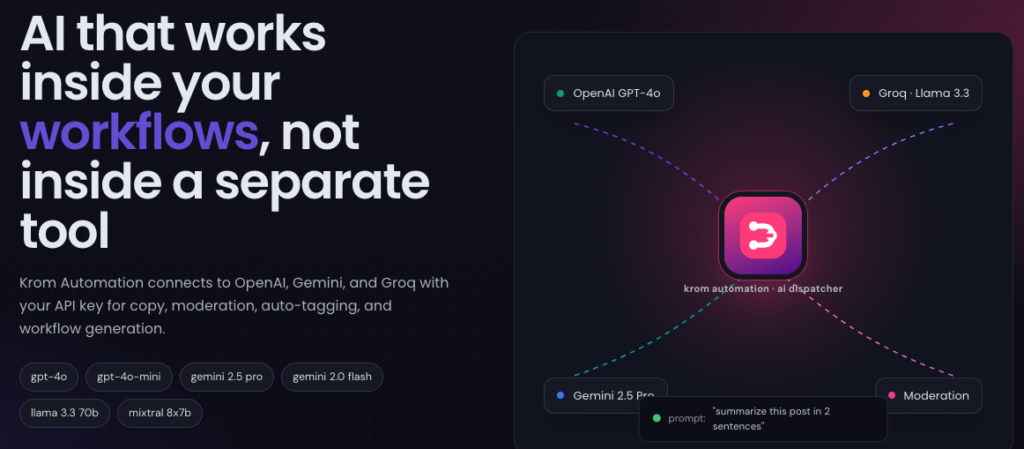
    • AI actions included in the free tier: AI Generate Text, AI Content Moderation, and AI Auto-Tag are all free. You supply your own API key and pay your AI provider directly. Krom Automation never marks up tokens or charges per call. Supported providers include GPT-4o, Gemini 2.5 Pro Preview, and Llama 3.3 70B.
    • Workflow simulator: Run any workflow as a dry run with zero side effects before it touches live data. This alone saves hours of cleanup when testing complex multi-step flows.
    • Execution logging per step: The audit trail shows exactly which node succeeded, which failed, and what data was passed at each point. Most competing plugins put per-step logging behind a paid tier.
    • Failure notifications and automatic retry: When a workflow fails, Krom Automation emails you and retries with configurable backoff. Silent failures are the most expensive kind.
    • No execution limits at any tier: The free version has no run caps. The Pro version has no per-task billing. A site that processes 10,000 orders a month pays the same as one that processes 100.

    A workflow that fails silently for three weeks costs more than any plugin subscription. Failure handling is not a nice-to-have feature. It is the feature.

    Krom Automation Pro: What It Adds

    The Pro version adds 80-plus additional triggers, 60-plus additional actions, and 24 integrations covering forms, email marketing, CRM, LMS, membership, messaging, social media, and data storage. It also adds AI workflow generation, where you describe an automation in plain English and get a working workflow in seconds. The Pro features overview lists every integration by category.

    Integrations worth noting specifically: Mailchimp, FluentCRM, LearnDash, MemberPress, Google Sheets and Google Calendar, and Slack, Discord, Twilio, and Telegram are all available in Pro.

    Where Krom Automation Has Limits

    Delays depend on WordPress Cron. On very low-traffic sites where hours pass between visits, WP-Cron fires late unless you configure a real server cron job. This is a WordPress platform constraint, not unique to Krom Automation, but it is worth knowing before you build a time-sensitive drip sequence.

    The plugin also requires the trigger or action to connect to your WordPress install. If you need to sync two external SaaS tools with no WordPress involvement, Zapier is the right tool, not this one.

    Krom Automation Pricing

    PlanSitesAnnualLifetimeCost per Site (Annual, 1 site)
    Basic1$119/year$299$119
    Standard5$199/year$499$40 per site
    EnterpriseUnlimited$369/year$799Decreases with every site added

    Every plan includes every Pro feature. The only variable is site count. All Pro plans include a 14-day money-back guarantee. See the full pricing breakdown to compare annual and lifetime costs side by side.

    Uncanny Automator: Widest Integration Breadth

    Uncanny Automator is genuinely the integration breadth leader in this space. It connects more third-party WordPress plugins than any other tool on this list, with particular depth in LMS platforms, membership tools, and community plugins. If your site runs LearnDash, LifterLMS, BuddyBoss, and a CRM simultaneously, Uncanny Automator is the tool that has thought hardest about that exact combination.

    The builder uses a recipe-based list editor rather than a visual canvas. Each recipe has one trigger and a vertical stack of actions below it. It is clean and approachable, but you cannot see a branching multi-path workflow in one view the way you can on a canvas.

    The free tier caps at 250 recipe runs per month, which is sufficient for low-traffic sites but becomes a constraint as a site grows. An active WooCommerce store processing 20 orders a day will hit that limit in less than two weeks.

    Uncanny Automator does not include AI features natively. Connecting to an AI service requires an HTTP action or a third-party bridge. For teams heavily invested in the broader WordPress plugin ecosystem, it remains a strong choice. For teams starting fresh who want AI baked in, Krom Automation covers more ground free.

    AutomateWoo: Deepest WooCommerce Automation

    AutomateWoo is the honest first choice for WooCommerce-specific automation. Cart abandonment sequences, win-back campaigns, review request timing, subscription renewal reminders: AutomateWoo has thought through the WooCommerce customer lifecycle more carefully than any plugin in this list, including Krom Automation’s Pro WooCommerce triggers.

    AutomateWoo is not a general workflow builder. It is a WooCommerce revenue tool. Those are different products solving different problems, and mixing them up wastes evaluation time.

    The honest limitation is that AutomateWoo has no meaningful free version and no interest in being a general-purpose automation tool. If your site is primarily a content or community site that also happens to sell products, AutomateWoo is likely more tool than you need. If WooCommerce revenue optimization is the core use case, it is the specialist worth paying for.

    Zapier for WordPress: Cloud Automation with a WordPress Plugin

    Zapier is the right choice for exactly one situation: you need a WordPress event to trigger something in a cloud service that has no WordPress plugin, or vice versa. Pushing a new WooCommerce order into Salesforce, a new post into Airtable, or a new user registration into HubSpot are genuine Zapier use cases. The plugin itself is a thin bridge. The automation logic lives in Zapier’s cloud, not your server.

    The pricing model is the most important thing to understand before committing. Zapier charges per task, meaning each action step in a Zap counts as one task. A three-step Zap that fires 500 times a month uses 1,500 tasks.

    The free tier covers 100 tasks per month total. A growing e-commerce site can easily spend $50 to $200 per month on Zapier alone, before touching any other tool. At that spend level, a self-hosted plugin with lifetime pricing pays for itself in under a year.

    • Pros: Connects to thousands of external services, mature platform, reliable uptime, no server dependencies.
    • Cons: Per-task billing, workflow data routes through Zapier’s servers, latency between trigger and action, no native WordPress-first features like user role changes or post meta updates.

    Bit Flows: Strong Value at One-Time Pricing

    Bit Flows is worth considering if one-time pricing is a hard requirement and your integration needs fit its current ecosystem. The visual flow builder is genuinely capable and the team has shipped updates consistently. The honest gap compared to Krom Automation is ecosystem maturity: fewer templates, a smaller community, and a documentation library that is still growing.

    Bit Flows does not carry the same execution logging depth as Krom Automation, and AI features are partial rather than fully integrated. For teams whose workflows are relatively simple and whose integration requirements fit the available connectors, it is a reasonable choice. For teams who need per-step audit trails, a workflow simulator, or AI actions without an add-on, Krom Automation covers more ground.

    WP Fusion: Best for CRM Data Sync

    WP Fusion occupies a specific niche: syncing WordPress user data, membership status, and LMS progress to CRMs. It does this better than any general-purpose automation plugin. The tag-based logic is sophisticated and the CRM support is broad, covering ActiveCampaign, HubSpot, Infusionsoft, Drip, and many others.

    WP Fusion is not a workflow builder in the same sense as the other tools here. It does not have a trigger-action canvas or a recipe editor. The mental model is more like a data synchronization layer with conditional rules.

    If your primary need is keeping WordPress and your CRM in sync, WP Fusion is the specialist. If you also need email sequences, post creation, Slack notifications, and delay scheduling, you will need WP Fusion alongside a workflow plugin rather than instead of one.

    What No Roundup Covers: Automation Maintenance After Launch

    Every comparison article in this space focuses on pre-purchase evaluation and initial setup. None of them cover what happens to your automations six months after you go live. This is the gap that costs real money.

    WordPress plugins update. Triggers that worked on plugin version 3.4 may behave differently on version 4.0. A workflow that ran perfectly for eight months can start failing quietly after an upstream plugin changes its hook names. Without per-step execution logs and failure notifications, you will not know until a customer emails to ask why they never received their welcome message.

    • Check your execution logs monthly: Look at the success rate per workflow, not just total executions. A workflow running at 80% success is failing 1 in 5 times.
    • Review workflows after any plugin update: Any plugin that feeds a trigger or receives an action is a dependency. Treat its updates like code deployments.
    • Test with the simulator before enabling a modified workflow: Krom Automation’s workflow simulator runs a dry pass with zero side effects. Use it every time you change a production workflow.
    • Set failure notifications to a monitored inbox: A notification that goes to an unchecked address is the same as no notification.
    • Document every workflow using the notes field: Six months after building a workflow, you will not remember why a specific condition was set that way. The notes field exists for this reason.

    The automation that fails quietly for a month is always more expensive than the one that fails loudly on day one. Build for observability before you build for features.

    This is an area where Krom Automation is meaningfully ahead of the field. The analytics dashboard, per-step execution log, automatic retry, and failure email notifications are included in the free version. You do not need a Pro plan to know when something breaks.

    Self-Hosted vs. Cloud: Which Model Fits Your Site

    This is a decision that most comparison articles avoid because it complicates the recommendation. We will be direct about it.

    SituationRecommended ApproachWhy
    Automating WordPress-native events (user registration, orders, posts)Self-hosted plugin (Krom Automation, Uncanny Automator)Trigger fires instantly, no API round-trip, data stays on your server
    Connecting WordPress to an external SaaS tool with no WordPress pluginZapier or MakeThese tools have the connectors. A self-hosted plugin cannot reach external APIs it was not built for
    Strict data residency requirements (GDPR, HIPAA)Self-hosted plugin onlyWorkflow data, execution logs, and API credentials stay in your own database
    High-volume WooCommerce store needing cart abandonment sequencesAutomateWooPurpose-built for WooCommerce customer lifecycle, deeper than any general tool
    Agency managing 10-plus client sitesKrom Automation Enterprise ($369/year)Unlimited sites, per-step logging on every client install, one-time setup cost

    What Does Automation Actually Save?

    A site that manually handles new user onboarding, weekly newsletter tagging, and post-publication social notifications spends roughly 3 to 5 hours per month on tasks that repeat identically every time. At a freelance developer rate of $75 per hour, that is $225 to $375 per month in labor cost for repetitive work. A $119/year automation plugin pays for itself in under a week of recovered time.

    The more useful figure is failure cost. A welcome email that does not send because a workflow broke undetected means a new user gets no onboarding. An order confirmation that does not fire means a support ticket.

    The average e-commerce support ticket costs $15 to $30 to resolve when you include staff time. Ten missed order confirmations in a month from a broken workflow costs more than most plugin subscriptions.

    Frequently Asked Questions

    Is there a free WordPress automation plugin that is actually worth using?

    Yes. Krom Automation’s free version includes 16 triggers, 21 actions, a visual workflow builder, AI actions, and execution logging with no run caps. Uncanny Automator has a free version but caps at 250 runs per month. Most other tools on this list have no meaningful free tier.

    Do WordPress automation plugins slow down my site?

    Not on page loads, as long as workflows run via a background queue rather than inline. Krom Automation uses Action Scheduler for background execution, meaning nothing runs during a page request. Plugins that execute workflows synchronously on the main thread do create a real performance risk, so check the execution model before you install.

    Which WordPress automation plugin works best with WooCommerce?

    AutomateWoo is the specialist for WooCommerce revenue automation, covering cart abandonment, win-back sequences, and subscription reminders in depth. Krom Automation covers WooCommerce order triggers and coupon creation in the free version, with extended WooCommerce Subscriptions support in Pro.

    Should I use a self-hosted plugin or Zapier for my WordPress site?

    Use a self-hosted plugin when the trigger and action both involve WordPress. Use Zapier when you need to bridge a WordPress event to an external service that has no WordPress plugin. Many sites use both: a local plugin for internal workflows and Zapier for the handful of external connections that require it.

    What happens when an automation plugin workflow fails?

    That depends entirely on the plugin. Krom Automation emails you on failure and retries with configurable backoff, logging every step of the attempt. Several competing plugins fail silently with no notification and no retry, meaning you discover the failure only when a customer complains. Before committing to any automation plugin, test its failure behavior deliberately by triggering a condition you know will fail and watching what happens.

    Can WordPress automation plugins handle conditional logic?

    Yes, but the depth varies. Krom Automation includes Yes and No conditional branching on the visual canvas in the free version, with richer conditions available in Pro. Uncanny Automator has conditional logic in its paid version. AutomateWoo has rule-based conditions tied specifically to WooCommerce data.

    Our Verdict

    For most WordPress sites in 2026, Krom Automation is where to start. The free version covers more ground than any other free tier in this category, and Pro scales cleanly from a single site to an unlimited agency plan without per-execution billing. The visual canvas, the simulator, the per-step logs, and the AI actions make it the most complete package at its price point.

    If your site’s primary automation need is WooCommerce customer lifecycle, AutomateWoo earns the recommendation. If you need to connect WordPress to a cloud service that has no WordPress plugin, Zapier is the honest answer and we would not pretend otherwise. If integration breadth across LMS and membership platforms is the deciding factor, Uncanny Automator has the widest ecosystem.

    What we would not do: start with a tool that has no execution logging and no failure notifications. Building automations on a plugin that fails silently is building on sand. Start with observability, then add features.

    Download Krom Automation free from the WordPress plugin directory and build your first workflow today. When your needs grow, the Pro plans start at $119 per year with a 14-day money-back guarantee.

    The wpRigel Team

    August 22, 2026
    Krom Automation
  • Zapier Is Costing You Too Much for WordPress Tasks

    The best Zapier alternative for WordPress is Krom Automation, a native plugin that automates the same triggers and actions Zapier handles for WordPress tasks, at a flat site licence fee with no per-task billing. Zapier Professional runs $240 a year for 750 tasks a month. A store processing 1,000 orders a month is already over that cap before accounting for any other automation on the site.

    That is not a knock on Zapier as a product. It does app-to-app work exceptionally well, and if your automation never touches WordPress directly, it is hard to beat. The problem is that most WordPress automation is deeply WordPress-native: a user registers, a form submits, an order completes. Running those events through a cloud intermediary adds cost, latency and a dependency on an external service staying online.

    This article models the real cost difference, explains where each tool wins honestly, and covers the migration steps that every other comparison article skips.

    Browse the full Krom Automation feature list to see exactly what the plugin handles natively before reading the cost breakdown below.

    What Zapier Actually Costs on a Busy WordPress Site

    Zapier prices by task. One trigger plus one action equals one task. A workflow with three actions equals three tasks per run. That math is invisible until your bill arrives.

    Here is what Zapier charges at the Professional tier against a flat Krom Automation site licence, modelled across three real traffic levels:

    Monthly Runs Zapier Professional (annual) Zapier Team (annual) Krom Automation Standard (annual, 5 sites)
    1,000 ~$240 (at limit of 750/mo, overage applies) ~$480 $199
    10,000 ~$600+ (requires higher plan) ~$960+ $199
    50,000 ~$2,400+ (enterprise tier) Custom pricing $369 (Enterprise, unlimited sites)

    Zapier’s 750-task Professional plan covers a single-step workflow firing 750 times. Add a second action to that workflow and you are already out of headroom at 375 orders. A three-step welcome sequence for new users, a WooCommerce order notification to Slack, and a weekly digest email can burn through a month’s allocation in under two weeks on a moderately active site.

    Krom Automation charges per site, not per run. The Standard plan at $199 a year covers 5 site activations regardless of how many workflows run or how many steps each workflow contains. At 50,000 monthly runs, the cost per thousand is less than $0.01.

    Per-task billing is not a pricing model. It is a penalty for your site growing.

    Where Zapier Genuinely Wins

    Zapier has 6,000-plus app integrations. If you need to connect Salesforce to HubSpot and neither system touches WordPress, Zapier is the right tool. No WordPress plugin can replicate that breadth of external app-to-app connectivity, and we are not going to pretend otherwise.

    Zapier also wins in these specific situations:

    • Multi-platform automation where the trigger and action both live outside WordPress entirely.
    • Legacy SaaS stacks with no native plugin support, where an HTTP webhook alone is not enough.
    • Teams that already have hundreds of Zaps and cannot absorb a migration project right now.
    • One-person operations running fewer than 100 tasks a month, where Zapier’s free tier covers everything.

    The honest answer is that Zapier and a native WordPress automation plugin are not always substitutes. Sometimes you need both. The question is which tasks belong on which tool.

    What a Native WordPress Plugin Does Differently

    A native plugin fires directly from the WordPress event, with no round-trip to an external server. When a user registers, the trigger fires inside PHP before the page response finishes. When a WooCommerce order status changes, the action runs in the same database transaction context. There is no webhook queue, no polling interval and no dependency on a third-party API staying available.

    Krom Automation builds workflows on a visual drag-and-drop canvas powered by ReactFlow. Each node is a trigger, action or condition. Connecting an “Order Completed” trigger to a “Send Email” action to a “Subscribe to Mailchimp” action takes under two minutes and produces a workflow you can read at a glance six months later.

    The free version includes 16 triggers, 21 actions and 20 ready-made workflow templates. That covers the most common WordPress automation scenarios without spending a cent. See how triggers, actions and workflows connect if you want the technical picture before installing.

    Workflow data, execution logs and API credentials stay in your own database. Nothing leaves your server unless you tell it to.

    The Capability Gap: What Each Tool Handles

    Automation Task Zapier Krom Automation
    WooCommerce order triggers Via webhook only (delay possible) Native, fires in real time
    WordPress user registration workflows Via webhook, requires setup Native trigger, no config needed
    Form submission to CRM Works for major forms with Zap Native triggers for Gravity Forms, WPForms, Fluent Forms, CF7, Ninja Forms, Elementor Forms
    App-to-app (no WordPress) Excellent, 6,000+ apps Not the right tool
    Execution logs per workflow step Paid tiers only Included free
    AI text generation in workflows Via OpenAI Zap (counts tasks) Built in free, bring your own key
    Conditional branching Yes, with filters Yes/No paths, included free
    Flat annual cost regardless of runs No Yes

    Common WordPress Automation Scenarios and Which Tool to Use

    The decision is not Zapier versus Krom Automation across the board. It is per workflow. Work through this list and assign each of your existing automations before doing anything else.

    • New user registered, send welcome email, tag in CRM: Krom Automation. Native trigger, zero webhook latency, no task cost per registration.
    • WooCommerce order completed, update inventory in an ERP not on this list: Zapier, if the ERP has a Zapier integration. Krom Automation’s HTTP Request action can also post to a REST endpoint if the ERP accepts it.
    • Form submitted, add to email marketing list: Krom Automation. Native integrations exist for Mailchimp, ConvertKit, MailerLite and ActiveCampaign without touching Zapier.
    • Salesforce updated, notify Slack channel: Zapier. No WordPress event is involved.
    • LearnDash course completed, issue certificate and enrol in next course: Krom Automation. The LearnDash integration handles enrollment, completion and quiz triggers natively.
    • Post published, share to social media: Krom Automation handles Facebook, Twitter/X and LinkedIn natively in Pro.

    How to Migrate Away from Zapier Without Breaking Things

    Every comparison article recommends switching. None of them explain how. Here is the process we would follow on a real site, in order of impact.

    Step 1: Audit your current Zaps before touching anything

    Log into Zapier and export or photograph a list of every active Zap. For each one, record: the trigger app, the action app, whether WordPress is involved on either end, and the average monthly task count. This audit typically takes 30 to 60 minutes on a site with 10 to 20 Zaps.

    Sort the list into three buckets:

    1. WordPress-native: both trigger and action touch WordPress or a WordPress plugin. These migrate fully to Krom Automation.
    2. WordPress-adjacent: one end is WordPress, the other is a third-party app. These may migrate to Krom Automation using the HTTP Request action or a Pro integration, but verify first.
    3. Fully external: no WordPress involvement. Keep these on Zapier or move them to Make.

    Step 2: Rebuild bucket one workflows first

    Install Krom Automation and build the WordPress-native workflows first. Run them in parallel with the existing Zaps for at least 7 days. The workflow simulator lets you dry-run a workflow with zero side effects before enabling it live.

    Check the execution log after 48 hours. Krom Automation logs every step of every run. If a step fails, the log names the step and the reason. Most Zapier users have never seen this level of per-step detail without paying for a higher tier.

    Step 3: Disable the Zap only after confirming parity

    Do not delete the Zap immediately. Pause it. Leave it paused for 14 days while the Krom Automation workflow runs live.

    Only delete when you are confident no edge case has been missed. The most common edge case is a Zap that only fires for specific post types or order statuses, which is easy to miss during a quick audit.

    Step 4: Handle data continuity for sequences

    If you had multi-step Zaps that included delays (for example, send an email 3 days after registration), users who entered that sequence before the migration will still be in the Zapier queue. Let Zapier finish those sequences rather than cancelling mid-flow. Set a cutoff date, stop new entries going into Zapier from that date, and let existing entries complete naturally. This avoids users getting no follow-up or getting it twice.

    Step 5: Cancel the Zapier plan at the right moment

    Cancel at the end of your billing cycle after the 14-day parallel run is clean. Cancelling mid-cycle wastes money and creates urgency that leads to mistakes. On a $240/year plan, the worst case is paying for one extra month while you verify the migration, which is a reasonable insurance cost.

    Hidden Costs and Limitations to Know Before You Decide

    We said we would cover what marketing pages omit. Here is the honest version for both sides.

    Zapier’s hidden costs:

    • Multi-step Zaps require a paid plan. The free tier is single-step only.
    • Filters and conditional logic count against task limits on some plans.
    • Polling intervals on free and low-tier plans mean a trigger may not fire for up to 15 minutes after the event.
    • Zap history retention is limited on lower plans, making debugging genuinely difficult.

    Krom Automation’s honest limitations:

    • Delays depend on WordPress Cron. On very low-traffic sites where no visitor arrives for hours, a scheduled action may fire late unless you configure a real server cron job.
    • AI actions require you to supply your own API key for OpenAI, Google Gemini or Groq. wpRigel never marks up tokens, but the key setup takes 10 to 15 minutes if you have not done it before.
    • App-to-app automation with no WordPress involvement is outside the scope of the plugin. The HTTP Request action covers many custom cases, but it is not a replacement for Zapier’s 6,000-app library.
    • Pro features including the incoming webhook receiver, schedule trigger and visual email builder require a paid plan starting at $119 a year for one site.

    A plugin that names its own limitations is a plugin you can trust in production.

    Krom Automation Pro: What the Upgrade Adds

    The free plugin covers the most common WordPress-native workflows. Pro extends it with 80-plus additional triggers, 60-plus additional actions and 24 integrations covering forms, e-commerce, CRM, email marketing, LMS, membership, messaging and social media. The total template library grows to 121 ready-made workflows.

    The three Pro features most relevant to former Zapier users are:

    • Incoming webhook receiver: a unique secret URL per workflow with HMAC-SHA256 signature verification and 9 security layers. Any external service that can send a POST request can trigger a Krom Automation workflow. See the incoming webhook documentation for setup steps.
    • Schedule trigger: run a workflow on a recurring schedule, hourly through monthly or a custom interval, without relying on a plugin-specific cron workaround.
    • AI workflow generation: describe an automation in plain English and get a working workflow in seconds. Useful for teams that know what they want but find the canvas unfamiliar at first.

    Pro plans carry a 14-day money-back guarantee. The free version is free forever with no run caps, no trial period and no feature locked behind an upgrade prompt.

    See the full comparison of free versus Pro features to decide which tier you actually need before buying.

    What the Numbers Say About WordPress Automation in 2026

    WordPress powers roughly 43% of all websites, and the majority of those sites run at least one automation today, whether it is a form-to-email connection or a full multi-step onboarding sequence. The shift toward self-hosted automation tools has accelerated as cloud billing models became harder to predict and data residency requirements tightened in regulated industries.

    The practical signal is simpler: the number of native WordPress automation plugins available in 2026 is higher than at any point before, which means site owners now have real choices rather than a forced migration to a cloud tool by default. The question is no longer whether to automate. It is where automation lives.

    Our Verdict: Who Should Switch and Who Should Not

    Switch to Krom Automation if your automation is primarily WordPress-native, your monthly runs exceed Zapier’s plan limits, or your execution logs are hidden behind a paywall tier you would rather not pay. The flat pricing model stops making sense to resist once you model your actual run volume against the per-task cost.

    Keep Zapier if your existing workflows are mostly app-to-app with no WordPress involvement, or if you are managing fewer than 100 tasks a month on the free tier. In those situations, a migration creates work without meaningful savings.

    Use both if your stack has a mix of WordPress-native and fully external automations. Move the WordPress tasks to Krom Automation, keep the external Zaps where they are and reduce your Zapier plan to a lower tier. That combination often costs less than either tool alone at full capacity.

    If you want to start without risk, download the free plugin from the WordPress.org plugin directory and build one workflow before committing to anything. The simulator lets you test it with no live impact.

    For a deeper look at what the plugin does across every tier, the honest Krom Automation review covers the free and Pro versions without pulling punches.

    See Krom Automation pricing and pick the plan that fits your site count. Every plan includes every Pro feature. The only variable is how many sites you activate it on.

    Frequently Asked Questions

    What is the best free Zapier alternative for WordPress?

    Krom Automation’s free version includes 16 triggers, 21 actions and 20 workflow templates with no run caps or paywalled features. It is the strongest free option for WordPress-native automation. For app-to-app tasks with no WordPress involvement, Make’s free tier is worth evaluating instead.

    Can I automate WooCommerce workflows without paying per task?

    Yes. Krom Automation includes WooCommerce Order Created and Order Completed triggers in the free version, plus Create Coupon and Update Order Status actions. The Pro version adds the WooCommerce Subscriptions integration and Easy Digital Downloads support. There are no per-task charges at any tier.

    Does Zapier work well with WooCommerce and Gravity Forms natively?

    Zapier requires a webhook or a third-party connector for most WordPress plugins. Gravity Forms has a Zapier add-on, and WooCommerce can push data via webhooks, but neither fires as immediately as a native plugin trigger. Latency of 5 to 15 minutes is common on lower Zapier tiers due to polling intervals.

    How long does it take to migrate from Zapier to Krom Automation?

    A site with 10 to 20 active Zaps typically completes a parallel-run migration in 2 to 3 weeks. The audit takes 30 to 60 minutes. Rebuilding workflows in the visual canvas averages 15 to 20 minutes each. Running both systems in parallel for 7 to 14 days before disabling Zapier is the step most people skip and later regret.

    Is Make (formerly Integromat) a better Zapier alternative than a WordPress plugin?

    Make is cheaper than Zapier for high-volume app-to-app automation and uses a scenario-based model rather than per-task billing. For WordPress-native triggers and actions, a native plugin outperforms both because there is no external API call, no polling delay and no dependency on a cloud service. Make and Krom Automation solve different problems and are not direct substitutes.

    What happens to my data if I cancel Zapier?

    Zapier retains your Zap history for a period after cancellation, but your task history, execution logs and Zap configurations are held on their servers. Krom Automation stores everything in your own WordPress database. You own the data, it does not leave your server, and cancelling a plan does not delete your logs.

    The wpRigel Team

    August 22, 2026
    Krom Automation
  • Krom Automation Review: Free and Pro, Honestly Assessed

    Krom Automation is a WordPress-native workflow automation plugin that lets you build visual “if this, then that” automations on a drag-and-drop canvas.

    The free version includes 16 triggers, 21 actions, built-in AI, and 20 ready-made templates. There are no run caps and no trial period. Pro plans start at $119 per year and unlock 80+ additional triggers, 60+ additional actions, and 24 integrations.

    We built Krom Automation because every other option forced you into a list-based rule editor or locked AI behind a paywall. Others sent your workflow data to someone else’s server.

    This review covers exactly what you get at each tier, how the plugin performs in practice, and where it genuinely will not be the right fit.

    If you want to see the full feature breakdown before reading further, browse the complete Krom Automation feature list.

    Quick Summary

    CategoryDetail
    Plugin typeVisual workflow automation for WordPress
    Free triggers16
    Free actions21
    Free templates20
    AI included freeYes, bring your own API key
    Pro triggers added80+
    Pro actions added60+
    Pro integrations24
    Pro templates total121 (20 free + 101 Pro)
    Pro pricing from$119/year or $299 lifetime
    Self-hostedYes, data stays in your database
    WP-Cron dependencyYes, affects delay accuracy on low-traffic sites

    What Does Krom Automation Actually Do?

    Krom Automation watches for events on your WordPress site and responds to them automatically. A user registers, an order completes, a post publishes. Instead of handling those moments manually or writing custom code, you build a workflow once and it runs every time.

    The workflow builder runs on a visual canvas powered by ReactFlow. You drag trigger nodes and action nodes onto the canvas, connect them, and the automation is live. There is no shortcode, no PHP snippet, and no separate dashboard login required.

    The full explanation of how triggers, actions, and workflows connect is in the documentation if you want the technical detail before installing.

    “The free version has no run caps, no trial period, and no features locked behind a paywall. You get all 16 triggers and all 21 actions the moment you activate it.”

    What Are the 16 Free Triggers?

    Triggers are the events that start a workflow. The free version includes 16 triggers across five categories.

    • User (7): User Registered, User Profile Updated, User Login, User Logout, User Role Changed, User Deleted, Password Reset
    • Post (4): Post Published, Post Updated, Post Deleted, Post Status Changed
    • Comment (2): Comment Submitted, Comment Approved
    • Media (1): Media Uploaded
    • WooCommerce (2): Order Created, Order Completed

    For most content sites, membership sites, and small WooCommerce stores, these 16 triggers cover the automations that matter most. The full free triggers reference documents every field and filter each trigger exposes.

    What Are the 21 Free Actions?

    Actions are what the workflow does after a trigger fires. The free version includes 21 actions across seven categories.

    • Email (1): Send Email
    • User (4): Create User, Update User Meta, Change User Role, Send Password Reset
    • Post (6): Create Post, Update Post, Update Post Field, Change Post Status, Add Post Meta, Delete Post
    • Comment (4): Add Comment, Update Comment Status, Add Comment Label, Add Comment Meta
    • HTTP Request (1): GET, POST, PUT, PATCH, and DELETE with JSON response parsing
    • AI (3): AI Generate Text, AI Content Moderation, AI Auto-Tag
    • WooCommerce (2): Create Coupon, Update Order Status

    The HTTP Request action is worth calling out specifically. It lets you send data to any external service that has an API, without needing a Pro plan or a dedicated integration. The free actions reference covers every available field.

    How Does the AI Work in the Free Version?

    AI is not a Pro feature. All three AI actions, Generate Text, Content Moderation, and Auto-Tag, are available in the free version from day one. You connect your own API key from your chosen provider. Every call goes directly from your site to that provider.

    We never charge per AI call and never mark up tokens. You pay your provider’s standard rate and nothing else.

    Supported providers in the free version:

    • OpenAI: GPT-4o Mini, GPT-4o
    • Google Gemini: Gemini 2.0 Flash, Gemini 2.5 Flash Preview, Gemini 2.5 Pro Preview
    • Groq: Llama 3.3 70B, Llama 3.1 8B

    The AI actions setup guide walks through connecting each provider and configuring prompts with merge tags.

    “Three AI actions, six supported models, zero additional cost from us. You own your API key and you pay your provider directly.”

    Other Free Features Worth Knowing

    Beyond triggers and actions, the free version includes a set of features that are often paywalled in competing tools.

    • Workflow simulator: Run a dry test with zero side effects before a workflow goes live
    • Execution logging: Full per-step audit trail for every workflow run
    • Analytics dashboard: Total executions, active workflows, estimated time saved, and a trend chart
    • Reports page: Date range filtering, success rate, per-workflow breakdown, CSV export
    • Conditional branching: Yes and No paths based on trigger data
    • Delay scheduling: Minutes, hours, days, weeks, or a custom number of seconds
    • Merge tags: Inject live event data into any action field dynamically
    • Run once per entity: Prevents duplicate executions on the same record
    • Import and export: Portable JSON for moving workflows between sites
    • Failure notifications: Email alerts plus automatic retry with configurable backoff
    • Full REST API: Under the krom-automation/v1 namespace
    • Background execution: Powered by Action Scheduler, nothing runs during page loads

    The workflow settings documentation covers run-once enforcement, notes, pausing, and import/export in detail.

    What Does Krom Automation Pro Add?

    Pro is an add-on that installs alongside the free plugin. It does not replace it. Every feature in the free version remains available after you activate Pro.

    Pro Trigger and Action Counts

    TierTriggersActionsTemplatesIntegrations
    Free1621200 dedicated
    Pro adds80+60+10124
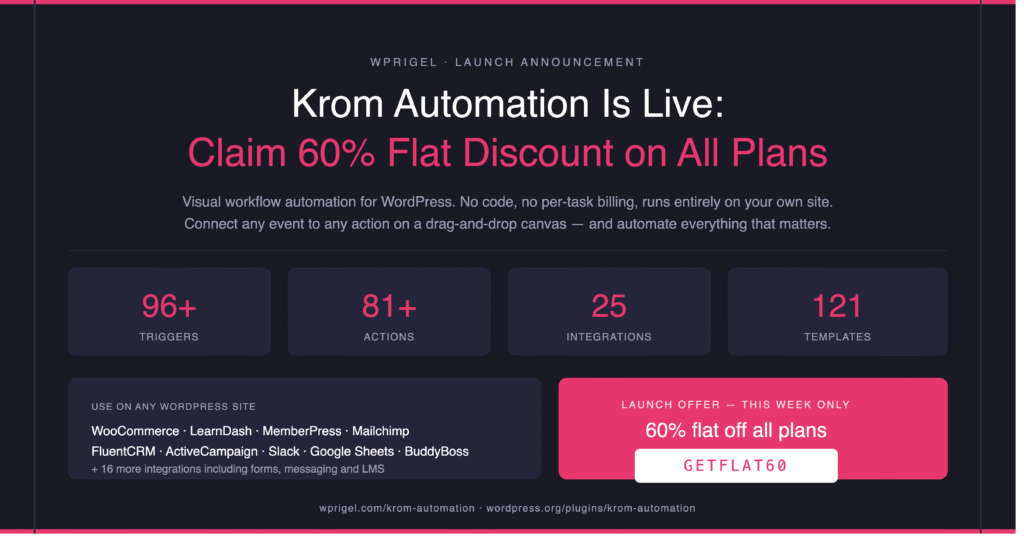
    Total with Pro96+81+12124

    Pro-Exclusive Features

    • AI workflow generation: Describe an automation in plain English and get a working workflow in seconds
    • Visual email builder: Block-based, powered by the Gutenberg editor, no code required
    • Schedule trigger: Hourly, daily, weekly, monthly, custom interval, or one-time
    • Incoming webhook receiver: A unique secret URL per workflow with HMAC-SHA256 signature verification and nine security layers
    • Extended delay units and advanced branching

    The Pro features and integrations overview lists every trigger, action, and integration added at the Pro tier.

    Pro Integration Categories

    Pro adds 24 integrations across the following categories: forms, e-commerce, CRM, email marketing, LMS, membership, messaging, social media, data storage, productivity, and affiliate.

    A few examples worth naming specifically:

    • Email marketing: Mailchimp, ConvertKit, MailerLite, ActiveCampaign
    • Forms: FluentForms, WPForms, Gravity Forms, Contact Form 7, Elementor Forms, Ninja Forms
    • LMS: LearnDash, TutorLMS
    • Membership: MemberPress
    • Messaging: Slack, Discord, Twilio, Telegram
    • Productivity: Google Sheets, Google Calendar
    • Affiliate: AffiliateWP

    What Does Krom Automation Pro Cost?

    Every Pro plan includes every Pro feature. The only difference between plans is the number of sites you can activate on.

    PlanAnnualLifetimeSites
    Basic$119/year$2991 site
    Standard$199/year$4995 sites
    Enterprise$369/year$799Unlimited

    All Pro plans carry a 14-day money-back guarantee. The free version remains free forever with no limits applied. See the full pricing page for current details and any active offers.

    “Every plan includes every Pro feature. You are never choosing between feature sets, only between site counts.”

    What Are the Real Limitations?

    No automation plugin is right for every situation. Here is an honest account of where Krom Automation will not serve you well.

    WP-Cron Dependency

    Delays and scheduled workflows depend on WordPress Cron. On very low-traffic sites, WP-Cron fires late if no visitor arrives for hours. If your delays need to be precise, configure a real server-side cron job instead of relying on the default WordPress behaviour.

    WordPress-Native Only

    Krom Automation is built for WordPress. The trigger or the action needs to touch your WordPress site. If you need automation between two external services with no WordPress involvement, a general-purpose automation platform is the better fit.

    AI Requires Your Own API Key

    The AI actions are free to use, but they are not plug-and-play out of the box. You need to create an account with OpenAI, Google, or Groq and supply a valid API key. There is no built-in AI credit system.

    Migration Cost from Existing Platforms

    Teams with hundreds of existing flows on an external automation platform will face real migration work. Krom Automation does not import from other tools. Each workflow needs to be rebuilt on the canvas.

    Who Should Look Elsewhere

    • Sites automating purely between external services with no WordPress involvement
    • Teams already deeply invested in another platform with no appetite to migrate
    • Very simple single-step needs that a lighter plugin could handle with less setup

    How Does Krom Automation Compare to Other WordPress Automation Tools?

    Most WordPress automation tools fall into one of two camps. Some use a list-based rule editor, which is simple but becomes hard to follow once a workflow has more than three or four steps. Others offer a visual canvas but charge extra for AI, analytics, or advanced branching.

    FeatureKrom Automation FreeTypical Competitor Free
    Visual canvas builderYesRarely
    AI actionsYes (3 actions, 6 models)Usually Pro only
    Execution logsYes, full audit trailOften limited or absent
    Analytics dashboardYesOften Pro only
    Workflow simulatorYesRarely free
    Run capsNoneCommon
    Self-hosted dataYesDepends on plugin
    HTTP Request actionYesSometimes Pro only

    For a direct side-by-side comparison with named alternatives, see the full comparison page.

    System Requirements and Installation

    Krom Automation has modest requirements that most WordPress hosts meet by default.

    • WordPress 6.2 or higher
    • PHP 7.4 or higher
    • MySQL 5.7+ or MariaDB 10.2+
    • WooCommerce is optional, required only for the two WooCommerce triggers and two WooCommerce actions

    The plugin creates nine custom database tables on activation. Background jobs run through Action Scheduler, so workflow execution never blocks a page load. The installation guide walks through every step.

    Free vs Pro: Is the Free Version Enough?

    For a single WordPress site handling user registrations, post publishing, comments, and basic WooCommerce orders, the free version covers the automations most sites actually need. The analytics, logging, AI, and workflow simulator are all included at no cost.

    Pro makes sense when you need to connect to a specific third-party service, use the schedule trigger for recurring jobs, or accept incoming webhooks from external platforms. The free vs Pro comparison documents every difference.

    Adoption and Market Context

    Workflow automation in WordPress is a growing category. The broader no-code automation market has expanded sharply since 2023 as teams look to reduce manual admin work without hiring developers. WordPress-native tools are gaining ground because they keep data on the site’s own server rather than routing it through a third-party cloud.

    Krom Automation sits in a specific position: a self-hosted, visual, AI-included tool built entirely for WordPress. There is no SaaS subscription for the core product and no per-execution billing at any tier. That combination is genuinely rare in the current tool landscape.

    Frequently Asked Questions

    Does the free version expire or have a trial period?

    No. The free version is free forever with no trial period, no run cap, and no features that revert after a set number of days. Install it free from WordPress.org and use it indefinitely.

    Do I need to install both the free and Pro plugins?

    Yes. Pro is an add-on that runs alongside the free plugin. The free plugin must be installed and active first. The Pro installation guide covers the exact steps.

    Can I use Krom Automation without WooCommerce?

    Yes. WooCommerce is entirely optional. The two WooCommerce triggers and two WooCommerce actions simply do not appear in your workflow builder if WooCommerce is not active. All other triggers and actions work without it.

    Is my workflow data sent to wpRigel’s servers?

    No. Krom Automation is self-hosted. Workflow definitions, execution logs, and API credentials are stored in your own WordPress database. Nothing is transmitted to our servers.

    What happens if a workflow fails?

    Krom Automation sends an email notification when a workflow execution fails. It then retries automatically with configurable backoff. Every attempt is recorded in the execution log so you can see exactly which step failed and why.

    Can I move workflows between sites?

    Yes. Workflows export as portable JSON files. You can import that file into any other WordPress site running Krom Automation. The workflow settings documentation explains the process.

    Does the schedule trigger require Pro?

    Yes. The schedule trigger lets you run workflows on a recurring interval or at a specific time. It is a Pro-exclusive feature. The free version supports delay scheduling within a workflow, but not a standalone time-based trigger.

    Is Krom Automation Worth It?

    The free version is genuinely competitive with what other plugins charge for. Sixteen triggers, 21 actions, three AI actions, a visual canvas, full execution logs, and analytics at no cost is a strong starting point. The absence of run caps alone separates it from most alternatives in the same category.

    Pro is the right upgrade when your workflows need to reach third-party services like Mailchimp, Slack, LearnDash, or Google Sheets. At $119 per year for a single site, it covers the cost quickly if it replaces even one or two hours of manual work per month. Compare all three Pro plans and pick the one that matches your site count.

    If you want to start without any commitment, get the free plugin from WordPress.org and build your first workflow today.

    The wpRigel Team

    August 20, 2026
    Krom Automation
wprigel logo

wpRigel builds innovative WordPress plugins for developers, marketers and agencies. Be with us, get more users for your business and increase conversion using our powerful tools.

  • x.com icon
  • linkedin icon

Products

  • Pollify
  • Commandify
  • Krom Automation (Now Live 🎉)

Company

  • Affiliate Program
  • About Us
  • Contact Us
  • Privacy Policy

Resources

  • Docs
  • Blog
  • Support Area
  • Refund policy

Comparisons

  • Commandify vs CommandUI
  • Pollify vs CrowdSignal
  • Krom Automation vs others

Changelogs

  • Commandify Changelog
  • Pollify Changelog
  • Krom Automation Pro Changelog

wpRigel 2026. All Rights Reserved

  • Terms of use
  • Privacy Policy
  • Cookie Policy